

What Are UK GDPR and PECR in the Context of UK News Publishing?
UK GDPR and PECR establish the primary legal framework for gathering, storing, and processing reader information across the United Kingdom. UK GDPR governs general personal data processing, whereas PECR regulates electronic tracking mechanisms, website cookies, and direct digital subscriber marketing.
The United Kingdom maintains strict statutory frameworks governing digital privacy, audience telemetry, and electronic communications. Digital news publishers operating within the United Kingdom collect personal data from website visitors to deliver journalism, measure reader engagement, and generate digital advertising revenue. Statutory compliance requires a comprehensive understanding of two distinct legal instruments: the United Kingdom General Data Protection Regulation (UK GDPR), enacted alongside the Data Protection Act 2018, and the Privacy and Electronic Communications Regulations 2003 (PECR). These statutory instruments establish binding obligations for digital publishers, data controllers, and third-party technology vendors.
Statutory Origins of Data Protection Law in the United Kingdom
UK GDPR represents the retained statutory adoption of Regulation (EU) 2016/679 following the departure of the United Kingdom from the European Union. Section 3 of the Data Protection Act 2018 incorporates these statutory provisions directly into domestic United Kingdom legislation. UK GDPR establishes legal standards for processing personal data, defining personal data as any information relating to an identified or identifiable natural person. Digital identifiers, such as IP addresses, cookie identification strings, and hardware MAC addresses, constitute personal data under Article 4(1) of UK GDPR.
PECR derives from European Directive 2002/58/EC, commonly known as the ePrivacy Directive. Regulation 6 of PECR specifically governs the storage of information, or the gain of access to information stored, in the terminal equipment of a subscriber or user. This rule applies to digital tracking technologies, such as local storage objects, tracking pixels, and browser cookies. While UK GDPR applies broadly to all personal data processing activities, PECR applies specifically to electronic communications, website cookies, and direct electronic marketing channels, such as email newsletters, SMS alerts, and browser push notifications.
Distinguishing Between UK GDPR and PECR Responsibilities
News publishers operate as data controllers under Article 4(7) of UK GDPR when determining the purposes and means of processing reader data. PECR functions as a specific law (lex specialis) that takes precedence over UK GDPR regarding the deployment of tracking technologies on user devices. PECR requires prior consent for any non-essential access to user devices before data collection occurs.
Once personal data is retrieved from a user device via cookies or form submissions, UK GDPR governs the ongoing retention, analysis, and sharing of that personal data. The Information Commissioner’s Office (ICO) serves as the independent supervisory authority enforcing both statutory frameworks across England, Scotland, Wales, and Northern Ireland. The ICO possesses statutory powers to issue monetary penalties reaching £17.5 million or 4% of total annual global turnover under UK GDPR, and up to £500,000 under PECR for statutory violations.
Explore More Expert Insights:
Why relying purely on email newsletters limits the public mobilisation potential of new foundations
What Is Audience Overlap Between UK News Titles and Why Does It Matter for Media Planning?
How Do UK GDPR and PECR Regulate Reader Data Collection?
UK GDPR and PECR mandate specific legal grounds, explicit consent rules, and operational protocols for retrieving reader data. News publishers must obtain affirmative consent prior to setting non-essential cookies and maintain documented legal bases for processing identifiable audience records consistently.
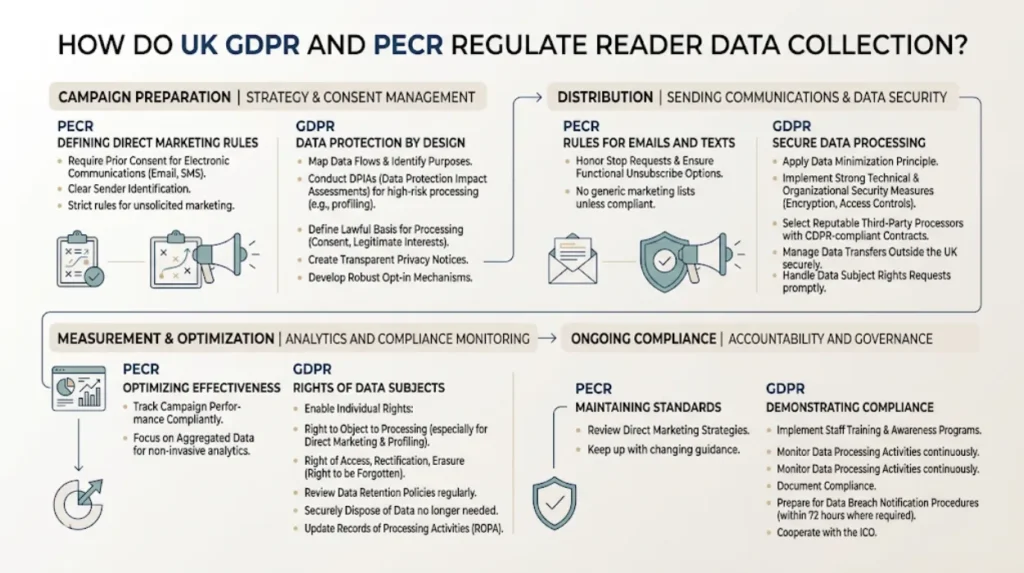
Digital news publishing relies on the systematic retrieval of reader information across desktop web interfaces, mobile web browsers, and native applications. Statutory compliance dictates that every data collection event requires a valid legal justification recognised by United Kingdom law. Publishers cannot collect, aggregate, or profile reader activity without aligning each data point to a statutory requirement.
Lawful Bases for Processing Under Article 6
Article 6(1) of UK GDPR outlines six lawful bases for processing personal data: consent, contractual necessity, legal obligation, vital interests, public task, and legitimate interests. News organisations primarily rely on three of these lawful bases for audience data collection:
- Consent (Article 6(1)(a)): The data subject gives clear, affirmative consent for a specific processing purpose, such as receiving direct email newsletters or targeted behavioural advertisements.
- Contractual Necessity (Article 6(1)(b)): Processing is necessary for the performance of a contract, such as fulfilling a paid digital subscription agreement or delivering premium paywalled news content.
- Legitimate Interests (Article 6(1)(f)): Processing is necessary for legitimate commercial interests pursued by the controller, such as basic website security monitoring, network performance optimisation, and fraud prevention.
When news publishers process special category data, such as political opinions, religious beliefs, trade union memberships, or health information, Article 9 of UK GDPR requires an explicit statutory exemption alongside an Article 6 legal basis. Special category data inference occurs frequently in news publishing when readers consume specific political analysis or niche editorial coverage. Publishers profiling readers based on political article consumption must comply with Article 9 requirements.
The PECR Regulation on Cookies and Similar Tracking Technologies
Regulation 6 of PECR establishes that news publishers must not store or access information on a reader’s terminal equipment unless two conditions are fulfilled:
- The reader receives clear and comprehensive information about the purposes of the storage or access.
- The reader gives explicit consent to that storage or access.
PECR provides a single statutory exception to the prior consent requirement: the strictly necessary exemption. Strictly necessary tracking mechanisms, such as session cookies holding subscriber login credentials, security tokens preventing cross-site request forgery, and load-balancing identifiers distributing network server traffic, execute without consent. All other tracking mechanisms, such as audience measurement analytics, A/B testing scripts, and third-party advertising cookies, require prior, freely given, specific, informed, and unambiguous opt-in consent before execution.
What Are the Key Components of Compliant Audience Data Collection?
Compliant audience data collection requires explicit consent mechanisms, comprehensive privacy notices, cookie management frameworks, and granular reader preference centres. News organisations must deploy transparent technical structures that allow readers to grant, refuse, or withdraw consent at any given time easily.
Achieving compliance under UK GDPR and PECR requires integrating technical systems with legal obligations. Digital news organisations implement structural solutions, such as preference centres, script consent blockers, and audit logging databases, to record reader choices, communicate data collection purposes, and control the execution of tracking scripts across editorial platforms.
Transparent Privacy Banners and Preference Centres
News sites must display clear consent notices upon a reader’s initial page visit. Pre-ticked checkboxes, implied consent models, and compulsory consent barriers that block access to content unless tracking is accepted violate United Kingdom data protection laws. The Information Commissioner’s Office explicitly states that scrolling down a web page or continuing to browse does not constitute valid statutory consent.
Compliant consent architectures feature specific design components, such as equal button layouts, granular preference toggles, and clear vendor disclosure lists:
- Equal Action Choices: A cookie banner must present Accept All and Reject All options with identical visual prominence, preventing deceptive design patterns.
- Granular Category Toggles: Readers maintain the ability to enable or disable specific processing categories, such as functional cookies, analytics cookies, and personalised advertising cookies.
- Clear Information Architecture: Banners must identify every third-party vendor receiving reader data, along with exact cookie retention periods.
Establishing a consent-led audience data collection process ensures full regulatory compliance while maintaining transparent relationship models with digital readers.
Technical Consent Signal Enforcement
News sites deploy technical consent management architectures to manage browser script execution based on user choices. When a reader rejects analytics or advertising cookies, the underlying script tags remain blocked. Firing analytics pixels or advertising trackers prior to explicit reader interaction constitutes an immediate violation of PECR Regulation 6.
Furthermore, news organisations honour reader choices regarding data subject rights under Chapter III of UK GDPR, such as the right to access, the right to erasure, and the right to object:
- The Right to Access (Article 15): Readers obtain copies of all personal records, reading histories, and profile attributes stored by the news organisation upon submitting a request.
- The Right to Erasure (Article 17): Readers require the permanent deletion of their personal records within 30 days of submitting a formal request.
- The Right to Object (Article 21): Readers maintain an absolute right to object to direct marketing processing at any time, halting marketing communications immediately without penalty.
What Benefits Does Regulatory Compliance Offer to News Publishers?
Regulatory compliance mitigates severe financial penalties from the Information Commissioner’s Office, reduces legal liability, and improves first-party data accuracy. Adherence to UK GDPR and PECR establishes institutional credibility, increases subscriber retention rates, and secures sustainable advertising revenue streams over time.
While compliance requires initial operational investments, adherence to UK GDPR and PECR provides structural advantages for news publishing organisations. Compliance transforms data collection from a legal risk factor into an institutional asset.
Financial Risk Mitigation and Regulatory Enforcement Protection
Non-compliance exposes digital news publications to substantial regulatory enforcement action. The ICO routinely investigates website tracking practices, real-time bidding ad-tech auctions, and illegal direct email marketing. Monetary penalties imposed under UK GDPR reach up to £17.5 million or 4% of total worldwide annual turnover, whichever is higher. PECR violations carry fine limits of up to £500,000 per statutory breach. Beyond regulatory fines, non-compliant publishers face statutory stop-processing orders, class-action litigation from privacy advocacy groups, and reputational degradation among news consumers.
Enhanced First-Party Audience Data Quality
Consent-led data architectures significantly elevate the quality of collected audience metrics. When readers explicitly opt into data collection, the resulting first-party data records display high accuracy and strong intent signals. Clean first-party data assets yield substantive operational benefits, such as accurate cohort building, higher advertising yields, and improved retention metrics:
- Accurate Cohort Building: Publishers build precise reader segments based on verified reader demographic profiles, article engagement metrics, and declared subscription preferences.
- Higher Advertising Yields: Programmatic ad buyers pay higher cost-per-mille (CPM) rates for verified, consent-backed ad inventory compared to unverified anonymous traffic impressions.
- Improved Retention Metrics: Transparent privacy notices build subscriber trust, directly reducing monthly churn rates for digital news subscriptions.
What Are the Primary Use Cases for Lawful Audience Data Processing?
Lawful audience data processing supports reader subscriptions, personalised editorial delivery, targeted direct email newsletters, and contextual advertising systems. News organisations utilise compliant data frameworks to measure content engagement, optimise paywalls, and execute consent-backed advertising monetisation campaigns across digital publishing channels.
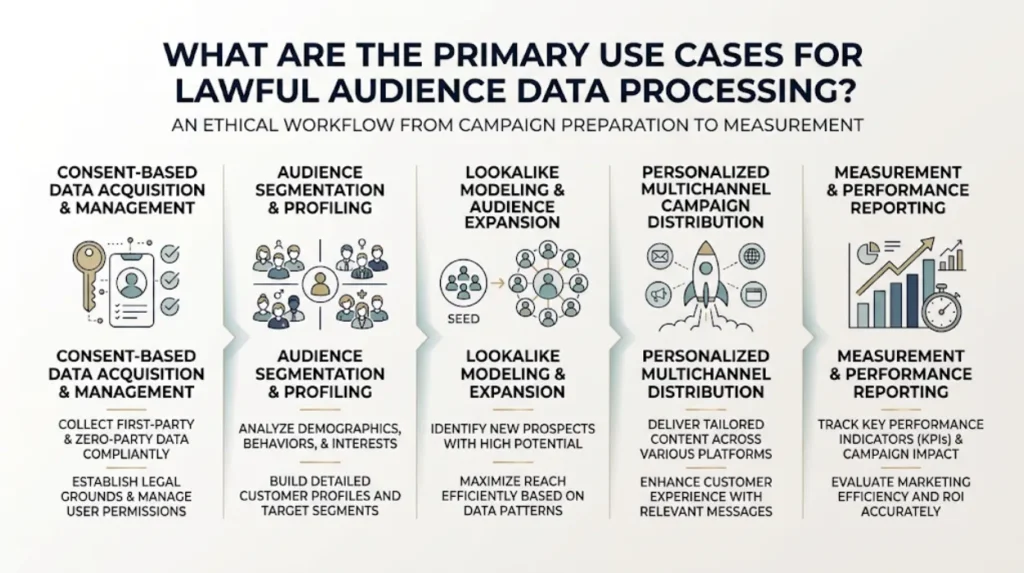
News organisations process audience data across multiple digital channels to support journalism and business operations. Aligning specific operational use cases with legal bases ensures that processing remains compliant under United Kingdom statutes.
Direct Email Marketing and Newsletter Distribution
Digital email newsletters represent a primary audience retention tool for contemporary newsrooms. Distributing direct electronic marketing messages, such as daily news briefings, promotional subscription discounts, and breaking news alerts, falls directly under PECR Regulation 22.
PECR mandates that senders obtain prior opt-in consent before transmitting direct marketing emails to individual subscribers. However, Regulation 22(3) provides a specific statutory exception known as the soft opt-in rule. News organisations rely on the soft opt-in rule under specific statutory conditions, such as obtaining contact details during a sale, marketing similar products, and offering opt-out choices:
- The publisher obtained the reader’s contact details in the course of the sale, or negotiations for the sale, of a product or service, such as a news subscription or paid digital edition.
- The publisher uses the contact details for direct marketing of its own similar products or services, such as premium editorial newsletters or event tickets.
- The publisher provided the reader a simple, free opportunity to refuse or opt out of marketing communications at the time of initial collection and in every subsequent marketing message.
Contextual Monetisation and Dynamic Paywalls
News publications utilise audience analytics data to manage content paywalls and contextual advertising systems. Data processing for dynamic paywalls involves evaluating reader engagement metrics, such as article impression counts, session frequencies, and content category preferences.
Publishers process basic reader engagement metrics under Article 6(1)(f) legitimate interests to enforce metered paywalls, provided no invasive profiling or cross-site tracking occurs. When publishers deploy dynamic paywalls that utilise behavioural tracking across third-party properties, processing requires explicit Article 6(1)(a) consent under UK GDPR and PECR Regulation 6.
Contextual advertising systems evaluate article text, metadata tags, and page categories to serve contextually relevant advertisements without tracking individual reader identities across websites. Contextual ad targeting operates entirely without setting non-essential cookies, allowing publishers to monetise non-consenting traffic compliant with PECR and UK GDPR.
How Will Statutory Data Laws Shape Future Reader Data Collection?
Statutory data laws compel news publishers to transition permanently from third-party tracking toward consent-based first-party data architectures. Compliance enforces operational transparency, guarantees reader control over personal information, and stabilises long-term digital publishing monetisation models in the United Kingdom moving forward.
The regulatory enforcement of UK GDPR and PECR by the Information Commissioner’s Office continues to reshape digital publishing strategy across the United Kingdom. As third-party cookies depreciate across major web browsers, news organisations must ground all audience data strategies in explicit consent, legal transparency, and strict adherence to statutory principles.
Publishers that integrate compliance directly into their technical architecture safeguard their operations against regulatory fines, protect reader privacy rights, and establish sustainable revenue models for digital journalism. Privacy-first reader engagement forms the foundation of commercial digital publishing in the United Kingdom.
FAQs
Q1: What does UK GDPR mean for collecting data from news readers?
Ans: UK GDPR requires news organisations to have a lawful basis for collecting and processing audience data, such as email addresses, account details, or behavioural information. They must also provide clear privacy information and follow data protection principles.
Q2: How does PECR affect data collection from UK news readers?
Ans: PECR regulates electronic marketing, cookies, and similar technologies used to communicate with or track news audiences. Its requirements can apply to email newsletters, marketing messages, cookies, and online audience measurement.
Q3: Can news websites use cookies to track reader behaviour?
Ans: News websites generally need consent before storing or accessing non-essential cookies and similar tracking technologies on a user’s device. Essential technologies may be treated differently where they are strictly necessary for the requested service.
Q4: What consent is required for news audience data collection?
Ans: Consent must generally be informed, specific, freely given, and clearly communicated where consent is the applicable legal basis. News publishers should explain what data is collected, why it is collected, and how readers can manage their choices.
Q5: How should UK media organisations manage audience data under UK GDPR and PECR?
Ans: UK media organisations should document their lawful bases, provide transparent privacy notices, manage cookie preferences, and maintain appropriate data security controls. They should also distinguish between editorial, analytics, advertising, and direct marketing uses of audience data.



