
Medical journalists receive a continuous flow of research announcements, clinical trial updates, public health reports, regulatory decisions, and scientific commentary every working day. They apply structured editorial filters to identify information that is accurate, newsworthy, evidence-based, and relevant to their audiences. Understanding this process explains why only a small percentage of science pitches become published stories.
Why do medical journalists receive so many science pitches?
Medical journalists receive hundreds of science pitches because universities, hospitals, pharmaceutical companies, research institutes, journals, charities, government agencies, and healthcare professionals all compete for editorial attention using press releases, media alerts, and expert commentary throughout every news cycle across multiple scientific disciplines.
Healthcare generates constant news. Clinical trials reach new milestones. Medical journals publish fresh studies every week. Public health organisations release surveillance reports. Regulatory agencies announce approvals and safety updates. Universities publish discoveries from academic laboratories.
Each organisation wants media coverage. This creates intense competition for limited editorial space.
Examples of common science pitches include:
- Clinical trial results
- Medical device approvals
- Public health campaigns
- Epidemiological studies
- Drug safety updates
- Healthcare policy reports
- Artificial intelligence research
- Digital health innovations
Editors and reporters therefore rely on consistent screening methods rather than reviewing every pitch equally.
What makes a science pitch immediately newsworthy?
Medical journalists identify newsworthy science by measuring public relevance, scientific significance, evidence quality, originality, regulatory importance, and timing. Stories affecting patient care, healthcare policy, or disease understanding receive greater editorial priority than routine organisational announcements and promotional updates.
News value starts with impact.
A study involving 20,000 participants attracts greater attention than preliminary laboratory findings involving a small experiment.
A regulatory approval affecting cancer treatment receives stronger consideration than a routine corporate appointment.
Scientific significance
Journalists examine whether research changes existing knowledge.
Examples include:
- Discovery of a new treatment pathway
- First successful human clinical trial
- Updated national treatment guideline
- Large-scale population health findings
Incremental updates rarely receive extensive coverage.
Public relevance
Editors ask whether readers benefit from the information.
Topics involving common conditions often receive broader attention.
Examples include:
- Heart disease
- Diabetes
- Dementia
- Influenza
- Mental health
Research affecting a rare disease still gains coverage when findings represent a major scientific milestone.
Timeliness
Medical journalism depends on timing.
Stories connected to conference presentations, journal publication dates, regulatory announcements, or disease outbreaks fit existing news cycles more effectively.
How do journalists verify scientific credibility?
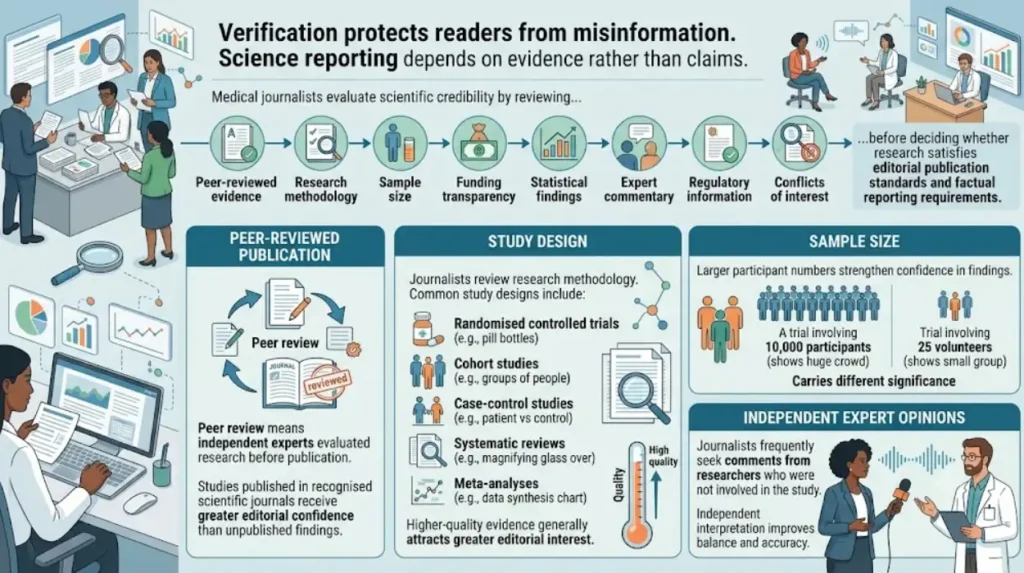
Medical journalists evaluate scientific credibility by reviewing peer-reviewed evidence, research methodology, sample size, funding transparency, statistical findings, expert commentary, regulatory information, and conflicts of interest before deciding whether research satisfies editorial publication standards and factual reporting requirements.
Verification protects readers from misinformation.
Science reporting depends on evidence rather than claims.
Peer-reviewed publication
Peer review means independent experts evaluated research before publication.
Studies published in recognised scientific journals receive greater editorial confidence than unpublished findings.
Study design
Journalists review research methodology.
Common study designs include:
- Randomised controlled trials
- Cohort studies
- Case-control studies
- Systematic reviews
- Meta-analyses
Higher-quality evidence generally attracts greater editorial interest.
Sample size
Larger participant numbers strengthen confidence in findings.
A trial involving 10,000 participants carries different significance from one involving 25 volunteers.
Independent expert opinions
Journalists frequently seek comments from researchers who were not involved in the study.
Independent interpretation improves balance and accuracy.
What information do journalists examine first in a science pitch?
Medical journalists first review the headline, summary, supporting evidence, publication status, research institution, statistical findings, and relevance to current healthcare issues before investing additional time in detailed evaluation of supporting materials and scientific documentation.
Editors make rapid decisions.
Many pitches receive less than one minute of initial attention.
Headline
The headline explains the central finding clearly.
Specific headlines perform better than vague promotional language.
Opening summary
The introduction answers essential questions.
It identifies:
- What happened
- Who conducted the research
- Why the findings matter
- Where results were published
Supporting evidence
Journalists immediately look for:
- Journal citation
- Clinical trial registration
- Statistical significance
- Participant numbers
- Research duration
Missing evidence reduces editorial confidence.
Why do many science pitches fail editorial review?
Science pitches fail because they lack evidence, exaggerate conclusions, omit supporting data, ignore editorial relevance, contain promotional language, provide unclear summaries, or present findings without sufficient scientific context for accurate public reporting and responsible journalism standards.
Most rejected pitches share common weaknesses.
Overstated conclusions
Scientific evidence rarely supports absolute claims.
Editors reject exaggerated language because accurate reporting depends on measured interpretation.
Missing context
Research exists within a broader scientific landscape.
Journalists expect comparisons with previous studies.
Context explains whether findings confirm, contradict, or expand existing knowledge.
Promotional language
Editorial reporting differs from marketing communication.
Phrases describing research as “revolutionary,” “game-changing,” or “breakthrough” without supporting evidence reduce credibility.
Insufficient evidence
Claims require documentation.
Journalists expect links to published studies, clinical trial identifiers, regulatory announcements, or official reports.
How does timing influence editorial decisions?
Timing determines editorial visibility because science stories compete against healthcare policy announcements, regulatory decisions, journal publication schedules, medical conferences, public health emergencies, and broader national news events occurring during the same reporting period across multiple sectors.
Editors organise coverage around predictable events.
Medical conferences generate concentrated reporting activity.
Examples include major meetings covering:
- Oncology
- Cardiology
- Neurology
- Infectious diseases
Journal publication dates also influence newsroom planning.
Embargo systems allow journalists to prepare accurate reporting before official publication.
Unexpected public health emergencies immediately change editorial priorities.
Routine research announcements often receive reduced attention during these periods.
How do journalists balance accuracy with reporting speed?
Medical journalists balance speed and accuracy through structured verification processes, expert interviews, evidence reviews, editorial oversight, and fact-checking procedures that maintain scientific accuracy while meeting publication deadlines across digital, broadcast, and print news platforms every day.
Healthcare reporting carries significant public responsibility.
Incorrect medical reporting affects public understanding.
Multiple source verification
Journalists compare information from several sources.
These include:
- Scientific journals
- Government agencies
- Medical associations
- Independent researchers
- Regulatory authorities
Agreement across multiple sources strengthens confidence.
Editorial review
Editors examine stories before publication.
They confirm factual consistency, balanced reporting, and appropriate scientific terminology.
Scientific terminology
Medical language requires precision.
Journalists distinguish between:
- Correlation and causation
- Association and proof
- Laboratory findings and clinical outcomes
- Early-stage research and established treatment
Accurate wording prevents misunderstanding.
Explore More Expert Insights:
Why Continuous Media PR is Essential for Sustaining Public Health Awareness
How Emerging MedTech Brands Build Public Trust in Crowded Digital Markets
What role do medical journals play in science reporting?
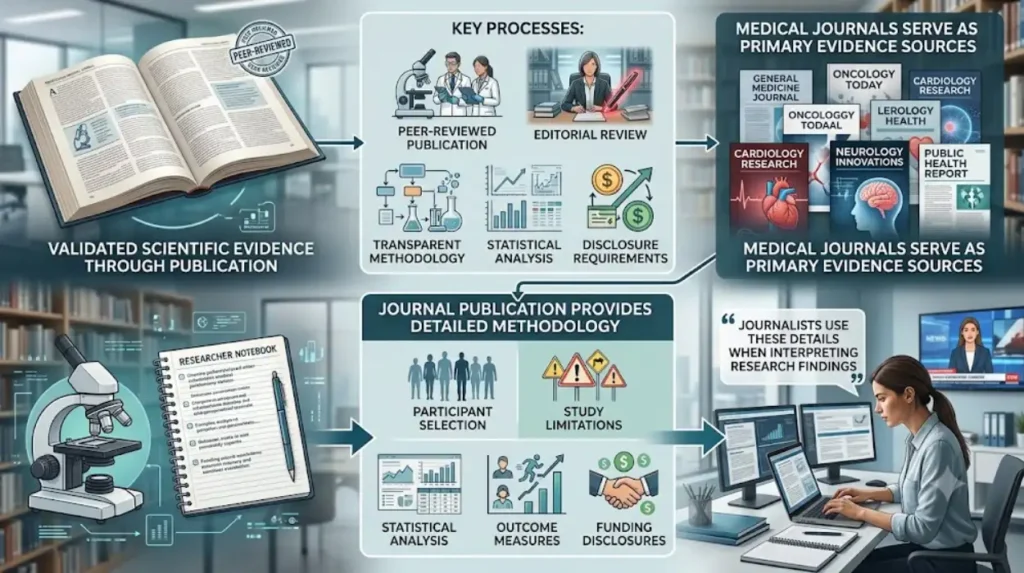
Medical journals provide validated scientific evidence through peer-reviewed publication, editorial review, transparent methodology, statistical analysis, and disclosure requirements that help journalists assess research quality before communicating findings to healthcare professionals and the wider public.
Medical journals serve as primary evidence sources.
Examples include journals covering:
- General medicine
- Oncology
- Cardiology
- Neurology
- Public health
Journal publication provides detailed methodology.
This includes:
- Participant selection
- Study limitations
- Statistical analysis
- Outcome measures
- Funding disclosures
Journalists use these details when interpreting research findings.
Understanding how scientific information is organised also supports better communication practices. Readers seeking additional educational guidance on press release structure can explore:
Crafting an Authoritative Press Release Layout.
How do readers benefit from understanding this editorial process?
Understanding editorial filtering helps readers recognise credible science reporting, distinguish evidence from promotion, interpret research responsibly, appreciate newsroom verification standards, and develop stronger confidence when evaluating healthcare news published through established media organisations and scientific publications.
Science reporting represents a structured editorial process rather than simple information sharing.
Journalists evaluate evidence before publication.
Editors compare competing stories.
Researchers provide supporting documentation.
Independent experts verify scientific interpretation.
Readers who understand this workflow recognise why published healthcare news often includes:
- Study limitations
- Independent expert comments
- Statistical context
- Regulatory information
- Links to published research
These elements improve transparency and scientific understanding.
People interested in how specialised healthcare announcements reach professional audiences can continue learning about:
Exclusive Medical and Pharma Syndication Networks.
Medical journalists review hundreds of science pitches by applying consistent editorial standards focused on evidence, relevance, credibility, timing, and public interest. They verify research through peer-reviewed publications, independent experts, regulatory information, and scientific methodology before publication. This structured filtering process improves the quality of healthcare reporting, supports accurate public understanding of medical research, and ensures that the strongest evidence receives editorial attention while unsupported or promotional claims are excluded.