
The digital healthcare market in the United Kingdom continues to expand as medical technology companies introduce connected devices, diagnostic platforms, digital therapeutics, and remote monitoring solutions. More products enter the market every year, increasing competition for attention and credibility. Public trust determines whether healthcare professionals, patients, investors, and healthcare organisations engage with an emerging MedTech brand.
Trust develops through transparency, evidence, regulatory compliance, consistent communication, and reliable performance. These elements help new MedTech businesses establish credibility before widespread market recognition.
What does public trust mean for an emerging MedTech brand?
Public trust describes the confidence that patients, healthcare professionals, regulators, investors, and healthcare organisations place in a MedTech company’s products, information, ethics, and operational standards. Trust develops through evidence, transparency, regulatory compliance, consistent communication, measurable performance, and responsible data protection practices.
Public trust extends beyond product quality. It includes confidence in how a company communicates scientific evidence, protects patient information, manages clinical validation, and responds to public concerns.
An emerging MedTech brand is a medical technology business in its early growth stage. Examples include companies developing wearable heart monitors, AI-assisted imaging software, digital diabetes management platforms, and robotic rehabilitation devices.
Healthcare differs from many other industries because purchasing decisions involve patient safety. Every public statement contributes to long-term credibility.
Which stakeholders evaluate trust?
Different stakeholder groups assess trust using different criteria.
- Patients examine usability, privacy, and safety.
- Healthcare professionals review clinical evidence and effectiveness.
- NHS organisations evaluate procurement standards.
- Investors analyse regulatory progress and commercial potential.
- Regulators assess compliance with legal requirements.
- Journalists examine factual accuracy and public interest.
Each audience expects clear, consistent information.
Why do crowded digital markets make trust harder to build?
Crowded digital markets expose audiences to thousands of healthcare messages every day. High information volume, misinformation, inconsistent quality, and increasing competition force MedTech companies to demonstrate credibility through verified evidence, transparent communication, regulatory compliance, and consistent educational content across multiple channels.
Healthcare consumers compare multiple products before making decisions. Search engines, social media platforms, healthcare websites, online reviews, and news publications all influence perception.
Many organisations publish health-related claims. Audiences therefore expect supporting evidence before accepting marketing messages.
How does information overload affect healthcare decisions?
People encounter healthcare information from multiple sources every day.
Examples include:
- NHS guidance
- Medical journals
- Healthcare news websites
- Professional associations
- Patient advocacy groups
- Medical conferences
- Social media discussions
When conflicting information appears, audiences prefer sources supported by research, recognised experts, and regulatory approval.
Why does consistency matter?
Consistent communication reduces confusion.
Product descriptions, safety information, clinical data, and educational materials need identical factual foundations across every communication channel.
Contradictory information reduces confidence quickly.
Which factors influence trust in MedTech companies?

Trust depends on scientific evidence, regulatory approval, transparent communication, cybersecurity standards, data privacy, clinical validation, independent verification, responsive customer support, and consistent educational messaging. Together these elements demonstrate organisational reliability and product credibility within regulated healthcare environments across digital markets today.
Trust develops from measurable actions rather than promotional claims.
Clinical evidence
Clinical evidence demonstrates whether a medical technology performs as intended.
Examples include:
- Clinical trials
- Peer-reviewed publications
- Independent evaluations
- Real-world performance studies
Evidence explains effectiveness using measurable outcomes.
Regulatory compliance
Regulatory compliance confirms that products satisfy legal healthcare requirements.
Examples include:
- UK Medical Devices Regulations
- UKCA marking requirements
- Post-market surveillance
- Clinical safety documentation
Compliance demonstrates accountability.
Data security
Many MedTech products process sensitive patient information.
Strong cybersecurity practices include:
- Encryption
- Secure authentication
- Continuous monitoring
- Access controls
- Security testing
Information security supports public confidence.
Transparency
Transparent communication explains both product capabilities and limitations.
Clear documentation helps audiences understand intended use, clinical evidence, known risks, and regulatory status.
How does educational content strengthen public confidence?
Educational content improves public understanding by explaining medical technology, clinical processes, regulatory standards, patient benefits, and scientific evidence using accurate language. Clear education reduces confusion, supports informed decisions, and encourages confidence through factual information instead of promotional messaging alone consistently.
Education answers questions before audiences ask them.
Healthcare communication performs best when technical language includes clear definitions.
What topics help educate audiences?
Educational resources often explain:
- Medical conditions
- Treatment pathways
- Device functionality
- Regulatory processes
- Clinical validation
- Data protection
- Patient safety
- Healthcare innovation
Each topic supports informed decision-making.
Why are simple explanations important?
Complex medical terminology limits understanding.
Simple language increases accessibility without reducing scientific accuracy.
For example, instead of presenting only technical specifications, educational material explains how a wearable cardiac monitor continuously records heart rhythm to help clinicians identify irregular patterns.
Educational content also creates natural progression toward deeper learning. Readers exploring broader communication planning can later access:
Designing an Omnichannel PR Strategy for additional educational context.
How do transparency and evidence improve credibility?
Transparency and evidence establish credibility by presenting verifiable facts, published research, regulatory information, product limitations, and measurable outcomes. Open communication enables audiences to independently evaluate healthcare claims using recognised scientific standards and documented clinical performance across healthcare settings consistently.
Evidence supports every factual statement.
Transparency explains both strengths and limitations.
Which evidence sources increase confidence?
Reliable evidence includes:
- Peer-reviewed journals
- Clinical trial summaries
- Government guidance
- Independent research
- Professional healthcare organisations
- Published performance metrics
Each source contributes objective information.
Why is accurate communication important?
Accurate communication prevents misunderstanding.
Healthcare information affects clinical decisions, purchasing decisions, and patient expectations.
Every statistic requires an identifiable source.
Every clinical statement requires supporting evidence.
What role does digital reputation play in trust?
Digital reputation reflects how consistently accurate information appears across websites, news coverage, professional directories, social platforms, review platforms, and search engines. Strong digital consistency helps audiences verify legitimacy, identify expertise, and recognise reliable healthcare information over extended periods successfully.
People research organisations before engaging with healthcare products.
Search results influence first impressions.
Which digital assets contribute to reputation?
Important digital assets include:
- Official websites
- Regulatory listings
- Published research
- Executive biographies
- Educational articles
- Conference presentations
- Media interviews
- Professional association memberships
These resources create a consistent digital presence.
How do reviews influence perception?
Reviews provide practical experiences.
Examples include clinician feedback, procurement evaluations, and patient experience reports where appropriate and compliant with healthcare regulations.
Authentic experiences strengthen credibility when supported by verified evidence.
How can emerging MedTech companies communicate responsibly?
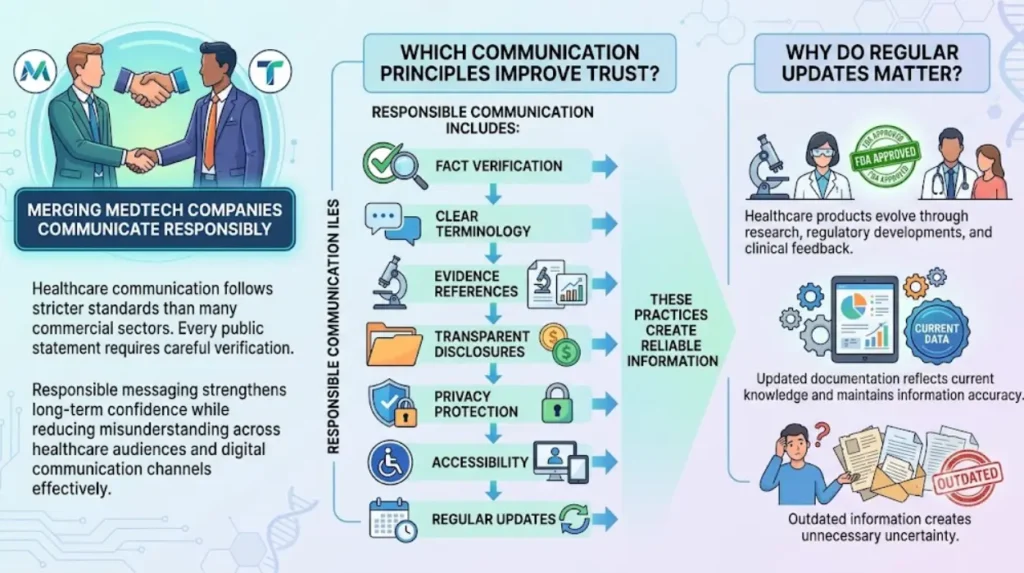
Responsible communication prioritises factual accuracy, regulatory compliance, patient safety, balanced scientific explanations, transparent disclosures, privacy protection, accessible language, and consistent updates. Responsible messaging strengthens long-term confidence while reducing misunderstanding across healthcare audiences and digital communication channels effectively.
Healthcare communication follows stricter standards than many commercial sectors.
Every public statement requires careful verification.
Which communication principles improve trust?
Responsible communication includes:
- Fact verification
- Clear terminology
- Evidence references
- Transparent disclosures
- Privacy protection
- Accessibility
- Regular updates
These practices create reliable information.
Why do regular updates matter?
Healthcare products evolve through research, regulatory developments, and clinical feedback.
Updated documentation reflects current knowledge and maintains information accuracy.
Outdated information creates unnecessary uncertainty.
Explore More Expert Insights:
The Role of Strategic Press Distribution in Accelerating Healthcare Venture Capital
Why Editorial Accuracy and Fact-Checking Matter in Digital Health PR Campaigns
How does trust influence long-term MedTech growth?
Public trust supports stronger stakeholder relationships, improved professional engagement, greater patient confidence, sustained media credibility, investor confidence, healthcare partnerships, and broader market acceptance. Trust creates a stable foundation for long-term organisational growth within regulated healthcare environments and competitive digital ecosystems globally.
Trust influences every stage of organisational development.
Healthcare professionals recommend products they consider reliable.
Patients engage with technologies they understand.
Healthcare organisations procure solutions supported by evidence.
Which long-term outcomes depend on trust?
Higher trust contributes to:
- Stronger stakeholder relationships
- Better healthcare adoption
- Improved patient confidence
- Increased professional engagement
- More consistent media credibility
- Sustainable organisational reputation
Each outcome develops through continuous evidence-based communication rather than short-term visibility.
Readers seeking implementation frameworks can later continue learning through:
Compliance-First Packages to understand how structured compliance approaches support communication planning.
Emerging MedTech brands build public trust through transparency, scientific evidence, regulatory compliance, consistent communication, strong cybersecurity, accurate educational content, and measurable clinical validation. Crowded digital markets increase the importance of factual information because audiences compare multiple healthcare solutions before making decisions.
Trust develops through documented actions rather than promotional claims. Clear explanations, verified research, responsible communication, and reliable digital information help patients, healthcare professionals, regulators, investors, and healthcare organisations evaluate medical technologies with confidence. As competition across digital healthcare continues to increase, organisations that consistently provide accurate, evidence-based information establish stronger credibility and support informed healthcare decisions.