
Public health awareness depends on consistent communication rather than isolated announcements. Continuous media PR keeps important health information visible across news cycles, reinforces evidence-based guidance, improves public understanding, and supports informed decisions throughout the year. In the United Kingdom, sustained communication helps maintain awareness of changing health priorities, seasonal risks, vaccination programmes, and disease prevention initiatives.
What is continuous media PR in public health?
Continuous media PR is the ongoing distribution of accurate, newsworthy public health information through trusted media channels over an extended period. This approach maintains visibility, reinforces evidence-based messaging, supports public education, and increases awareness through repeated exposure to verified information across different audiences.
Continuous media PR refers to a planned communication process that delivers health-related information regularly instead of relying on a single campaign. It combines media relations, public announcements, educational updates, expert commentary, research findings, and community-focused stories.
Public health awareness refers to the public’s understanding of diseases, prevention strategies, healthcare services, and healthy behaviours. Continuous communication strengthens that understanding by presenting consistent information across multiple stages of a health issue.
Examples include:
- Seasonal influenza prevention campaigns every autumn.
- Mental health awareness updates throughout the year.
- Regular vaccination programme announcements.
- Weekly air quality alerts during pollution events.
- Ongoing diabetes prevention education.
Each example provides repeated opportunities for the public to receive accurate health information.
Why does public health awareness require continuous communication?
Public health awareness depends on repeated communication because people encounter new health information, changing risks, and evolving scientific evidence throughout the year. Consistent media coverage improves message retention, supports informed decisions, reduces misinformation, and keeps essential guidance visible across different communities and demographic groups.
Health awareness declines when communication stops after a single announcement.
People consume information through newspapers, television, online publications, radio, podcasts, and social media. Different audiences access different sources at different times. Continuous communication increases the likelihood that important messages reach diverse populations.
Health priorities also change throughout the calendar year.
Examples include:
- Winter respiratory infections.
- Summer heat-related illnesses.
- Allergy seasons.
- Food safety during holidays.
- Vaccination programme updates.
- New clinical research findings.
Each situation requires timely communication to maintain public understanding.
Repeated messaging also reinforces important preventive behaviours such as hand hygiene, cancer screening attendance, smoking cessation, and healthy eating.
How does continuous media PR support accurate health information?

Continuous media PR strengthens accurate health information by providing verified facts, expert explanations, updated research, and consistent messaging. Regular communication reduces confusion, improves understanding of medical terminology, and increases public exposure to evidence-based recommendations from recognised health authorities and researchers.
Health information changes as scientific evidence develops.
Medical researchers publish new studies.
Public health agencies update recommendations.
Healthcare organisations release surveillance reports.
Continuous media communication helps explain these developments in clear language.
Explaining complex medical research
Medical studies often contain technical terminology.
Public communication translates scientific findings into understandable language without changing their meaning.
Examples include:
- Clinical trial outcomes.
- Vaccine effectiveness data.
- Disease prevalence statistics.
- Public screening recommendations.
Clear explanations improve comprehension.
Counteracting misinformation
False health information spreads rapidly during disease outbreaks and public emergencies.
Consistent publication of verified information provides an alternative source supported by evidence and expert review.
Repeated factual communication strengthens public confidence in reliable information.
What are the main components of an effective continuous media PR strategy?
An effective continuous media PR strategy combines planning, accurate messaging, trusted sources, audience segmentation, media engagement, performance measurement, and regular updates. These components create consistent communication that remains relevant throughout changing health priorities and public information needs across multiple communication channels.
Continuous communication requires structured planning rather than isolated activity.
Editorial planning
An editorial calendar organises communication across the year.
Topics align with:
- National awareness campaigns.
- Seasonal diseases.
- Research publications.
- Health policy updates.
- Screening initiatives.
Planning creates consistent information flow.
Evidence-based messaging
Every communication uses verified evidence.
Sources include:
- Peer-reviewed research.
- Government statistics.
- Public health surveillance.
- Clinical guidelines.
Evidence strengthens factual accuracy.
Expert participation
Healthcare professionals explain specialised topics.
Examples include:
- Epidemiologists.
- General practitioners.
- Public health consultants.
- Medical researchers.
- Clinical specialists.
Expert commentary improves credibility.
Multi-channel distribution
Public information reaches audiences through multiple communication channels.
Examples include:
- National newspapers.
- Regional newspapers.
- Television news.
- Radio interviews.
- Online news websites.
- Healthcare publications.
Each channel reaches different audience groups.
How does continuous media PR improve long-term public engagement?
Continuous media PR improves long-term public engagement by maintaining regular visibility, reinforcing familiar health topics, encouraging repeated learning, supporting behavioural awareness, and creating ongoing opportunities for audiences to encounter reliable health information through trusted media platforms and recurring educational coverage.
Public engagement develops over time.
One announcement attracts temporary attention.
Regular communication builds familiarity.
Repeated educational stories encourage audiences to recognise recurring health themes.
Examples include:
- Annual vaccination reminders.
- Monthly nutrition education.
- Weekly physical activity campaigns.
- Ongoing smoking prevention initiatives.
Each communication contributes to cumulative awareness.
Building recognition
Repeated exposure increases recognition of:
- Health campaigns.
- Disease prevention advice.
- Screening programmes.
- Healthy lifestyle recommendations.
Recognition improves information recall.
Encouraging informed behaviour
People make better-informed decisions when accurate information remains consistently available.
Continuous communication supports awareness before important health decisions occur.
How does media PR help during public health emergencies?
Continuous media PR supports emergency communication through timely updates, verified information, coordinated messaging, and transparent reporting. Regular media engagement reduces uncertainty, communicates evolving risks, explains protective measures, and improves public understanding during rapidly changing public health situations and disease outbreaks.
Public health emergencies require ongoing communication rather than single announcements.
Information changes frequently.
Examples include:
- Disease outbreaks.
- Extreme weather events.
- Environmental hazards.
- Food contamination incidents.
- Medication safety alerts.
Each event requires updated information.
Delivering timely updates
Emergency communication includes:
- Situation reports.
- Safety recommendations.
- Service availability.
- Healthcare guidance.
- Preventive actions.
Frequent updates reflect changing circumstances.
Supporting public understanding
Emergency terminology often changes quickly.
Continuous explanation improves understanding of:
- Transmission patterns.
- Risk levels.
- Protective measures.
- Healthcare access.
Consistent reporting reduces confusion.
What challenges affect continuous public health communication?
Continuous public health communication faces challenges including information overload, changing scientific evidence, audience fatigue, misinformation, fragmented media consumption, and unequal access to reliable news sources. Addressing these challenges requires consistency, clarity, transparency, and regular factual updates supported by credible evidence.
Communication environments change continuously.
Audiences receive thousands of information messages every week.
Health information competes with entertainment, politics, business news, and social media trends.
Information overload
Large information volumes reduce attention.
Simple, structured communication improves understanding.
Clear language supports accessibility.
Scientific updates
Medical evidence evolves through ongoing research.
Communication explains updated findings while maintaining consistency with established evidence.
Explore More Expert Insights:
How Emerging MedTech Brands Build Public Trust in Crowded Digital Markets
The Role of Strategic Press Distribution in Accelerating Healthcare Venture Capital
Audience diversity
Different groups require different communication formats.
Examples include:
- Young adults.
- Older adults.
- Parents.
- Healthcare workers.
- People living with chronic conditions.
Each audience has different information needs.
How can public health organisations measure awareness over time?
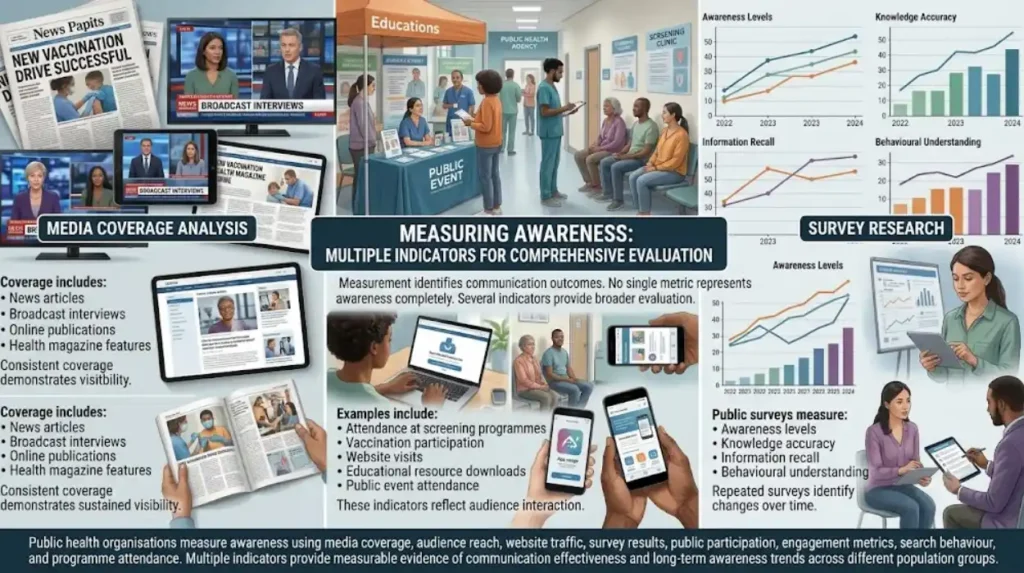
Public health organisations measure awareness using media coverage, audience reach, website traffic, survey results, public participation, engagement metrics, search behaviour, and programme attendance. Multiple indicators provide measurable evidence of communication effectiveness and long-term awareness trends across different population groups.
Measurement identifies communication outcomes.
No single metric represents awareness completely.
Several indicators provide broader evaluation.
Media coverage analysis
Coverage includes:
- News articles.
- Broadcast interviews.
- Online publications.
- Health magazine features.
Consistent coverage demonstrates sustained visibility.
Public engagement indicators
Examples include:
- Attendance at screening programmes.
- Vaccination participation.
- Website visits.
- Educational resource downloads.
- Public event attendance.
These indicators reflect audience interaction.
Survey research
Public surveys measure:
- Awareness levels.
- Knowledge accuracy.
- Information recall.
- Behavioural understanding.
Repeated surveys identify changes over time.
How does continuous media PR contribute to healthier communities?
Continuous media PR contributes to healthier communities by improving health literacy, supporting disease prevention, encouraging informed healthcare decisions, strengthening public understanding of evidence-based guidance, and maintaining reliable communication throughout changing health priorities, seasonal risks, and emerging medical developments across society.
Health literacy refers to a person’s ability to find, understand, evaluate, and use health information.
Continuous communication supports this ability through repeated education.
Communities with stronger health literacy understand preventive care more effectively.
Examples include:
- Cancer screening participation.
- Vaccination awareness.
- Healthy nutrition education.
- Physical activity promotion.
- Chronic disease management.
Regular communication reinforces these topics throughout the year.
As healthcare research continues to expand, communication also extends beyond immediate news coverage into long-term digital visibility. Organisations exploring this progression can learn more through:
Maximizing Post-Launch Momentum. Decision-makers evaluating large-scale communication infrastructure can continue with:
Best Press Release Distribution Networks for additional educational context.
Continuous media PR strengthens public health awareness through consistent, accurate, and evidence-based communication. It keeps essential health information visible, explains evolving scientific knowledge, counters misinformation, and supports informed public understanding. Sustained communication creates long-term awareness that extends beyond individual campaigns and contributes to stronger health literacy across communities.