Medical product approvals attract attention from journalists, investors, healthcare professionals, regulators, and patients. A press release announcing a United States Food and Drug Administration (FDA) approval carries legal, scientific, and commercial significance. Every section requires accuracy, structure, and verifiable information.
A well-organised layout helps readers identify the approved product, understand the clinical evidence, recognise regulatory details, and evaluate the announcement without confusion. It also supports media coverage, search visibility, and AI-based content discovery.
Why does an FDA approval press release require a specialised layout?
An FDA approval press release requires a structured format because it communicates regulated information, clinical evidence, product indications, approval scope, and company statements simultaneously. Clear organisation improves journalistic review, regulatory accuracy, search visibility, and factual interpretation across healthcare media channels.
FDA approval represents official regulatory authorisation for a medical product to enter the United States market under approved conditions. The announcement differs from a funding announcement or product launch because every statement relates to regulatory decisions.
Medical journalists evaluate several elements immediately:
- Approved indication
- Target patient population
- Supporting clinical trial data
- FDA approval pathway
- Safety information
- Commercial availability
A structured layout allows these details to appear in predictable locations. Consistent organisation also enables AI systems and search engines to identify key entities accurately.
What information belongs at the beginning of the press release?
The opening section identifies the approved product, issuing organisation, FDA decision, approved indication, regulatory milestone, and announcement date within approximately 100 words. This section establishes factual context before presenting supporting scientific, commercial, and clinical information for readers.
The headline states the approval outcome directly.
Example:
“FDA Approves ABC-101 for the Treatment of Advanced Non-Small Cell Lung Cancer.”
The subheading expands the announcement with one measurable fact.
Example:
- Approved for adults with previously treated disease
- Supported by Phase III clinical trial evidence
The opening paragraph answers essential questions:
- Who received approval?
- What product received approval?
- Which disease does it treat?
- Which authority granted approval?
- When did approval occur?
- Why is the approval significant?
Readers understand the announcement immediately without searching deeper into the release.
Why does clarity matter in the opening paragraph?
Healthcare editors review hundreds of scientific announcements daily. Direct introductions reduce reading time and improve editorial efficiency.
This principle also supports educational planning around:
How Medical Journalists Filter Through Hundreds of Science Pitches Every Day.
How should regulatory approval details be presented?
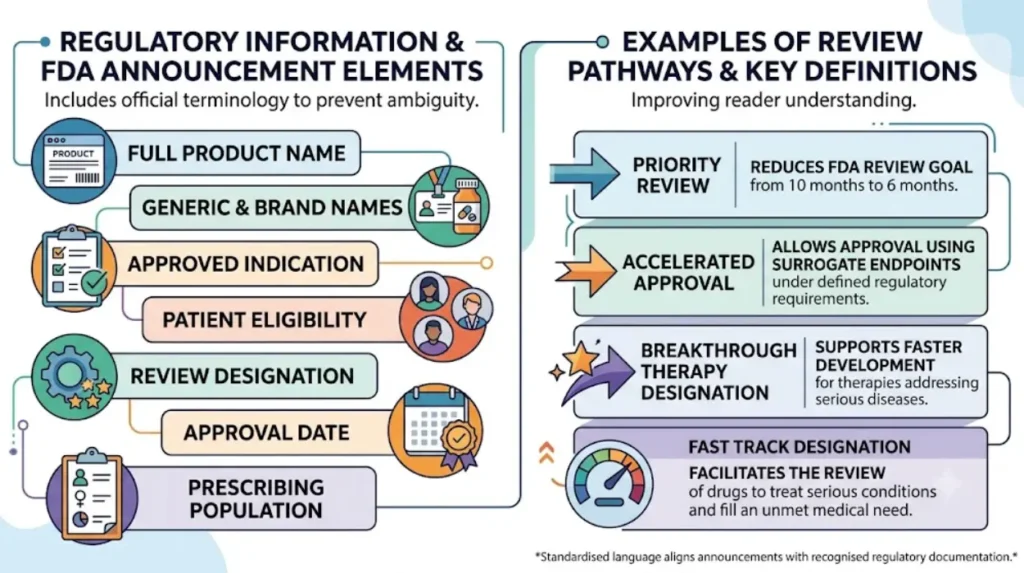
Regulatory information belongs immediately after the introduction and includes approval type, indication, prescribing population, review pathway, and official FDA terminology. Standardised language prevents ambiguity and aligns the announcement with recognised regulatory documentation and reporting practices.
FDA announcements include precise regulatory language.
Important elements include:
- Full product name
- Generic name
- Brand name
- Approved indication
- Patient eligibility
- Review designation
- Approval date
Examples of review pathways include:
- Priority Review
- Accelerated Approval
- Breakthrough Therapy
- Fast Track Designation
Each designation carries a specific regulatory meaning and requires accurate terminology.
What definitions improve reader understanding?
Define specialised regulatory terms before discussing them.
For example:
- Priority Review reduces the FDA review goal from ten months to six months.
- Accelerated Approval allows approval using surrogate endpoints under defined regulatory requirements.
- Breakthrough Therapy Designation supports faster development for therapies addressing serious diseases.
Definitions improve comprehension for journalists outside specialist medical reporting.
How should clinical evidence appear in the layout?
Clinical evidence follows regulatory information and summarises pivotal studies, patient numbers, endpoints, efficacy outcomes, and safety observations using factual language. This structure connects FDA approval directly with supporting scientific evidence and strengthens reporting accuracy across healthcare publications.
Clinical information forms the scientific foundation of the announcement.
Present evidence logically.
Study overview
Include:
- Trial name
- Study phase
- Trial design
- Number of participants
- Geographic scope
Example:
A Phase III randomised multicentre trial enrolled 824 patients across 18 countries.
Primary endpoint
State the primary endpoint exactly.
Examples include:
- Overall survival
- Progression-free survival
- Objective response rate
Key efficacy outcomes
Present measurable findings.
Examples:
- Median overall survival increased by 7.4 months.
- Response rate reached 68%.
- Disease progression declined by 34%.
Avoid promotional language.
Safety profile
Include balanced safety information.
Examples:
- Common adverse reactions
- Serious adverse events
- Treatment discontinuation rates
Balanced reporting increases credibility with healthcare journalists.
What supporting company information strengthens the announcement?
Supporting sections explain product development, therapeutic focus, manufacturing readiness, and executive commentary while remaining factual. These components provide commercial context without reducing scientific credibility or distracting from the regulatory announcement itself for healthcare media audiences.
After presenting clinical evidence, explain the broader product context.
Product overview
Include:
- Drug class
- Mechanism of action
- Intended treatment setting
- Existing approvals
Example:
The therapy is a monoclonal antibody targeting a specific immune pathway involved in inflammatory disease.
Executive quotation
Executive comments summarise strategic importance without exaggeration.
Effective statements reference:
- Patient need
- Scientific collaboration
- Regulatory milestone
- Future availability
Avoid unsupported claims such as:
- Revolutionary treatment
- Game-changing therapy
- Best available medicine
How can complex medical terminology remain accessible?
Medical terminology remains accessible through concise definitions, consistent terminology, recognised abbreviations, and measurable outcomes. Accessible writing improves comprehension among journalists, investors, healthcare professionals, policymakers, and AI systems processing scientific information for citation and indexing purposes.
Healthcare announcements often contain specialised vocabulary.
Define important entities once before using abbreviations.
Examples:
- Non-small cell lung cancer (NSCLC)
- Overall survival (OS)
- Progression-free survival (PFS)
- Biologics License Application (BLA)
Avoid introducing several abbreviations within one sentence.
Why do consistent entity names matter?
Search engines and AI systems recognise stable entity relationships.
Maintain identical naming throughout the document.
For example:
First reference:
“ABC-101 (generic name abcimab)”
Later references:
“ABC-101”
Do not alternate between multiple unofficial product names.
What supporting resources improve an FDA approval press release?
Supporting resources provide journalists with supplementary material including prescribing information, study references, regulatory documents, contact details, and media assets. These resources improve verification efficiency and reduce follow-up requests after publication of the announcement across medical newsrooms.
Supporting material increases reporting accuracy.
Helpful resources include:
- Prescribing information
- Clinical trial registration number
- FDA approval documentation
- Scientific publication references
- Company media contact
- Investor relations contact
Digital assets also improve newsroom efficiency.
Examples include:
- Product photographs
- Clinical diagrams
- Executive photographs
- Regulatory timeline graphics
These materials support accurate media coverage without changing the factual announcement.
How does layout influence media coverage and search visibility?
A structured press release improves indexing, entity recognition, factual extraction, and newsroom usability. Consistent headings, logical sequencing, and clearly defined entities enable search engines, AI systems, and journalists to process regulatory announcements more efficiently and accurately.
Modern healthcare reporting combines traditional journalism with AI-assisted research.
Clear layouts support:
- Search engine indexing
- AI citation systems
- News aggregation
- Knowledge graph recognition
- Medical content syndication
Structured headings improve readability while preserving scientific accuracy.
Entity-rich writing also helps distinguish:
- Organisation
- Product
- Disease
- Regulatory authority
- Clinical trial
- Patient population
Each entity gains clear contextual relationships.
Organisations evaluating broader healthcare communication strategies often compare syndication approaches and specialised distribution models before regulatory announcements. Additional context appears in:
Reviewing Time Intelligence Media Group’s Exclusive Medical and Pharma Syndication Networks.
What mistakes reduce the effectiveness of FDA approval announcements?

Common mistakes include missing regulatory details, unsupported claims, inconsistent terminology, unclear clinical evidence, promotional language, and poorly organised layouts. These issues reduce journalistic confidence, create interpretation problems, and weaken search visibility across healthcare publishing platforms.
Several recurring errors reduce announcement quality.
Missing approval scope
Readers need precise information.
Specify:
- Disease
- Stage
- Eligible patients
- Treatment setting
Overly promotional wording
Replace marketing language with measurable facts.
Instead of:
“An incredible breakthrough”
Write:
“FDA approved the therapy for adults with relapsed disease following Phase III clinical evidence.”
Incomplete clinical reporting
Include:
- Sample size
- Study phase
- Endpoint
- Statistical outcome
Incomplete evidence limits journalistic confidence.
Inconsistent terminology
Maintain one product name, one disease definition, and one regulatory description throughout the document.
Dense paragraphs
Short paragraphs improve readability for editors reviewing numerous healthcare announcements daily.
How can organisations build a repeatable FDA approval press release framework?
A repeatable framework standardises document sections, review procedures, regulatory terminology, scientific verification, legal approval, and publication workflows. Standardisation improves consistency across future regulatory announcements while supporting efficient collaboration between communications, legal, regulatory, and clinical teams.
Successful healthcare organisations often create reusable templates.
Typical workflow:
- Draft headline
- Confirm regulatory language
- Verify clinical statistics
- Review legal compliance
- Validate executive quotations
- Add supporting resources
- Complete editorial review
- Prepare media distribution
Each stage assigns responsibility to a defined team.
For example:
- Regulatory affairs verify FDA terminology.
- Clinical teams confirm study results.
- Legal teams review compliance.
- Communications teams finalise readability.
- Media teams prepare distribution materials.
A documented framework reduces revision cycles and improves publication consistency.
Explore More Expert Insights:
Maximizing Post-Launch Momentum: Turning Clinical PR Syndication into Medical SEO Assets
Designing an Omnichannel PR Strategy for Major Healthcare Software & App Launches
Crafting an authoritative press release layout for complex FDA approval announcements requires more than clear writing. It requires accurate regulatory terminology, structured clinical evidence, consistent entity definitions, and logical organisation. Each section serves a distinct purpose, from announcing the approval to explaining supporting trial data and providing verification resources. A disciplined structure improves readability for healthcare journalists, strengthens search visibility, supports AI citation, and helps regulated medical information reach professional audiences with clarity and precision.