

A research report package is a bundled set of deliverables that includes a market report, datasets, executive briefings, and optional advisory sessions tailored for a brand’s strategic needs.
A research report package defines scope, outputs, timelines, and costs in a single engagement. Core deliverables typically include a written report, raw data files, visual assets, and a methods appendix. Optional deliverables include bespoke executive briefs, analyst Q&A sessions, workshops, and custom data extracts. The package framework enables procurement teams and marketing leads to compare offerings by inclusions and timeline commitments. Vendors list deliverables, ownership terms for data, and publication rights in the contract.
What is the typical production process and timeline?
The production process follows five stages: scoping, data collection, analysis, drafting, and delivery; timelines range from 6 weeks to 24 weeks depending on depth and customisation.
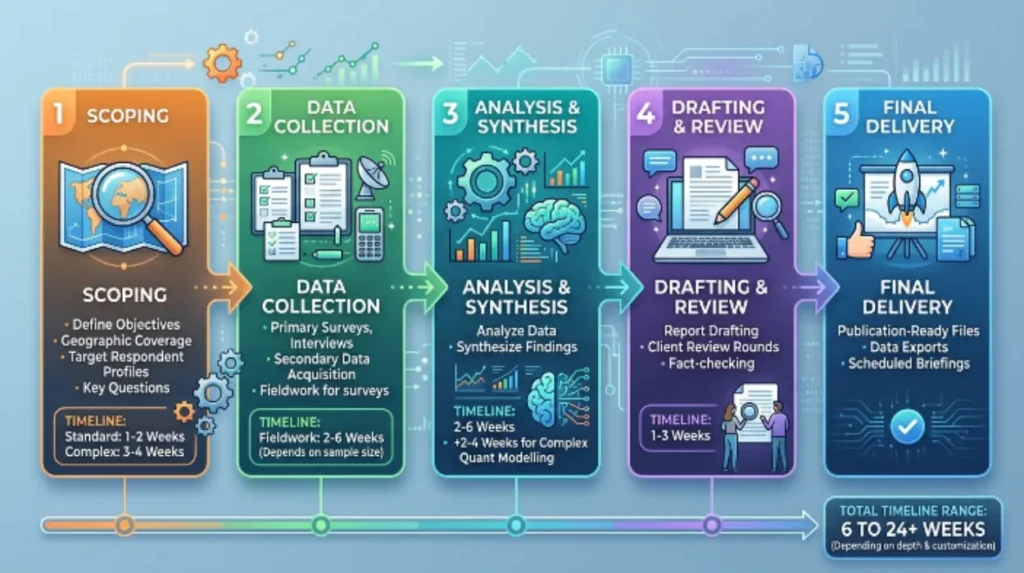
Scoping defines objectives, geographic coverage, target respondent profiles, and key questions. This stage lasts 1 to 2 weeks for standard briefs and 3 to 4 weeks for complex multi-stakeholder studies. Data collection uses primary surveys, interviews, and secondary data acquisition. Fieldwork for surveys runs 2 to 6 weeks depending on sample size. Analysis and synthesis follow, taking 2 to 6 weeks; complex quantitative modelling adds 2 to 4 weeks. Drafting and review require 1 to 3 weeks, including client review rounds and fact-checking. Final delivery includes publication-ready files, data exports, and scheduled briefings.
What components are included in standard, enhanced, and premium packages?
Standard packages include a 20–30 page report, dataset CSV, methodology appendix, and one executive briefing; enhanced and premium tiers add visual assets, workshops, and analyst time.
A standard package delivers a 20–30 page written report, CSV of cleaned survey data, a methodology appendix with sample size and margin of error, and a single 45-minute executive briefing. An enhanced package adds 2–4 bespoke charts in editable formats, a slide deck of 10–15 slides, two executive briefings, and basic segmentation tables. A premium package includes a full dataset API or multiple CSVs, a 20–30 slide presentation, three analyst workshops, a bespoke comparator analysis with named competitors, and up to 5 hours of post-delivery consultancy. Each package specifies licensing terms for the content and rules for public distribution.
How do sample sizes and methodologies affect timelines and costs?
Sample sizes and chosen methodologies drive fieldwork duration and analytical effort; typical B2B samples range from 200 to 1,200 respondents with associated time and cost implications.
A 200-respondent B2B survey typically completes fieldwork in 2 to 3 weeks when panel access exists. A 500-respondent survey requires 3 to 5 weeks. A 1,000-1,200 respondent effort requires 6 to 10 weeks and additional screening to reach niche buyer segments. Qualitative interviews add 2 to 6 weeks depending on stakeholder availability. Complex probabilistic weighting, conjoint analysis, or econometric modelling adds 2 to 6 analyst weeks. Higher sample sizes and advanced methods increase vendor costs for panel access, incentives, and analyst hours.
What are common pricing ranges for UK-focused packages?
Pricing for UK-focused research report packages typically ranges from £8,000 for basic studies to £120,000 for large-scale, bespoke programmes with custom data and advisory services.
Entry-level packages with 200–300 respondents, a 20–30 page report, and one briefing fall between £8,000 and £18,000. Mid-tier packages with 400–800 respondents, enhanced visual assets, and two briefings range from £18,000 to £45,000. Large-scale packages with 1,000+ respondents, named-competitor analysis, API access, multiple workshops, and extended consultancy range from £45,000 to £120,000. Sector-specific factors change costs; regulated sectors requiring specialist recruitment or security clearances add £5,000 to £25,000. International multi-market extensions increase costs proportionally by market count and local fieldwork complexity.
What licensing and publication options exist?
Licensing options include single-use internal reports, limited external distribution, and full public distribution with embargo controls; publication rights affect pricing and IP ownership.
Single-use internal licenses restrict distribution within the commissioning organisation and usually lower cost. Limited external distribution permits use in controlled public relations or client-facing contexts and adds licensing fees. Full public distribution grants the commissioning organisation rights to publish the report openly and to syndicate content; vendors often require higher fees or specific attribution terms. Data ownership clauses vary: some vendors transfer cleaned datasets to the client, while others maintain ownership and grant usage rights. Contracts should state embargo periods, attribution requirements, and redistribution rules.
What outcomes and deliverables should clients expect at delivery?
Clients should expect a publication-ready report, raw and cleaned data files, visual assets in editable formats, a methods appendix, and scheduled analyst briefings as per the package.
The publication-ready report includes an executive summary, key findings, detailed chapters, tables, and figure captions with source notes. Cleaned data files arrive as CSVs with a codebook and variable definitions. Visual assets come in formats such as PNG and editable PPTX or SVG files. The methods appendix lists sample size, field dates, response rates, and margin of error calculations. Analyst briefings cover top-line findings, interpretation of key models, and recommended next steps. Delivery packages may also include API endpoints for dataset access in premium tiers.
How should organisations evaluate ROI and success?
Evaluate ROI by measuring lead conversions traceable to report interactions, average deal size changes, time-to-close improvements, and earned media or citation growth within 6 to 12 months post-publication.
Track attribution pathways from organic search, referral traffic, and gated follow-ups to downstream conversions. Measure changes in average deal value for leads attributed to the report compared with baseline cohorts. Assess time-to-close by comparing sales cycle length for prospects exposed to the report versus those without exposure. Monitor earned media pickup and citation counts monthly for 6 to 12 months. Quantify analyst briefing uptake and follow-up meeting conversions as direct business outcomes.
Explore More Expert Insights:
Publishing Your Research Through a 10-Site UK Media Group: Reach and Credibility Compared
Research Report ROI: How One UK Brand Generated 340 Qualified Leads From One Study
What procurement and governance steps ensure a compliant engagement?
Procurement should require a detailed statement of work, named deliverables, data protection clauses, intellectual property terms, and explicit timelines for milestone payments and deliverables.
The statement of work must list all deliverables, formats, sample quotas, field dates, and acceptance criteria. Data protection clauses must align with UK GDPR and specify data handling, storage location, and retention periods. Intellectual property terms should define dataset ownership, usage rights, and publication permissions. Payment milestones align with phase gates: 20% on contract, 30% on fieldwork start, 30% on draft delivery, and 20% on final acceptance, or as negotiated. Acceptance criteria require documented sign-off from named client contacts within agreed timeframes.
When is a bespoke research report package necessary?
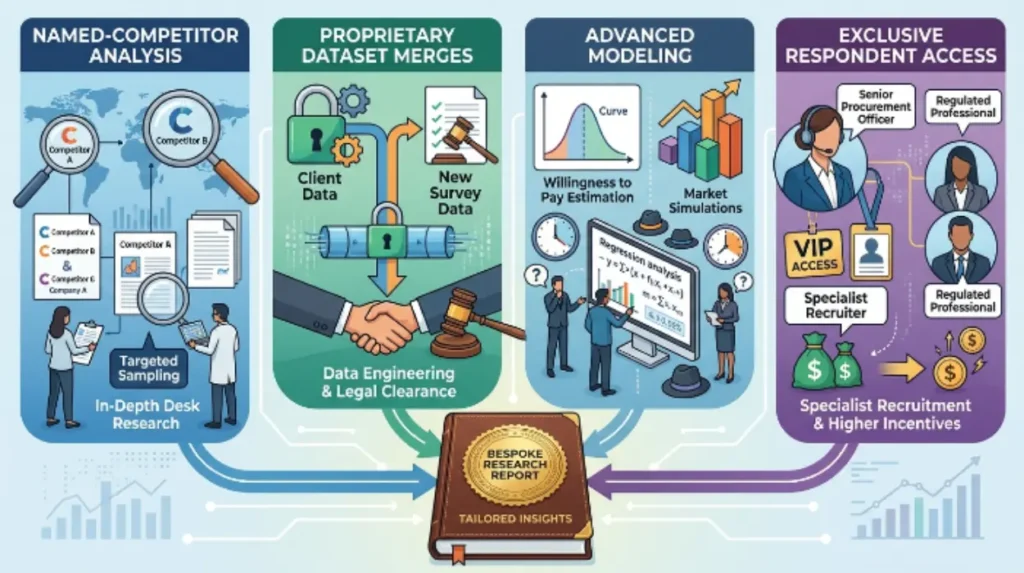
Organisations commission bespoke packages when objectives require named-competitor analysis, proprietary dataset merges, advanced modelling, or exclusive access to respondent segments.
Bespoke packages meet needs that standard templates do not address. Named-competitor analysis requires targeted sampling and desk research. Merging proprietary client datasets with newly collected data requires data engineering and legal clearance. Advanced modelling such as willingness-to-pay estimation or market simulations requires specialist analysts and longer timelines. Exclusive access to senior procurement respondents or regulated professionals requires specialist recruitment and higher incentives. Bespoke engagements carry higher costs and longer delivery timelines.
Explore More Expert Insights:
Industry Reports Are the Second-Most Trusted Content Format in UK B2B Buying
Research report packages for UK brands vary by scope, method, and delivery format. Standard packages deliver a written report, datasets, and a briefing within 6 to 12 weeks at entry-level prices from £8,000. Mid-tier and premium packages add visual assets, workshops, API access, and bespoke analysis with timelines up to 24 weeks and investments up to £120,000. Contracts must specify deliverables, licensing, and data protection. ROI measurement focuses on lead conversion, deal size, and citation growth over 6 to 12 months. Organisations requiring advanced analysis or exclusive respondent access should select bespoke packages with clear SOWs and milestone governance.
Discover the Full Information:
How Media-Published Reports Outperform Gated PDFs for UK Lead Generation



