Sponsored content has shifted from a publication-only format to a search-visibility asset. In the UK, sponsored articles now compete across traditional search results, news surfaces, featured answers, and generative search experiences.
Generative Engine Optimisation (GEO) focuses on making content understandable, extractable, and attributable to AI-powered search systems. Google AI Overviews, Microsoft Copilot, and other generative search interfaces use information from web sources to construct responses. Sponsored articles therefore require structures that communicate facts clearly and establish strong topical relevance.
GEO does not replace Search Engine Optimisation (SEO). It extends content optimisation beyond rankings toward machine-readable answers, source recognition, and contextual relevance. A sponsored article that follows both principles provides clear information for readers and identifiable evidence for search systems.
What is Generative Engine Optimisation for sponsored content?
Generative Engine Optimisation is the process of structuring sponsored content so AI search systems can identify entities, facts, relationships, and answers accurately when generating responses for users.
GEO applies semantic clarity to sponsored articles. The article establishes a defined subject, identifies relevant entities, answers specific questions, and connects claims to supporting information.
Sponsored content requires additional editorial discipline because commercial intent exists alongside informational intent. The article must communicate useful information without allowing promotional language to obscure the primary topic.
For example, an article about UK fintech regulation needs clear references to fintech, financial services, compliance, regulatory requirements, and relevant UK institutions. Each entity requires contextual definition.
How does GEO differ from traditional SEO?
Traditional SEO focuses heavily on search visibility, relevance, crawlability, links, page experience, and keyword targeting. GEO focuses on how effectively information can be interpreted and reused by generative systems.
The two approaches overlap through:
- Clear headings
- Explicit definitions
- Consistent terminology
- Structured information
- Factual statements
- Strong topical relevance
- Authoritative sources
- Entity relationships
- Concise answers
The difference lies in the output. SEO targets discoverability in search results. GEO targets discoverability and extractability within generated answers.
This distinction matters for sponsored content because an article can receive search impressions without becoming a useful source for an AI-generated answer.
How should a sponsored article be structured for AI Overview citations?
A citation-friendly sponsored article uses question-led headings, direct answers, defined entities, factual evidence, concise paragraphs, and consistent terminology that allows search systems to identify individual statements without ambiguity.
Structure determines how easily information can be extracted. A long paragraph containing several unrelated claims creates weak information boundaries. A focused paragraph containing one defined fact creates a clearer semantic unit.
A strong sponsored article begins with the main subject and progressively explains its components.
A practical structure includes:
- A precise introduction defining the subject.
- Question-based H2 headings.
- Direct answers immediately beneath headings.
- Supporting explanations.
- Relevant H3 sections.
- Specific examples.
- Data and evidence.
- Clear entity references.
- A concise conclusion.
Why do direct answers matter?
AI-generated answers frequently require concise factual passages. A paragraph that directly answers a question gives a search system a complete information unit.
For example:
What is sponsored content?
Sponsored content is paid editorial-style material published by a media organisation to communicate information about a brand, product, service, or topic.
The definition establishes the entity, commercial relationship, format, and purpose in one statement.
A weaker version begins with promotional language before defining the subject. That structure increases ambiguity because the primary entity remains unclear.
How do question-led headings improve content extraction?
Question-led headings establish an explicit relationship between a user query and the information that follows.
Examples include:
- What is sponsored content?
- How does GEO affect sponsored articles?
- Which article elements support AI citation?
- How should statistics be presented?
- What makes a source identifiable?
- How can brands improve citation readiness?
Each heading creates a defined semantic section. The following paragraph answers the exact question.
This structure also supports long-tail search queries because the article addresses specific information needs rather than relying on one broad keyword.
Which content elements help AI systems identify sponsored articles as useful sources?
AI systems need identifiable facts, entities, relationships, evidence, and context. Sponsored articles become stronger sources when every major claim has a clear subject, precise wording, relevant evidence, and consistent terminology.
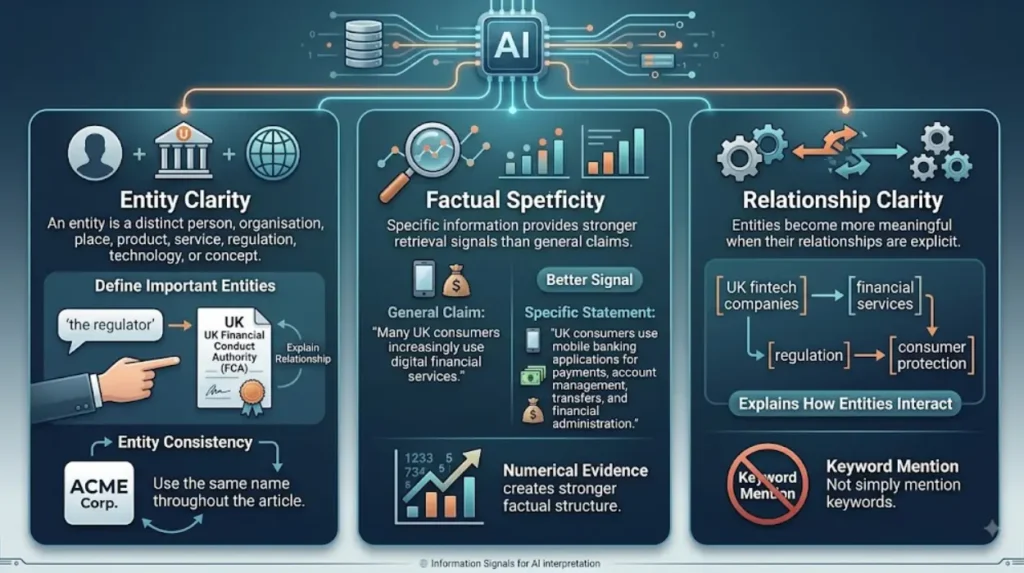
The strongest elements are not individual SEO tricks. They are information signals that improve interpretation.
Entity clarity
An entity is a distinct person, organisation, place, product, service, regulation, technology, or concept.
A sponsored article should define important entities when they first appear.
For example, instead of repeatedly using an undefined phrase such as “the regulator”, name the relevant UK regulatory body and explain its relationship to the topic.
Entity consistency also matters. If an organisation is introduced under one name, use the same name throughout the article.
Factual specificity
Specific information provides stronger retrieval signals than general claims.
Compare:
“Many UK consumers increasingly use digital financial services.”
with:
“UK consumers use mobile banking applications for payments, account management, transfers, and financial administration.”
The second statement defines the activity more precisely. Numerical evidence creates an even stronger factual structure when reliable data is available.
Relationship clarity
Entities become more meaningful when their relationships are explicit.
For example:
UK fintech companies → financial services → regulation → consumer protection
This relationship provides topical context. The article does not simply mention keywords. It explains how the entities interact.
How should statistics and research be used in GEO-focused sponsored content?
Statistics strengthen citation-ready content when they include a defined subject, numerical value, timeframe, geography, and identifiable source. Data without context creates weak evidence and reduces the usefulness of the surrounding claim.
A statistic needs more than a percentage.
A strong data statement identifies:
- What was measured
- Who was measured
- Where the research applies
- When it was collected
- The numerical result
- The original source
For example, a UK news audience article can distinguish between UK adults, UK news readers, publication visitors, and a specific survey sample.
Why does source attribution matter?
Source attribution establishes provenance. Provenance identifies where information originated and allows readers and search systems to distinguish original evidence from secondary commentary.
Sponsored articles benefit from sources such as government publications, recognised research institutions, regulatory bodies, established industry reports, and original datasets.
A source should connect directly to the claim it supports. One general source listed at the end of an article does not establish evidence for every statement.
This principle also connects with the educational findings explored in:
Sponsored content reader behaviour.
How can brands balance commercial messaging with citation-friendly information?
A GEO-focused sponsored article separates factual education from commercial claims. It establishes the topic first, provides evidence second, and introduces the sponsoring organisation through relevant facts rather than repeated promotional statements.
Commercial messaging remains part of sponsored content. The problem occurs when promotion becomes the dominant information structure.
A useful article answers the reader’s question before presenting the sponsor’s position.
For example, a sponsored article about cybersecurity can first explain:
- What cybersecurity risk means
- Which threats affect UK organisations
- How risk assessment works
- Which controls address common vulnerabilities
- How organisations measure security performance
The sponsoring company can then appear within a clearly relevant section explaining its expertise or solution.
What promotional patterns reduce information quality?
Several patterns weaken citation readiness:
- Repeated brand names without additional information
- Unsupported superlatives
- Generic claims about market leadership
- Excessive calls to action
- Keyword repetition
- Product descriptions without context
- Claims without sources
- Paragraphs containing multiple unrelated subjects
A citation-oriented article requires informational density rather than promotional density.
How does article length affect GEO performance?
Article length alone does not determine citation potential. A focused 900-word article with precise answers provides stronger information signals than a 2,000-word article containing repetition, vague claims, and unrelated sections.
Length remains relevant when the subject requires comprehensive coverage. Complex topics require sufficient context to define entities, explain relationships, present evidence, and answer related questions.
The earlier analysis of [sponsored article length] provides useful context for understanding how article depth relates to reader behaviour.
When is a shorter sponsored article appropriate?
A shorter article works when the topic has a narrow information scope.
Examples include:
- A definition of a regulatory change
- An explanation of one technology
- A focused industry update
- A single research finding
- A concise process guide
The article needs enough information to answer the defined search intent completely.
When does a longer article provide greater value?
Longer content fits topics containing multiple connected questions.
For example, an article about UK fintech compliance can explain regulatory terminology, operational requirements, risk management, reporting processes, implementation challenges, and practical examples.
The additional length serves information completeness rather than word-count targets.
Which on-page elements make sponsored content easier for AI search systems to interpret?
Clear headings, short paragraphs, descriptive titles, consistent terminology, factual lists, meaningful internal links, structured data where appropriate, and accessible page content create stronger information architecture for AI-powered search interpretation.
The article itself remains the primary information source. Technical elements support discovery and interpretation.
Use descriptive headings
A heading such as “Key Considerations” provides little semantic information.
A heading such as “How Does UK Sponsored Content Support Brand Visibility?” defines the subject and information requirement.
Keep paragraphs focused
Each paragraph should address one central idea. Two to four sentences often provide enough space for a factual explanation without combining unrelated concepts.
Use lists for discrete information
Lists work well for:
- Requirements
- Steps
- Features
- Criteria
- Examples
- Data points
- Evaluation factors
They create clear information boundaries.
Link related concepts naturally
Internal links create contextual relationships between pages.
A sponsored content strategy can connect educational content about reader behaviour with an article about citation-focused content and then with an implementation-focused onboarding resource.
The progression moves from understanding the audience to evaluating the content approach and then applying a service process.
How can publishers and brands measure whether sponsored content is GEO-ready?
GEO readiness requires reviewing information clarity, entity coverage, source attribution, answer structure, topical completeness, technical accessibility, and evidence quality before publication and during performance analysis.
A practical GEO review examines the article as an information asset.
A GEO content checklist
Before publication, check whether the article:
- Defines the primary topic clearly.
- Answers the main question directly.
- Uses question-led headings.
- Identifies important entities.
- Provides specific factual statements.
- Attributes statistics to sources.
- Avoids unsupported claims.
- Uses consistent terminology.
- Separates information from promotion.
- Covers the connected search intent.
- Includes relevant internal links.
- Uses descriptive metadata.
- Remains accessible to search crawlers.
- Provides original or clearly attributed information.
Performance analysis then examines organic visibility, query relevance, referral traffic, branded searches, engagement, and citation appearances where measurement tools provide that data.
What types of sponsored articles are best suited to GEO strategies?
GEO works particularly well for sponsored articles that answer defined questions, explain complex subjects, interpret research, provide practical guidance, or clarify industry developments using structured and attributable information.
Several sponsored formats support this approach.
Explainer articles
Explainers define unfamiliar subjects and establish relationships between entities.
Example: an article explaining how open banking affects UK consumers.
Research-led articles
Research-led articles present findings, methodology, statistics, and interpretation.
Example: an article analysing UK consumer attitudes toward digital payments.
Practical guides
Guides answer procedural questions through defined steps.
Example: a guide explaining how UK businesses prepare for a regulatory reporting requirement.
Industry analysis
Industry analysis connects market developments with specific sectors and entities.
Example: an article examining how artificial intelligence affects UK financial services operations.
These formats give AI search systems distinct information units to interpret while providing readers with useful context.
How should a brand approach GEO when planning a sponsored content campaign?

A GEO-focused campaign begins with search intent, defines the entities and questions to cover, selects evidence sources, builds a structured article, and evaluates the published content against both reader needs and search visibility objectives.
The process begins before drafting.
First, identify the primary question. Then identify related questions that complete the topic.
Next, map the entities involved. A UK business article can include organisations, regulations, technologies, industries, locations, consumer groups, and relevant processes.
Then establish the evidence structure. Each important factual claim receives an appropriate source or explanation.
The article is then drafted around information hierarchy rather than promotional messaging.
Finally, review the published page for accessibility, topical completeness, internal linking, and factual consistency.
This approach connects sponsored content with modern search behaviour without treating GEO as a separate replacement for SEO.
For organisations moving from content strategy into implementation, the next stage is understanding the operational path from publication to measurable commercial outcomes through:
What is the key principle for writing sponsored content that earns AI Overview citations?
The central principle is information clarity. Sponsored articles need precise answers, identifiable entities, credible evidence, strong topical relationships, and focused sections that allow both readers and AI search systems to understand each claim.
GEO does not require sponsored content to abandon commercial objectives. It requires the commercial message to operate within a useful information framework.
A citation-ready article defines its subject. It answers specific questions. It uses evidence. It establishes entity relationships. It avoids unnecessary repetition. It separates facts from promotion.
Explore More Expert Insights:
How to Repurpose a Sponsored Article Into 6 UK Distribution Assets
Working With a UK Editorial Team on Sponsored Articles: Dos, Don’ts and Deadlines
For UK brands and publishers, this creates a practical content standard: write sponsored articles as structured sources of information first, then integrate the commercial context where it directly supports the subject.
That structure improves readability, strengthens semantic relevance, and gives AI-powered search systems clearer information to evaluate when generating answers.