Fintech sponsored content by Time Intelligence Media Group is paid editorial-style content created for fintech brands and distributed through relevant UK media channels. It combines brand messaging, audience targeting, publication placement, and measurable campaign objectives.
Fintech sponsored content is a paid media format designed to place a company, product, service, research report, executive perspective, or market announcement in front of a defined business audience. The content follows the commercial requirements of sponsored publishing while maintaining a publication-appropriate structure.
Time Intelligence Media Group provides a route for fintech companies seeking sponsored content distribution across media environments relevant to UK business audiences. The service focuses on connecting fintech messaging with publications and readers aligned with the campaign objective.
For brands evaluating the wider role of sponsored publishing, fintech sponsored content provides the context behind how this format reaches UK business readers.
What does sponsored content mean for a fintech brand?
Sponsored content is paid media content published through a media platform under a commercial arrangement. It differs from earned editorial coverage because the brand pays for the publishing opportunity and controls the approved content.
Typical fintech sponsored content includes:
- Product and platform announcements
- Fintech company profiles
- Executive thought leadership
- Financial technology research
- Market analysis
- Business expansion announcements
- Customer-focused educational content
- Industry reports and data-led articles
The content remains focused on a defined business subject rather than using promotional claims without supporting information.
How does Time Intelligence Media Group distribute fintech sponsored content?
Time Intelligence Media Group distributes fintech sponsored content by matching the campaign topic with relevant media opportunities, preparing publication-ready material, coordinating placement, and providing campaign information that supports performance evaluation.
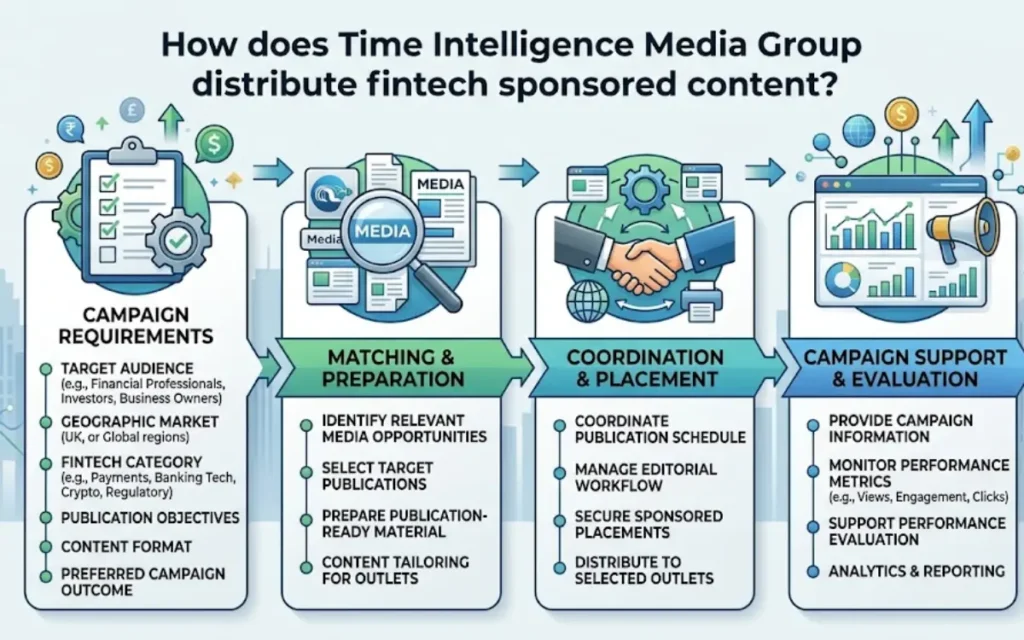
The process starts with campaign requirements. These requirements establish the target audience, geographic market, fintech category, publication objectives, content format, and preferred campaign outcome.
A UK fintech campaign can focus on audiences such as financial services professionals, business owners, investors, technology decision-makers, compliance professionals, or enterprise buyers.
How is the target audience defined?
Audience definition determines where sponsored content receives the strongest contextual relevance. A payment technology company and a wealth management platform require different publication environments.
For example, a B2B payments provider targeting finance directors requires business and financial audiences. A cybersecurity fintech targeting banking institutions requires financial technology and security-focused audiences.
Audience definition also establishes the language, subject depth, and commercial context of the content.
How is publication placement selected?
Publication selection considers relevance to the campaign rather than relying only on publication volume. Relevant factors include audience profile, subject category, UK market relevance, publication format, and content requirements.
A campaign targeting UK business readers benefits from placements where financial technology already forms part of the publication’s subject environment.
What does a fintech sponsored content campaign include?
A fintech sponsored content campaign includes strategic content development, audience definition, publication targeting, sponsored placement, campaign coordination, and reporting. Each component supports a specific stage of the paid media distribution process.
The campaign structure depends on the brand’s commercial objective and the type of content being published.
Content development
Content development converts the fintech company’s information into a publication-ready article. The structure typically includes a clear headline, introduction, supporting sections, relevant evidence, and a controlled brand reference.
A strong article establishes the subject before presenting the company’s relevance. This structure keeps the content informative and commercially focused.
Publication targeting
Publication targeting identifies media environments with relevant UK business audiences. Targeting reduces unnecessary distribution and concentrates the campaign around defined readers.
Examples include financial news audiences, business decision-makers, technology professionals, and specialist fintech communities.
Sponsored placement
Sponsored placement provides the paid publishing mechanism. The content appears through a commercial media arrangement and follows the applicable sponsored-content requirements.
The placement gives the brand a controlled route to communicate its message to an established audience.
Reporting
Reporting provides campaign information after publication. Depending on the campaign, reporting can include publication details, URLs, placement records, and other available performance information.
This information helps marketing teams maintain an accurate record of where sponsored content appeared.
Why do fintech companies use sponsored content in the UK?
Fintech companies use sponsored content to reach defined UK business audiences, communicate detailed commercial messages, establish topical relevance, support digital visibility, and secure controlled publication opportunities across appropriate media environments.
Fintech companies operate in a competitive market where financial products often require explanation before a buyer understands their commercial value.
Sponsored content gives brands sufficient space to explain complex subjects such as payment infrastructure, embedded finance, open banking, digital banking, fraud prevention, wealth technology, and financial software.
How does sponsored content support complex fintech messaging?
A conventional advertisement often uses limited copy. Sponsored content provides a longer format for explaining a product or market issue.
For example, an open banking company can explain how account connectivity works, identify a business problem, introduce its technology, and present relevant company information within one structured article.
This format supports B2B fintech campaigns where purchasing decisions involve multiple stakeholders.
How does sponsored content support brand visibility?
Sponsored publishing places the brand within an established media environment. The company receives a controlled publishing opportunity rather than relying entirely on organic editorial selection.
The result is a documented media placement that marketing teams can incorporate into broader content and visibility campaigns.
What outcomes can fintech brands measure from sponsored content?
Fintech brands can measure sponsored content through publication placements, campaign reach data, referral activity, engagement metrics, content interactions, and other reporting indicators supplied by the relevant media platform or campaign provider.
Measurement begins with the campaign objective. A brand focused on awareness uses different indicators from a company focused on website traffic or lead generation.designed for brand visibility requires different evaluation criteria from one designed for website acquisition.
How does fintech sponsored content compare with earned media coverage?
Sponsored content provides controlled publication and messaging, while earned media depends on editorial selection. Fintech brands use sponsored publishing when message control, planned placement, audience targeting, and campaign timing are important commercial requirements.
Earned media coverage is independently selected by journalists or editors. Sponsored content operates through a commercial publishing arrangement.
The two formats serve different purposes.
What does sponsored content control?
Sponsored content gives the advertiser greater control over:
- Core message
- Headline direction
- Brand references
- Supporting information
- Publication timing
- Campaign structure
- Approved calls to action
This control is particularly relevant when fintech products require technical or regulatory explanation.
What does earned coverage provide?
Earned coverage provides independent editorial treatment. The publication decides whether a story meets its editorial criteria and determines the final framing.
A fintech marketing strategy can use both formats, but the decision depends on the campaign objective and level of message control required.
Which fintech businesses benefit from sponsored content?
Fintech businesses that benefit from sponsored content include payment providers, digital banks, financial software companies, wealth technology platforms, insurtech businesses, lending platforms, compliance technology firms, and financial cybersecurity providers.
Different fintech categories require different audience and publication strategies.
Payment technology companies
Payment providers use sponsored content to explain transaction technology, merchant services, cross-border payments, payment security, and business payment infrastructure.
Digital banking platforms
Digital banking companies use content to communicate product capabilities, customer experiences, financial technology developments, and market expansion.
Wealth technology providers
Wealthtech brands use sponsored content to explain investment technology, portfolio management systems, financial planning platforms, and adviser technology.
Regtech companies
Regtech providers use educational content to explain compliance technology, reporting systems, identity verification, monitoring, and regulatory workflows.
How does Time Intelligence Media Group fit into a fintech media strategy?
Time Intelligence Media Group fits into a fintech media strategy by providing a structured sponsored-content route for brands seeking controlled UK media placement, audience-focused distribution, publication visibility, and campaign documentation.
The service is most relevant when a fintech marketing team has a defined message and requires a controlled publishing route.
A campaign can support product awareness, market education, executive positioning, business expansion, research promotion, or technology communication.
When is sponsored content a practical choice?
Sponsored content fits campaigns with a specific publication objective and defined audience. It is particularly relevant when the brand needs detailed messaging that exceeds standard advertising formats.
For example, a UK fintech entering a new business market can use sponsored content to explain its technology, market focus, business proposition, and industry relevance in one publication-ready asset.
What information should a fintech brand prepare?
A campaign brief should establish:
- Primary campaign objective
- Target UK audience
- Fintech category
- Core message
- Supporting evidence
- Preferred content format
- Target publication profile
- Campaign timeframe
- Measurement requirements
A clear brief reduces revisions and creates a direct connection between the content and the commercial objective.
What should UK fintech brands check before buying sponsored content?

UK fintech brands should check publication relevance, audience alignment, sponsored-content labelling, content requirements, placement details, campaign reporting, pricing, delivery timelines, and the exact scope of distribution before approving a sponsored-content campaign.
The buying decision requires more than checking the number of publications available.
Which questions belong in a supplier evaluation?
A fintech marketing team can ask:
- Which UK publications are available for the campaign?
- What audience does each publication serve?
- How is sponsored content labelled?
- What content formats are accepted?
- What information is included in campaign reporting?
- What is the expected publication timeline?
- What is included in the quoted price?
- Are publication URLs provided after placement?
- What revisions are included?
- How is the campaign delivered and documented?
These questions establish the actual scope of the service before purchase.
How can a fintech brand request sponsored content through Time Intelligence Media Group?
A fintech brand can request sponsored content by defining its target audience, campaign objective, content requirements, preferred UK media environment, and delivery expectations, then requesting a campaign proposal based on those specifications.
The decision process starts with the campaign requirement rather than the publication list.
A clear request identifies the fintech category, target readers, commercial objective, preferred content topic, and required timing. Time Intelligence Media Group can then structure the sponsored-content opportunity around those requirements.
For brands already researching UK fintech media reach, the next step is converting audience requirements into a defined sponsored-content campaign.
Why choose Time Intelligence Media Group for fintech sponsored content?
Time Intelligence Media Group provides fintech brands with a structured route to controlled sponsored publishing, combining campaign requirements, UK audience targeting, publication placement, content coordination, and campaign documentation within one commercial media process.
The primary decision factors are control, relevance, transparency, and measurable delivery.
A fintech brand needs publication opportunities that match its audience rather than simply increasing the number of placements. It also needs clear campaign requirements and documentation for internal marketing reporting.
Time Intelligence Media Group positions sponsored content as a defined media distribution service for brands that need controlled access to UK business audiences.
Explore More Expert Insights:
From First Article to First Lead: A UK Sponsored Content Onboarding Timeline
Buying Sponsored Content in the UK: A Step-by-Step Procurement Guide for Marketers
For a fintech marketing team comparing providers, the appropriate evaluation focuses on publication relevance, audience fit, content standards, delivery scope, reporting, and total campaign cost.
The next step is to provide the campaign objective, target audience, content requirements, preferred UK media profile, and timeframe to Time Intelligence Media Group for a tailored sponsored content quotation.