Festival coverage across 15 UK news websites uses coordinated story distribution, publication targeting, editorial adaptation, timing control, and coverage monitoring to place one festival announcement across relevant national, regional, entertainment, lifestyle, and specialist media audiences.
Multi-site festival coverage is a structured media distribution process. It connects one core festival story with multiple UK publications that serve different audiences.
The process begins with a newsworthy announcement. Examples include a festival launch, headline act announcement, programme release, ticket milestone, venue update, charity partnership, or attendance figure.
A central press release provides the factual source. Distribution then expands the story across selected websites. Each publication contributes a separate visibility point.
This approach differs from publishing one article on one website. It creates a broader coverage footprint across several media environments.
Organisations evaluating distribution approaches can first understand:
Multi-site news coverage before comparing specific service structures.
What happens before a festival story reaches 15 UK news websites?
Before distribution begins, the festival story is prepared around a verified news angle, accurate facts, media relevance, publication requirements, timing, imagery, links, and audience priorities. This preparation determines whether the announcement fits the selected UK websites effectively.
How is the festival story prepared?
The source material normally contains:
- Festival name and location
- Announcement date
- Event dates
- Key performers or programme details
- Venue information
- Ticket information
- Organiser details
- Official quotes
- Supporting statistics
- Contact information
- Relevant images
Facts need consistency across the distribution package. Dates, locations, performer names, ticket URLs, and event descriptions remain accurate.
The headline establishes the main news event. The opening paragraph explains what happened and why it matters.
For example, a festival announcing 20 new artists uses the artist announcement as the primary news angle. The copy then establishes the festival date, location, ticket status, and programme context.
How is the media list selected?
A 15-site distribution strategy does not require 15 identical publications. The selection normally combines different media categories.
Examples include national news websites, regional publications, entertainment websites, lifestyle platforms, music publications, business outlets, and event-focused media.
Audience relevance remains important. A music festival benefits from entertainment and music coverage. A regional festival benefits from publications serving the event location.
How is one festival announcement distributed across multiple websites?
One festival announcement is distributed through a central media campaign that identifies suitable publications, prepares the release, sends it through the selected network, tracks publication activity, and records resulting URLs for verification and reporting.
What is the distribution sequence?
The process follows a defined sequence:
- Story assessment identifies the strongest news angle.
- Release preparation converts the announcement into publishable media content.
- Publication selection identifies relevant UK websites.
- Distribution scheduling establishes the release time.
- Media delivery sends the story to the selected network.
- Publication monitoring identifies live coverage.
- Coverage verification checks titles, URLs, dates, and content.
- Reporting consolidates the results.
The distribution stage connects the prepared announcement with the selected websites.
Publication timing matters because festival announcements often relate to ticket launches, artist confirmations, programme releases, or event milestones. A coordinated release gives the campaign a defined publication window.
Monitoring then separates successful publication from simple distribution activity.
What types of UK news websites are included in festival coverage?
A 15-website festival campaign can combine national, regional, entertainment, lifestyle, music, business, and specialist publications. Each category provides a different editorial environment, audience profile, geographic focus, and search visibility opportunity for the same festival announcement.
Which publication categories matter?
A balanced media network can include:
National news websites: These provide broad UK audience reach.
Regional news websites: These focus on cities, counties, or local communities. A Manchester festival, for example, benefits from publications serving Greater Manchester.
Entertainment websites: These cover performers, programmes, cultural events, and audience experiences.
Music publications: These are relevant for festivals centred on live music and artist announcements.
Lifestyle websites: These cover food, travel, culture, family activities, and leisure events.
Business publications: These provide relevance for commercial announcements involving investment, partnerships, economic impact, or business growth.
Specialist publications: These serve defined interests such as events, tourism, technology, sustainability, or hospitality.
The combination depends on the festival’s subject, location, audience, and announcement type.
How does editorial relevance affect coverage across 15 websites?
Editorial relevance determines which websites have a logical reason to publish a festival story. Strong relevance connects the announcement with a publication’s audience, geographic area, editorial category, or specialist subject, creating a more coherent multi-site coverage strategy.
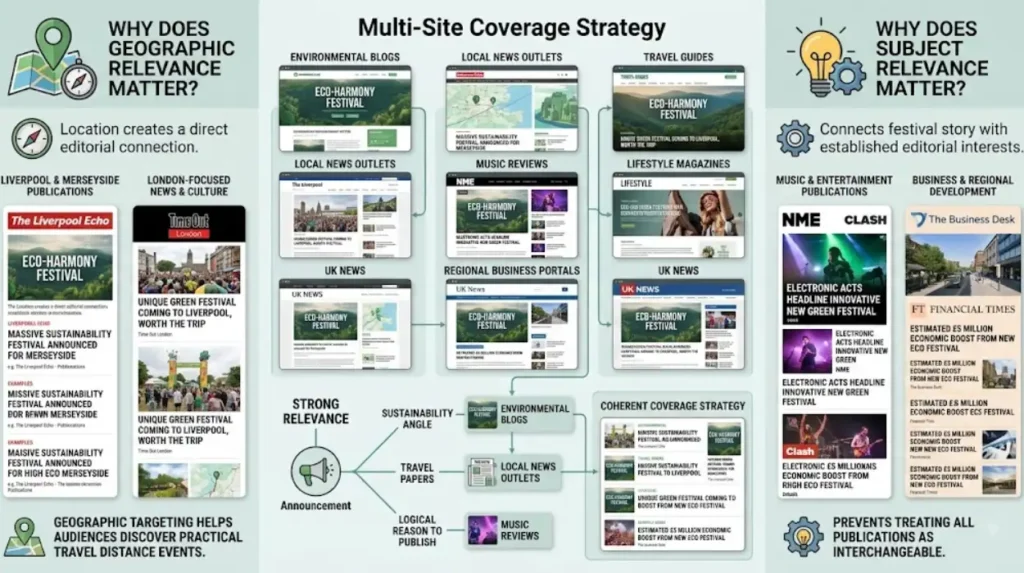
A festival announcement has different levels of relevance across media categories.
For example, a sustainability-focused festival announcement has a clear connection with environmental publications. A regional tourism partnership has stronger relevance for local news and travel websites.
Why does geographic relevance matter?
Location creates a direct editorial connection.
A festival in Liverpool has stronger local relevance for Liverpool and Merseyside publications. A London event connects with London-focused news websites and culture platforms.
Geographic targeting also helps audiences discover events within practical travel distance.
Why does subject relevance matter?
Subject relevance connects the festival story with established editorial interests.
A new electronic music festival relates to music and entertainment publications. A festival generating £5 million in local economic activity provides a business and regional development angle.
This distinction helps prevent a distribution campaign from treating every publication as interchangeable.
What content components are used in multi-site festival coverage?
A multi-site festival campaign normally combines a headline, introduction, factual body copy, quotes, event details, supporting evidence, imagery, links, contact information, and publication-specific metadata required for accurate and consistent media distribution.
Which elements form the core release?
The headline communicates the announcement.
The introduction answers the basic news questions: what happened, who is involved, where it happens, and when it happens.
The body provides supporting information.
Quotes add statements from organisers, performers, partners, or stakeholders.
Event details provide practical information such as dates, venue, ticket status, and programme information.
Links direct readers towards official information.
Images provide visual assets for publications that use them.
These components create a complete media package rather than a short promotional message.
How are links used?
Links normally point towards authoritative festival information. Examples include an official event page, ticketing page, programme page, or organiser website.
Link placement remains factual. The destination needs to match the information presented in the release.
How is festival coverage monitored after distribution?
Coverage monitoring identifies which websites published the festival story, records publication URLs and dates, checks the published content, and separates confirmed coverage from distribution activity. Monitoring creates the evidence required to evaluate the campaign accurately.
What does coverage monitoring measure?
A monitoring process can record:
- Publication name
- Article headline
- Live URL
- Publication date
- Media category
- Geographic relevance
- Story format
- Included links
- Included images
- Editorial changes
The resulting coverage list provides a factual record of campaign output.
Distribution and publication are separate measurements. A story being sent to 15 websites does not automatically mean that 15 websites published it.
This distinction is important when comparing media distribution solutions.
How can organisations compare different festival coverage approaches?
Festival coverage approaches can be compared through publication relevance, network size, geographic targeting, editorial quality, distribution process, monitoring capability, reporting detail, turnaround time, and alignment between the festival announcement and intended UK media audiences.
What should a media distribution comparison include?
A practical comparison examines several dimensions.
| Evaluation area | Key question |
|---|---|
| Network | Which UK websites are included? |
| Relevance | Do publications match the festival audience? |
| Geography | Does coverage reach priority UK locations? |
| Editorial fit | Does the story suit each publication category? |
| Distribution | How is the release delivered? |
| Monitoring | Are live placements tracked? |
| Reporting | Are URLs and publication dates recorded? |
| Timing | Does distribution match the announcement schedule? |
Network size alone does not define campaign quality. A relevant 15-site network has greater strategic value than an unrelated list of websites.
This comparison helps organisations move from general awareness toward selecting an appropriate media distribution model.
What benefits does coverage across 15 UK news websites provide?
Coverage across 15 UK news websites creates multiple publication touchpoints, expands audience exposure, supports regional relevance, strengthens the festival’s digital media footprint, and produces measurable coverage records that organisations can use for campaign evaluation and future distribution planning.
How does multi-site coverage expand visibility?
Different websites attract different audiences.
A regional publication reaches local readers. A music website reaches genre-focused audiences. A lifestyle website reaches people researching leisure activities.
The same announcement therefore enters multiple editorial contexts.
How does repeated media presence support discovery?
A festival can appear across several search results and publication environments when different websites publish related coverage.
The value comes from the combination of publication relevance, factual consistency, and audience diversity.
The coverage also creates a record of the festival announcement across independent media properties.
When is a 15-site festival coverage strategy most useful?
A 15-site strategy is most useful for significant festival announcements that require broader UK visibility, regional awareness, entertainment relevance, or measurable media distribution. Examples include launches, major line-up announcements, ticket releases, partnerships, and attendance milestones.
Which announcements fit this approach?
Suitable examples include:
- Launching a new UK festival
- Announcing a major headline performer
- Revealing a full festival line-up
- Opening ticket sales
- Announcing a new festival venue
- Publishing a major programme
- Announcing a charity partnership
- Reporting a significant attendance milestone
- Revealing a sustainability initiative
- Announcing a major commercial partnership
Each announcement requires its own editorial angle.
A line-up announcement focuses on performers and programme details. A regional economic announcement focuses on jobs, tourism, visitor numbers, or local spending.
Organisations moving toward implementation can evaluate:
Festival news coverage services to understand how structured multi-site distribution is delivered.
How should organisations evaluate festival coverage after publication?
Post-campaign evaluation compares planned publications with confirmed coverage, examines audience and geographic relevance, verifies live URLs, reviews the news angle, and records measurable results for future festival announcements, media targeting decisions, and distribution planning.
The final report establishes what the campaign actually achieved.
A useful review records the number of confirmed publications, publication categories, geographic spread, live URLs, publication dates, and story variations.
It also identifies which media categories produced the strongest relevance.
For example, a regional festival can compare local news coverage against national entertainment coverage. A music festival can assess specialist music publications separately from general news websites.
This evidence supports the next campaign.
The organisation can then refine its publication mix, announcement timing, content angle, and distribution requirements for future festival news.
Explore More Expert Insights:
How Sports Events Reach 15 UK News Sites Fast
What News Coverage Adds to UK Real Estate Events
What is the complete process for running festival coverage across 15 UK websites?
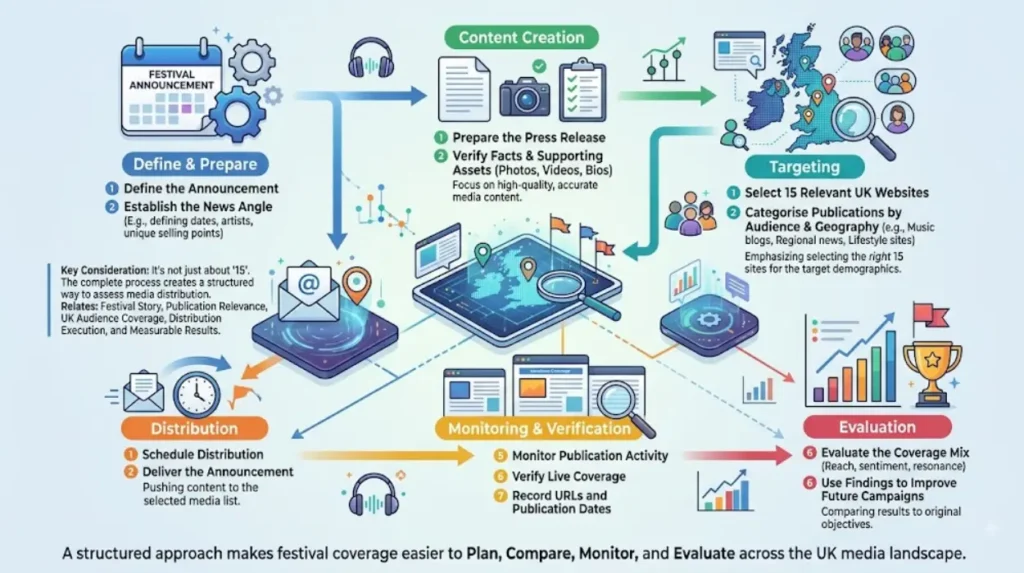
The complete process starts with defining the festival announcement, preparing accurate media content, selecting relevant UK websites, scheduling distribution, delivering the release, monitoring publication activity, verifying coverage, and evaluating results against the original campaign objectives.
The workflow is therefore:
- Define the announcement.
- Establish the news angle.
- Prepare the press release.
- Verify facts and supporting assets.
- Select 15 relevant UK websites.
- Categorise publications by audience and geography.
- Schedule distribution.
- Deliver the announcement.
- Monitor publication activity.
- Verify live coverage.
- Record URLs and publication dates.
- Evaluate the coverage mix.
- Use findings to improve future campaigns.
This process gives festival organisers a structured way to assess multi-site media distribution.
The key consideration is not simply the number 15. It is the relationship between the festival story, publication relevance, UK audience coverage, distribution execution, and measurable media results.
A structured approach makes festival coverage easier to plan, compare, monitor, and evaluate across the UK media landscape.