Real estate event coverage across 15 UK news sites is a coordinated media distribution approach that places an event announcement, news report, or event-related story across 15 relevant UK publications, creating measurable national, regional, and property-sector visibility.
Real estate event coverage connects property events with established news audiences. These events include property conferences, investment forums, development launches, awards, exhibitions, networking events, and industry briefings.
A 15-site distribution model gives the event a defined media footprint. The coverage can include publication of the original story, adapted editorial versions, syndicated announcements, or separate reports depending on each publication’s editorial process.
The objective is not simply to publish the same text repeatedly. Effective distribution identifies suitable UK news environments and aligns the event story with property, business, investment, construction, and regional interests.
For decision-makers, the key consideration is the quality and relevance of the 15 sites rather than the number alone.
What types of real estate events can receive coverage?
Typical events include:
- Property investment conferences
- Commercial real estate forums
- Residential development launches
- Property awards
- Construction and development exhibitions
- Real estate networking events
- PropTech conferences
- Housing policy events
- Real estate investment briefings
- Developer and investor announcements
Each event requires a news angle that provides a clear reason for publication.
How does real estate event coverage reach UK property readers?
Real estate event coverage reaches UK property readers through targeted publication across relevant news, business, property, construction, investment, and regional media sites, allowing one event story to enter multiple established audience environments with measurable publication outcomes.
The distribution process starts with the event information. The media strategy then identifies the strongest news angle, prepares the content, selects relevant publications, distributes the story, and records the resulting coverage.
The audience is segmented by publication type. A property publication reaches professionals actively following the sector. A business publication reaches investors, executives, and company decision-makers. A regional publication reaches audiences connected with a specific UK location.
This segmentation gives the event greater contextual relevance.
For example, a London commercial property conference has a different media audience from a regional housing development event in Manchester. The distribution strategy reflects that difference.
How does publication selection affect coverage quality?
Publication selection determines where the event appears and which audience encounters it.
A strong 15-site campaign can include several publication categories:
- Property media — real estate professionals and property investors.
- Business media — executives, entrepreneurs, and investors.
- Construction media — developers, contractors, architects, and suppliers.
- Regional news media — audiences connected with local developments.
- Specialist media — readers focused on areas such as PropTech, housing, or commercial property.
The final mix depends on the event’s subject, location, audience, and news value.
What makes 15 UK news sites useful for a property event?
Fifteen UK news sites create a defined coverage footprint across multiple audience segments, improving discoverability, establishing repeated event visibility, supporting branded search activity, and giving organisers a structured set of published media outcomes to evaluate.
The value comes from distribution breadth combined with relevance.
One publication reaches one audience environment. Fifteen relevant sites create multiple entry points for people searching for the event, its speakers, organisers, sponsors, location, or subject matter.
The coverage also creates a collection of published references. These references support media reporting, stakeholder communication, event promotion, and post-event documentation.
Why does publication diversity matter?
Publication diversity prevents the campaign from depending on a single audience.
For example, an event about UK property investment can appeal to:
- Property investors
- Developers
- Estate agents
- Construction companies
- Financial professionals
- Technology providers
- Local authorities
- Housing professionals
A carefully selected media mix reflects these audience groups.
How is a real estate event story prepared for UK media distribution?
A real estate event story is prepared around a specific news angle, factual event information, named organisations, relevant locations, measurable developments, speaker details, and supporting evidence that gives UK media outlets a clear editorial reason to publish it.
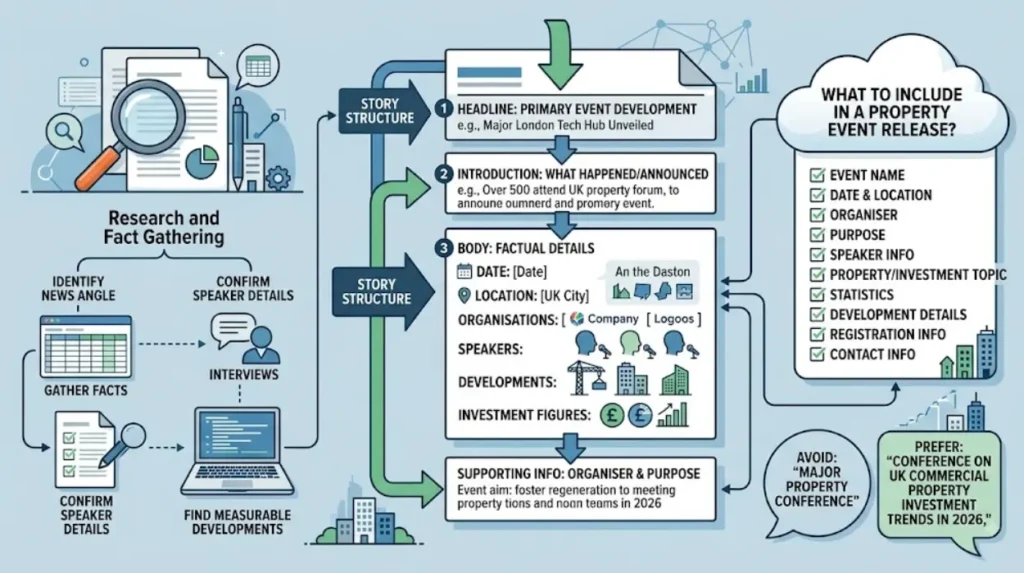
The content needs a defined news structure.
The headline identifies the primary event development. The introduction explains what happened or what is being announced. The body provides factual details, including dates, location, participating organisations, speakers, developments, investment figures, or sector relevance.
The story then provides supporting information about the organisers and event purpose.
What information belongs in a property event release?
A strong event story typically contains:
- Event name
- Event date
- Event location
- Organiser
- Event purpose
- Speaker or participant information
- Property or investment topic
- Relevant statistics
- Development details
- Registration information
- Contact information
- Supporting company information
Specific information improves clarity and reduces ambiguity.
For example, stating that a conference will examine “UK commercial property investment trends in 2026” provides more context than describing an event as a “major property conference.”
How can event coverage support property-sector visibility?
Event coverage supports property-sector visibility by placing the event, organisation, speakers, developments, and key announcements in multiple media environments where property professionals, investors, business audiences, and regional stakeholders already consume industry information.
Visibility operates across several stages.
Before an event, coverage communicates the event’s existence and key themes. During the event, coverage can highlight announcements, speakers, awards, or developments. After the event, coverage can document outcomes, statements, partnerships, and sector discussions.
This creates a wider media record around the event lifecycle.
How does coverage support event discovery?
Searchers often use combinations of event names, speaker names, locations, organisations, and property topics.
A media article containing these entities creates another searchable reference point.
For example, an event involving a Birmingham residential development can connect the event name with Birmingham property, residential development, the developer, and participating speakers.
This improves the breadth of information associated with the event.
What measurable outcomes can organisers evaluate from 15-site coverage?
Organisers can evaluate 15-site coverage through publication count, publication relevance, audience category, geographic distribution, backlinks where available, referral activity, branded search visibility, social engagement, and the quality of media references generated by the campaign.
Measurement needs defined criteria.
Publication count confirms distribution. Publication relevance confirms whether the selected sites match the intended property audience. Geographic distribution shows whether the campaign reached national or regional audiences.
Referral activity provides direct evidence of traffic from published coverage where tracking is available.
Which metrics matter most at decision stage?
Useful evaluation metrics include:
| Metric | What it measures |
|---|---|
| Published articles | Confirmed media placements |
| Relevant publications | Audience and sector alignment |
| Geographic coverage | UK market reach |
| Referral traffic | Visitors generated by coverage |
| Branded searches | Interest associated with the event or organisation |
| Backlinks | External website references where included |
| Engagement | Interaction with published coverage |
| Coverage longevity | Continued availability after publication |
The most useful measurement framework connects each metric to the event objective.
A lead-generation event requires stronger attention to referral traffic and registrations. A sector conference requires greater emphasis on industry visibility and audience relevance.
How does 15-site coverage compare with a single UK publication?
Fifteen-site coverage provides broader media distribution than a single publication because it creates multiple publication points across different audience environments, while single-site coverage concentrates visibility within one publication and its associated readership.
The two approaches serve different purposes.
A single high-relevance publication can provide strong contextual authority. A multi-site campaign provides broader distribution and greater coverage volume.
The decision depends on the campaign objective.
An organiser seeking visibility across UK property audiences benefits from a multi-publication approach. An organisation targeting one specialist audience can prioritise a highly relevant publication.
When is multi-site coverage more appropriate?
Multi-site coverage is useful when the event needs:
- UK-wide awareness
- Multiple audience segments
- Regional visibility
- Wider stakeholder exposure
- A stronger media footprint
- Multiple published references
- Post-event media documentation
The campaign becomes particularly relevant for major property events involving multiple organisations or locations.
How can organisers choose a real estate media distribution service?
Organisers can choose a real estate media distribution service by checking publication relevance, confirmed UK media reach, distribution scope, reporting standards, editorial requirements, turnaround times, content support, and evidence of published coverage across the agreed media list.
The service evaluation process needs clear specifications.
A provider should identify the publications included in the campaign. The organiser needs to understand whether the 15 sites represent genuine editorial publications, syndicated outlets, specialist platforms, regional media, or a combination.
The reporting method also matters.
What questions should organisers ask before purchasing coverage?
Ask these questions:
- Which 15 UK news sites receive the content?
- Which sites focus on property or business?
- Are placements guaranteed or subject to editorial review?
- What content format is required?
- What is the expected publication timeframe?
- Is publication evidence provided?
- Does the report list every published URL?
- Are regional and specialist publications included?
- Are backlinks available where editorially appropriate?
- How are campaign results reported?
Clear answers establish the actual scope of the service.
How can real estate event coverage support a broader UK PR strategy?
Real estate event coverage works as one component of a broader UK PR strategy by connecting event announcements with ongoing corporate communications, executive visibility, property-sector news, regional storytelling, thought leadership, and post-event reporting.
A single event should not exist separately from the organisation’s wider media activity.
Pre-event coverage introduces the subject. Event-day content captures developments. Post-event coverage documents outcomes. Future announcements build on the established media presence.
This creates a structured communications sequence.
Organisations planning recurring property events can also use previous coverage to identify which publications produced relevant engagement and which audience segments responded most strongly.
How does real estate event coverage connect with the wider reader journey?
Real estate event coverage forms part of a wider reader journey from understanding the role of event news to evaluating how property stories reach UK audiences and finally selecting an appropriate distribution model for a specific campaign.
Readers first need to understand what news coverage contributes to an event. They then need to understand how distribution reaches UK property audiences. The final decision concerns the appropriate media coverage structure.
This creates a logical progression from education to evaluation to implementation.
The related resource on:
Real estate event coverage explains how event stories reach UK property readers and how publication environments influence audience exposure.
For organisers ready to evaluate a defined media campaign,
News Coverage Adds provides the decision-stage context for assessing multi-site real estate event coverage.
What should organisers expect from a 15-site UK real estate coverage campaign?
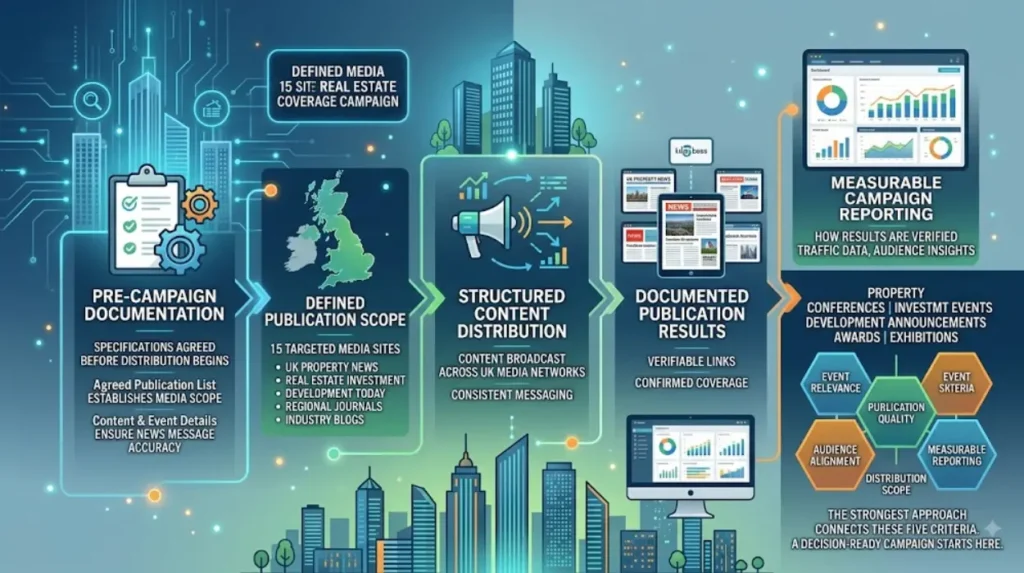
Organisers should expect a defined publication scope, relevant UK media targeting, structured content distribution, documented publication results, and measurable campaign reporting when purchasing a 15-site real estate event coverage service from a clearly specified provider.
The campaign specification needs to be documented before distribution begins.
The agreed publication list establishes the media scope. The content establishes the news message. The event details establish factual accuracy. The reporting process establishes how results are verified.
A 15-site campaign is therefore a defined media distribution product rather than a general promise of visibility.
Explore More Expert Insights:
Healthcare Event News Coverage on 15 Trusted UK Sites
Fintech Event News Coverage Services Across 15 UK Sites
For property conferences, investment events, development announcements, awards, and industry exhibitions, the strongest approach connects event relevance, publication quality, audience alignment, distribution scope, and measurable reporting.
A decision-ready campaign starts with those five criteria. Organisers can then assess whether a 15-site UK media distribution package matches their event objectives, target audience, geographic requirements, and reporting expectations.