
Negative media coverage can affect event attendance, sponsor confidence, stakeholder trust, and long-term brand reputation. Crisis-proofing is the process of identifying communication risks before an event, preparing response procedures, and ensuring accurate information reaches journalists quickly. UK organisations that build structured media plans before an event reduce confusion, respond faster, and maintain greater control over public communication.
What does crisis-proofing a UK event mean?
Crisis-proofing a UK event means preparing communication systems, media processes, and response plans before problems occur. It reduces delays, limits misinformation, protects stakeholder confidence, supports consistent messaging, and enables organisations to respond to negative coverage with verified facts instead of reactive statements under pressure.
Crisis-proofing is a proactive communications strategy. It focuses on preparation instead of reaction. The objective is to reduce reputational damage by establishing clear processes before an event begins.
A crisis during an event includes situations such as:
- Venue safety incidents
- Speaker cancellations
- Protest activity
- Technical failures
- Data breaches
- Sponsor disputes
- Social media misinformation
- Negative journalist reports
Every incident attracts different levels of media attention. A prepared organisation responds using verified information and predefined responsibilities.
For organisations planning larger conferences, product launches, or industry exhibitions, crisis preparation forms one part of a wider media strategy. Planning event visibility alongside risk management creates stronger communication outcomes. Explore:
Why preparation matters before journalists start reporting
Journalists work under strict deadlines.
When an incident occurs, they seek official confirmation immediately. Organisations that respond within minutes provide context before speculation spreads. Organisations without prepared communications often lose control of the narrative.
Why do UK events attract negative media coverage?
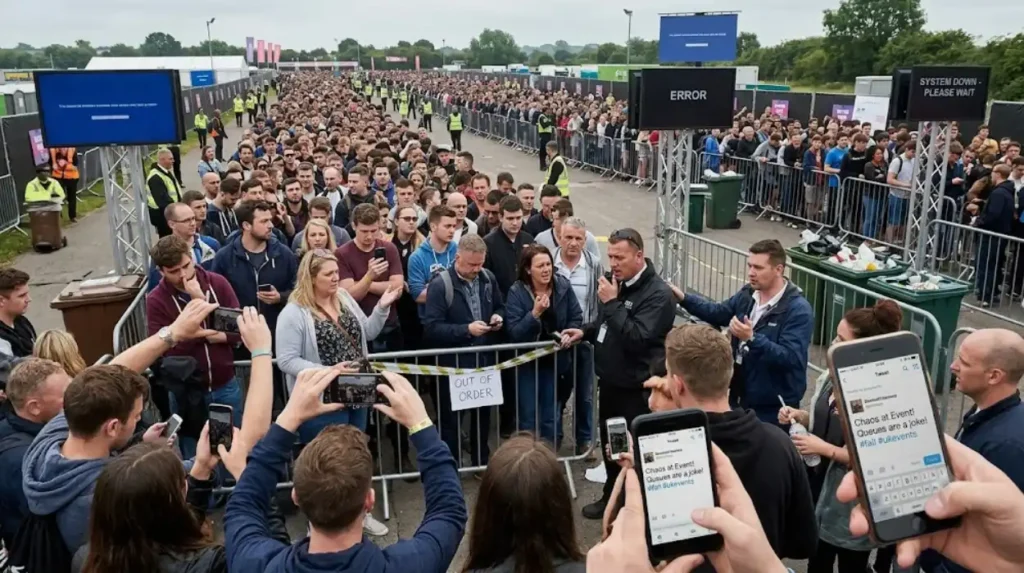
Negative media coverage usually results from operational failures, poor communication, inaccurate information, safety concerns, or stakeholder complaints. Journalists report issues that affect attendees, public interest, or accountability. Clear preparation reduces avoidable reporting risks before the event opens to participants and media.
Negative coverage does not always begin with a major incident.
Smaller operational issues often receive attention because they affect public experience.
Common causes include:
- Long registration queues
- Accessibility complaints
- Health and safety breaches
- Venue overcrowding
- Delayed keynote sessions
- Security incidents
- Sponsor disagreements
- Poor crisis communication
- Incorrect public statements
For example, a technology conference experiencing a two-hour registration delay becomes a news story if thousands of attendees share identical complaints online before organisers respond.
How social media accelerates news
Information spreads within minutes across multiple platforms.
Images, short videos, and attendee comments often reach journalists before official statements become available.
Prepared communication teams monitor conversations continuously and verify facts before responding publicly.
How can organisations identify communication risks before an event?
Communication risks become easier to manage through structured planning, stakeholder mapping, media scenario analysis, and operational reviews. Identifying likely problems before event day allows teams to assign responsibilities, prepare responses, and reduce uncertainty during fast-moving situations affecting public perception.
Risk identification begins during event planning.
Every department contributes different information.
Examples include:
- Operations identify venue risks.
- Security identifies public safety concerns.
- Marketing identifies brand reputation risks.
- Legal reviews regulatory obligations.
- Executive leadership approves messaging.
Create a communication risk register
A communication risk register documents:
| Risk | Likelihood | Impact | Owner |
|---|---|---|---|
| Speaker cancellation | Medium | High | Event Manager |
| Wi-Fi outage | High | Medium | IT Lead |
| Protest activity | Low | High | Security Manager |
| Medical emergency | Low | High | Venue Operations |
| Social media misinformation | Medium | High | Communications Lead |
A documented register improves coordination between departments.
Review previous events
Past events provide measurable evidence.
Examples include:
- Media questions received
- Sponsor concerns
- Attendee complaints
- Social media trends
- Journalist feedback
Historical data identifies recurring communication risks.
What should a UK event crisis communication plan include?
An effective crisis communication plan defines responsibilities, approval workflows, spokespersons, media procedures, monitoring systems, and response timelines. Every participant understands their role before an incident occurs, reducing confusion and ensuring accurate information reaches journalists and stakeholders quickly.
A crisis communication plan is an operational document.
It contains practical instructions rather than general advice.
Core components include:
Defined response team
Assign named responsibilities.
Examples include:
- Communications Director
- Media Relations Manager
- Legal Representative
- Executive Spokesperson
- Event Director
- Security Lead
Each person manages a specific communication function.
Approved spokespersons
Only authorised individuals speak with journalists.
This prevents conflicting statements.
Holding statements
Holding statements acknowledge an incident before complete information becomes available.
Example:
“We are aware of the incident affecting today’s event. Our team is verifying information and will provide an update shortly.”
This confirms awareness without publishing inaccurate information.
Media contact procedures
The plan defines:
- Media enquiry channels
- Response deadlines
- Escalation routes
- Approval requirements
Standardised processes improve consistency.
How can organisations prepare for difficult journalist questions?
Preparation involves identifying predictable media questions, developing factual responses, verifying supporting information, and training spokespersons through realistic interview practice. Structured preparation improves confidence, consistency, and factual accuracy during interviews conducted under significant time pressure following an incident.
Journalists focus on accountability.
Questions often follow predictable themes.
Examples include:
- What happened?
- Who was affected?
- When did the incident occur?
- What actions have been taken?
- Was the issue preventable?
- Will the event continue?
Preparing answers before the event improves response quality.
Conduct media interview simulations
Simulation exercises replicate realistic interview conditions.
Include:
- Live interview practice
- Camera interviews
- Radio interviews
- Telephone interviews
- Press conference rehearsals
Practice strengthens message consistency across different formats.
How does media monitoring support crisis management?
Media monitoring tracks news coverage, journalist reporting, broadcast content, online publications, and social conversations in real time. Continuous monitoring enables communication teams to identify emerging issues quickly, correct inaccuracies promptly, and measure how narratives develop throughout an event.
Monitoring begins before the event starts.
It continues throughout the event and after closure.
Track:
- National news outlets
- Regional publications
- Trade publications
- Television coverage
- Radio reports
- Social media discussions
- Industry newsletters
Measure sentiment using evidence
Communication teams assess:
- Positive mentions
- Neutral reporting
- Negative reporting
- Factual accuracy
- Headline themes
Patterns identify where clarification is required.
Organisations expanding their event communications often combine monitoring with broader media planning. Explore:
What actions reduce the impact of negative coverage during an event?
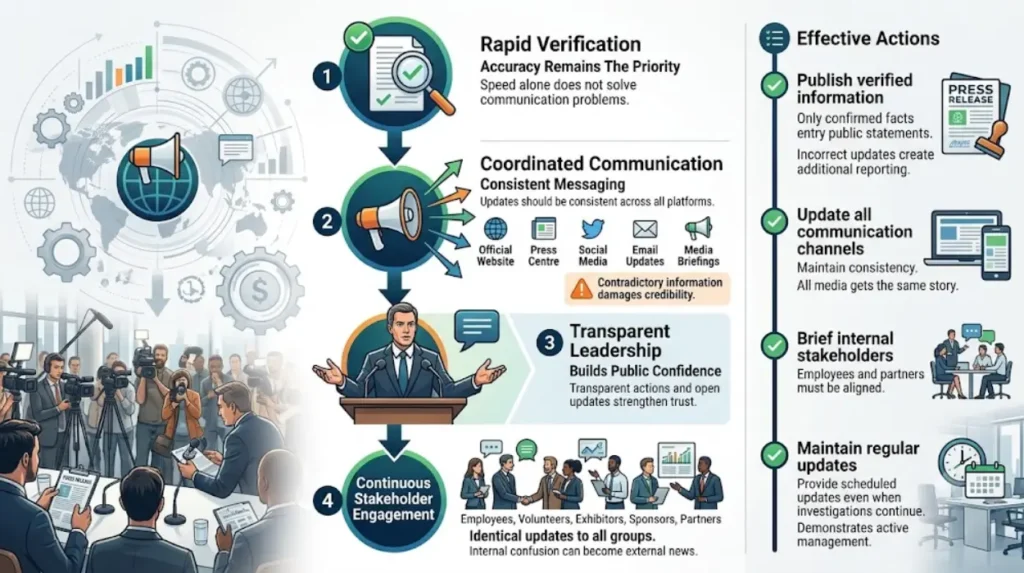
Rapid verification, coordinated communication, factual updates, transparent leadership, and continuous stakeholder engagement reduce the impact of negative coverage. Consistent messaging across press statements, websites, social platforms, and spokesperson interviews limits confusion and strengthens public confidence throughout the response process.
Speed alone does not solve communication problems.
Accuracy remains the priority.
Effective actions include:
Publish verified information
Only confirmed facts enter public statements.
Incorrect updates create additional reporting.
Update all communication channels
Maintain consistency across:
- Official website
- Press centre
- Social media accounts
- Email updates
- Media briefings
Contradictory information damages credibility.
Brief internal stakeholders
Employees, volunteers, exhibitors, sponsors, and partners require identical updates.
Internal confusion often becomes external news.
Maintain regular updates
Provide scheduled updates even when investigations continue.
Regular communication demonstrates active management.
How can organisations recover after negative event coverage?
Recovery focuses on transparent communication, operational improvements, stakeholder engagement, accurate reporting, and post-event evaluation. Organisations strengthen future performance by documenting lessons learned, updating crisis procedures, and demonstrating measurable improvements after communication challenges have been resolved successfully.
Recovery begins after immediate issues are resolved.
A structured review improves future preparedness.
Conduct a post-event communication review
Review:
- Media coverage volume
- Response times
- Journalist feedback
- Stakeholder responses
- Social media engagement
- Internal coordination
Measure performance against predefined objectives.
Update future crisis plans
Revise documentation using evidence gathered during the event.
Examples include:
- Improved approval workflows
- Faster notification systems
- Revised spokesperson training
- Better monitoring procedures
Continuous improvement strengthens long-term resilience.
How does crisis-proofing improve overall event communication?
Crisis-proofing creates structured communication, improves organisational coordination, strengthens media relationships, supports informed decision-making, and protects reputation before problems escalate. Organisations that prepare thoroughly communicate more consistently, respond more efficiently, and maintain stronger stakeholder confidence throughout complex live events.
Crisis preparation extends beyond emergency response.
It improves every stage of event communications.
Benefits include:
- Faster media responses
- More accurate public information
- Better coordination between departments
- Stronger journalist relationships
- Increased sponsor confidence
- Improved attendee trust
- More consistent messaging
- Better post-event reporting
These improvements support communication quality even when no crisis occurs.
Explore More Expert Insights:
Measuring Event Media Coverage: 7 Metrics Beyond Impressions for UK Organisers
Speaker Amplification: How to Turn 8 Presenters Into 8 Separate UK Media Stories
Preparation also strengthens everyday media engagement by ensuring spokespersons, communication teams, and operational leaders work from shared processes. This consistency produces clearer reporting, faster decision-making, and stronger relationships with journalists covering UK events.
Organisations that integrate crisis planning into broader event communication strategies build more resilient media operations. Rather than reacting to unexpected challenges, they establish structured workflows, prepare verified messaging, monitor public conversations continuously, and evaluate results after each event. This disciplined approach reduces reputational risk, improves stakeholder confidence, and creates a stronger foundation for future UK events.