
A crisis communication framework is a structured process that enables an organisation to issue accurate, timely, and consistent public statements during disruptive events. For UK online retailers, this framework protects customer confidence during supply chain disruptions, shipping delays, product shortages, cyber incidents, and operational failures. Fast communication reduces uncertainty, limits misinformation, and supports long-term customer loyalty.
Businesses that understand how reputation changes during disruption benefit from first understanding:
What Happens to an Online Store’s Reputation During a Supply Chain or Shipping Crisis? before developing a structured response process.
What is a crisis communication framework?
A crisis communication framework is a documented system that defines responsibilities, approval processes, communication channels, message templates, and response timelines. It enables organisations to publish verified information within minutes while maintaining consistency across every customer touchpoint during operational disruption and public scrutiny.
A crisis communication framework is a predefined operational process. It removes uncertainty when an unexpected event occurs.
The framework identifies:
- Decision-makers
- Approved spokespersons
- Internal approval steps
- Customer communication channels
- Media response procedures
- Statement templates
- Update schedules
Every organisation communicates during a crisis. A structured framework ensures communication remains accurate instead of reactive.
For an online retailer, common crisis events include:
- Warehouse closures
- Courier disruptions
- Stock shortages
- Payment platform outages
- Data security incidents
- Product recalls
Each event requires different operational information but follows the same communication structure.
Why documentation matters
Documented procedures reduce delays.
Instead of creating messages from scratch, teams adapt approved templates using verified facts.
This approach improves consistency across:
- Website notices
- Email updates
- Social media
- Customer support
- Press statements
Why does rapid communication protect customer loyalty?
Rapid communication reduces uncertainty by providing verified information before customers seek answers elsewhere. Fast statements demonstrate organisational awareness, explain operational impact, set realistic expectations, and preserve trust through transparency, consistency, and regular updates across all communication channels available.
Customers expect information immediately.
Silence creates uncertainty.
Uncertainty increases complaints, refund requests, and negative reviews.
A rapid statement achieves several objectives:
- Confirms awareness of the incident
- Explains what has happened
- States what customers experience
- Outlines immediate actions
- Sets expectations for further updates
Speed alone is not enough.
Accuracy remains essential.
Publishing incorrect information damages credibility more than waiting for verified facts.
Customer expectations during disruption
Research consistently shows customers value:
- Honest explanations
- Clear delivery expectations
- Frequent progress updates
- Visible accountability
A simple acknowledgement published within the first hour often reduces customer frustration significantly compared with delayed communication.
What components does an effective crisis communication framework include?
An effective framework combines governance, message approval, communication channels, monitoring procedures, customer updates, media coordination, and post-incident evaluation. Every component supports fast decision-making while ensuring factual consistency throughout the entire crisis response process from detection until recovery.
A complete framework contains several operational components.
Crisis response team
Every organisation defines specific responsibilities.
Typical roles include:
- Executive decision-maker
- Communications manager
- Customer support manager
- Operations lead
- Legal adviser
- Technical specialist
Each person owns defined responsibilities.
Approval workflow
Approval processes remain simple.
Many organisations use two-stage approval:
- Operational verification
- Executive approval
This process balances speed and accuracy.
Communication channels
Messages appear simultaneously across multiple channels.
Examples include:
- Company website
- Customer emails
- SMS notifications
- Social media platforms
- Press releases
- Help centre updates
Customers receive identical information regardless of channel.
Monitoring procedures
Monitoring includes:
- Customer complaints
- Social media discussions
- Media coverage
- Website traffic
- Support ticket volume
Monitoring identifies misunderstandings requiring clarification.
How should a rapid crisis statement be structured?
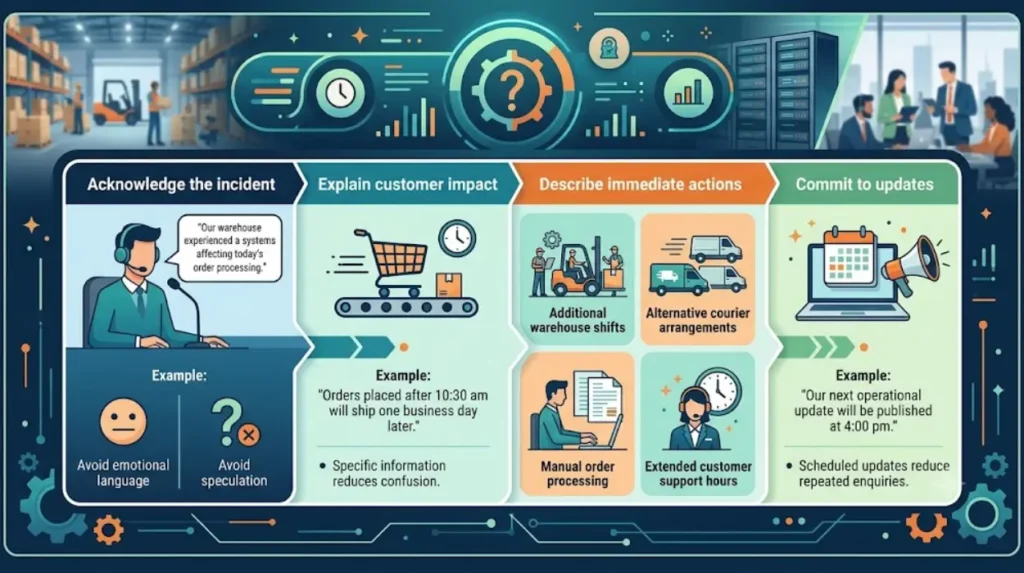
An effective rapid statement acknowledges the incident, explains confirmed facts, describes customer impact, outlines immediate actions, provides realistic timelines, identifies support channels, and commits to scheduled updates without speculation or unsupported promises regarding future developments or outcomes.
A structured statement improves clarity.
Each section serves one purpose.
Acknowledge the incident
State what has happened.
Example:
“Our warehouse experienced a systems outage affecting today’s order processing.”
Avoid emotional language.
Avoid speculation.
Explain customer impact
Describe exactly what customers experience.
Example:
“Orders placed after 10:30 am will ship one business day later.”
Specific information reduces confusion.
Describe immediate actions
Explain operational responses.
Examples include:
- Additional warehouse shifts
- Alternative courier arrangements
- Manual order processing
- Extended customer support hours
Commit to updates
Provide a fixed update schedule.
Example:
“Our next operational update will be published at 4:00 pm.”
Scheduled updates reduce repeated enquiries.
Which communication channels work best during a retail crisis?
Multiple communication channels ensure customers receive consistent information regardless of how they interact with the business. Coordinated messaging across owned, earned, and customer service channels strengthens transparency and reduces conflicting information throughout the response period effectively.
Different audiences access different channels.
No single platform reaches every customer.
Effective communication combines several channels.
Website updates
The company website becomes the primary source of verified information.
Status pages provide:
- Current incident status
- Operational updates
- Frequently asked questions
Email communication
Email reaches affected customers directly.
Emails include:
- Order-specific information
- Delivery revisions
- Compensation details
- Support contacts
Social media
Social platforms distribute updates rapidly.
Examples include LinkedIn, Facebook, Instagram, and X.
Messages remain brief and direct.
Each post links customers to detailed information.
Customer support
Support representatives use identical approved messaging.
Consistent scripts reduce conflicting answers.
How can businesses balance speed with accuracy?
Organisations balance speed and accuracy by separating confirmed facts from ongoing investigations, limiting statements to verified information, using pre-approved templates, and publishing scheduled updates whenever additional operational details become available through internal verification processes.
Verification remains essential.
Every statement requires factual confirmation.
Businesses verify:
- Operational status
- Delivery estimates
- Customer impact
- Recovery actions
Information not yet confirmed remains excluded.
Use approved templates
Templates accelerate publishing.
Standard sections include:
- Incident summary
- Customer impact
- Operational response
- Next update time
Only factual content changes.
Schedule regular updates
Predictable updates reduce speculation.
For example:
- Initial statement within 30 minutes
- Operational update after two hours
- Evening progress summary
- Recovery confirmation
Customers know when new information arrives.
How does crisis communication support long-term reputation?
Consistent crisis communication demonstrates accountability, operational control, transparency, and customer focus. These characteristics strengthen organisational credibility, reduce reputational damage, encourage repeat purchasing, and improve customer confidence after operational recovery has been completed successfully through structured communication practices.
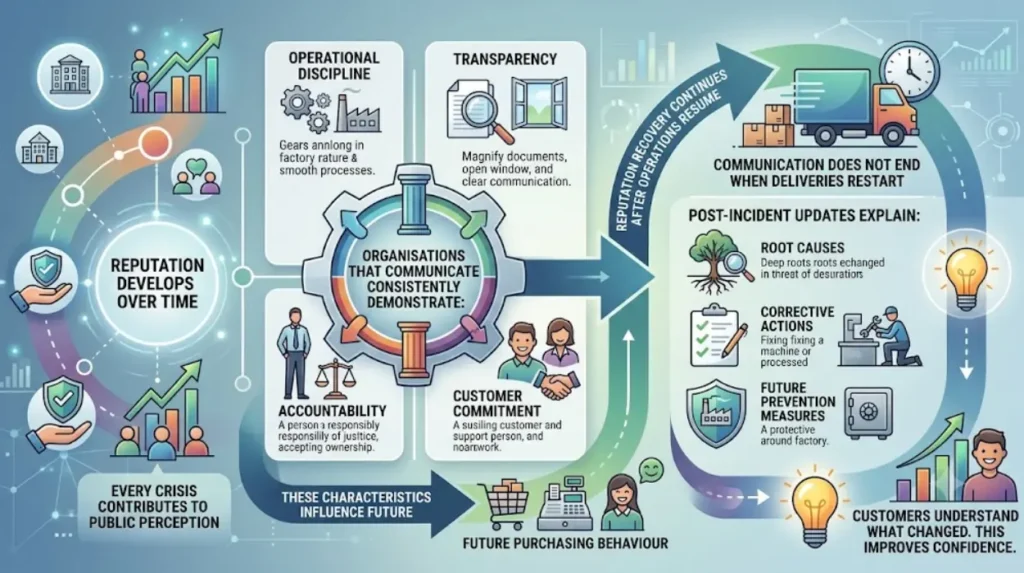
Reputation develops over time.
Every crisis contributes to public perception.
Organisations that communicate consistently demonstrate:
- Operational discipline
- Transparency
- Accountability
- Customer commitment
These characteristics influence future purchasing behaviour.
Reputation recovery continues after operations resume
Communication does not end when deliveries restart.
Post-incident updates explain:
- Root causes
- Corrective actions
- Future prevention measures
Customers understand what changed.
This improves confidence.
Explore More Expert Insights:
Crafting an Authoritative Press Release Layout for Major Inventory Clearances and Pivots
Maximizing Post-Launch Momentum: Turning Product Syndication into Long-Tail Search Traffic
When is professional PR distribution useful during a crisis?
Professional PR distribution becomes valuable when organisations require coordinated communication with journalists, industry publications, stakeholders, partners, and wider audiences. Structured distribution supports consistent messaging while maintaining accurate public information during significant operational or reputational events affecting business performance.
Large incidents attract media attention.
Examples include:
- Nationwide delivery disruption
- Major product recall
- Significant cyber incident
- Large-scale warehouse closure
These situations require communication beyond existing customers.
Professional distribution services help organisations:
- Reach verified media contacts
- Maintain consistent messaging
- Coordinate updates efficiently
- Reduce conflicting public information
Businesses evaluating structured distribution options can continue with:
Secure PR Distribution to understand how specialist services support vulnerable e-commerce businesses during high-pressure situations.
A crisis communication framework transforms emergency communication into a repeatable operational process. Instead of reacting under pressure, organisations follow documented procedures, publish verified information quickly, and maintain consistency across every communication channel.
For UK online retailers, rapid communication protects customer confidence by reducing uncertainty and providing realistic expectations. A successful framework defines responsibilities, streamlines approvals, uses multiple communication channels, and schedules regular updates until normal operations resume.
Strong crisis communication does not eliminate operational disruption. It ensures customers receive accurate information promptly, understand the organisation’s response, and retain confidence throughout the recovery process.