
Product syndication distributes consistent product information across multiple relevant media, publishing, search, and commerce channels. After launch, this creates additional indexed references, reinforces product entities, and gives search engines more evidence connecting the brand, product, category, and customer intent.
Product syndication is the structured distribution of product-related content across external websites and digital channels. It includes press releases, product announcements, industry publications, retailer pages, business directories, and relevant content platforms.
For a new product, launch-day coverage creates an initial visibility spike. That visibility often declines after the announcement. Post-launch syndication extends the content lifecycle by creating additional opportunities for discovery.
The process also supports search visibility. Each relevant publication creates another contextual reference to the product. Consistent naming, descriptions, categories, and links help establish a clearer digital identity.
Why does post-launch activity matter?
A product launch is a single event. Search demand continues after the launch date.
Consumers search for product names, features, alternatives, categories, use cases, prices, reviews, and problems the product solves. Post-launch content targets these different search behaviours.
For example, a boutique skincare brand launching a vitamin C serum can build content around searches such as “vitamin C serum for sensitive skin”, “UK vitamin C skincare”, and “brightening serum ingredients”.
This creates a broader search footprint than the original launch announcement.
How does product syndication turn launch coverage into long-tail search traffic?
Product syndication creates long-tail search opportunities by placing consistent product information across relevant indexed pages. These pages target specific queries, reinforce product terminology, generate referral paths, and extend visibility beyond the initial launch announcement.
Long-tail search traffic comes from specific, lower-volume queries. Examples include “vegan leather handbags made in Britain” and “waterproof running jacket for winter commuting”.
These searches often contain stronger intent because they identify a precise need.
Product syndication supports this process by distributing information that answers specific questions about a product. Search engines can encounter the product in multiple relevant contexts.
Which search elements need consistent optimisation?
Several elements influence how effectively syndicated content supports search discovery:
- Product name
- Product category
- Key features
- Customer use case
- Geographic relevance
- Brand name
- Product attributes
- Supporting terminology
- Relevant landing-page links
For example, a UK footwear company launching recycled running shoes can consistently use terms such as “recycled running shoes”, “sustainable running footwear”, and “UK running shoes”.
Consistency prevents fragmented product descriptions across different publications.
The content also needs factual accuracy. Product specifications, pricing information, availability, materials, and launch dates must remain aligned across syndicated placements.
What content should brands syndicate after a product launch?
Post-launch syndication works best when content addresses different stages of product discovery. Product updates, customer-use information, technical details, industry developments, partnerships, and relevant announcements provide fresh reasons for publications and search engines to reference the product.
A single press release does not provide enough content for sustained search coverage. Brands need different news angles connected to legitimate developments.
Which post-launch content types generate additional search opportunities?
Useful content formats include:
Product updates: New versions, features, packaging changes, or availability announcements provide fresh search contexts.
Industry developments: A product connected to a significant sector trend can gain contextual relevance. For example, a smart home device launch can connect with energy-efficiency developments.
Partnership announcements: Retail partnerships, distribution agreements, and collaborations create new entities and search relationships.
Customer use cases: Specific applications help target searches based on problems and use situations.
Founder or expert commentary: Relevant commentary can connect a product with wider industry topics.
Geographic announcements: UK-specific launches, regional availability, and retail expansion create location-based search opportunities.
These formats support a content ecosystem rather than repeated versions of the same announcement.
Brands also need editorial variation. Repeating identical copy across dozens of websites provides less useful context than creating distinct, fact-based stories around genuine developments.
How should syndicated product content be structured for long-tail keywords?
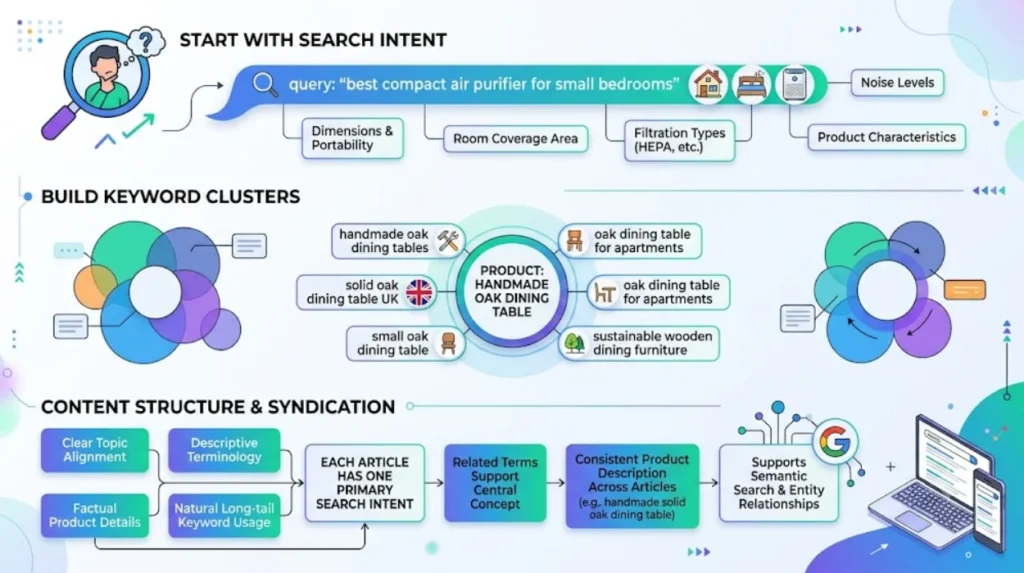
Syndicated product content needs clear topic alignment, descriptive terminology, factual product details, and natural long-tail keyword usage. Each article needs one primary search intent supported by related terms that accurately describe the product and its use.
Long-tail optimisation starts with search intent.
A query such as “best compact air purifier for small bedrooms” expresses a specific need. Content addressing that query needs information about dimensions, room coverage, filtration, noise levels, and relevant product characteristics.
How can keyword clusters improve product visibility?
Keyword clusters group closely related searches around one topic.
For a boutique furniture company, a cluster could include:
- handmade oak dining tables
- solid oak dining table UK
- small oak dining table
- oak dining table for apartments
- sustainable wooden dining furniture
The product remains the central entity, while each term addresses a different aspect of search intent.
Syndicated content can then distribute these concepts across relevant stories.
The approach also supports semantic search. Search engines evaluate relationships between entities and concepts rather than relying only on exact keyword repetition.
A product described consistently as a “handmade solid oak dining table” gains stronger contextual alignment with related searches when surrounding content discusses oak furniture, dining spaces, British manufacturing, dimensions, and sustainable materials.
How can internal links strengthen post-launch search performance?
Internal links connect syndicated traffic with relevant pages on the brand website. They direct visitors from external coverage toward product, category, buying, and informational pages while helping search engines understand relationships between related website content.
Syndication creates external discovery. Internal linking controls what happens after visitors reach the website.
A press mention can link to a product page. The product page can link to a category page. Supporting articles can then connect to buying guides, FAQs, and related products.
This creates a structured information pathway.
Where should internal links point?
Relevant destinations include:
- Product pages
- Category pages
- Product comparison pages
- Buying guides
- Technical specifications
- FAQs
- Supporting educational articles
Anchor text needs to describe the destination accurately.
For example, a link using “UK sustainable running shoes” provides clearer context than a generic phrase such as “click here”.
Internal links also connect funnel stages. Brands building awareness through:
Continuous press coverage can direct relevant audiences towards deeper educational content.
The purpose is not to add links to every page. Each link needs a clear relationship with the surrounding content.
How frequently should brands syndicate content after launch?
Post-launch syndication needs a planned cadence based on genuine business developments. Monthly product updates, quarterly campaigns, seasonal announcements, partnerships, and industry news provide defined opportunities without relying on repetitive announcements.
Frequency needs to follow news value.
A brand launching a product in January can create several legitimate content opportunities throughout the year. February can focus on a new retail partnership. April can address a seasonal use case. June can announce a product enhancement. September can cover expanded distribution.
This creates sustained visibility without rewriting the same launch story.
What does a practical 12-month cadence look like?
A structured programme can include:
Month 1: Product launch and core announcement.
Month 2: Distribution or retail development.
Month 3: Product feature or technical update.
Month 4: Relevant industry commentary.
Month 5: Customer use case.
Month 6: Partnership or expansion announcement.
Months 7–9: Seasonal product relevance, new availability, or product developments.
Months 10–12: Annual milestones, new launches, partnerships, or updated product information.
The exact schedule depends on the number of genuine developments available.
Consistency matters more than arbitrary publishing volume.
How can brands measure long-tail traffic from product syndication?
Measurement requires tracking organic impressions, clicks, indexed pages, referral traffic, ranking queries, landing-page engagement, and conversions. These metrics show whether syndicated content expands search visibility and contributes qualified traffic after the launch period.
Search performance needs measurement beyond media placement counts.
A brand can track which queries generate impressions, which syndicated pages receive organic traffic, and which referrals send visitors to the website.
Which metrics matter most?
Organic impressions: Shows how often product-related pages appear in search results.
Organic clicks: Measures visits generated from search results.
Search queries: Identifies the specific terms connecting users with the product.
Indexed pages: Shows how many relevant external and owned pages appear in search indexes.
Referral traffic: Measures visitors arriving from syndicated coverage.
Engagement: Tracks behaviour after visitors reach the website.
Conversions: Connects traffic with purchases, enquiries, registrations, or other defined business outcomes.
Google Search Console can identify search queries and page performance. Website analytics can then connect referral and organic traffic with engagement and conversion activity.
Tracking also reveals content gaps. If users search for a product feature that existing content does not address, the brand has a clear opportunity for another relevant article or announcement.
What are the main benefits of turning product syndication into long-tail search traffic?
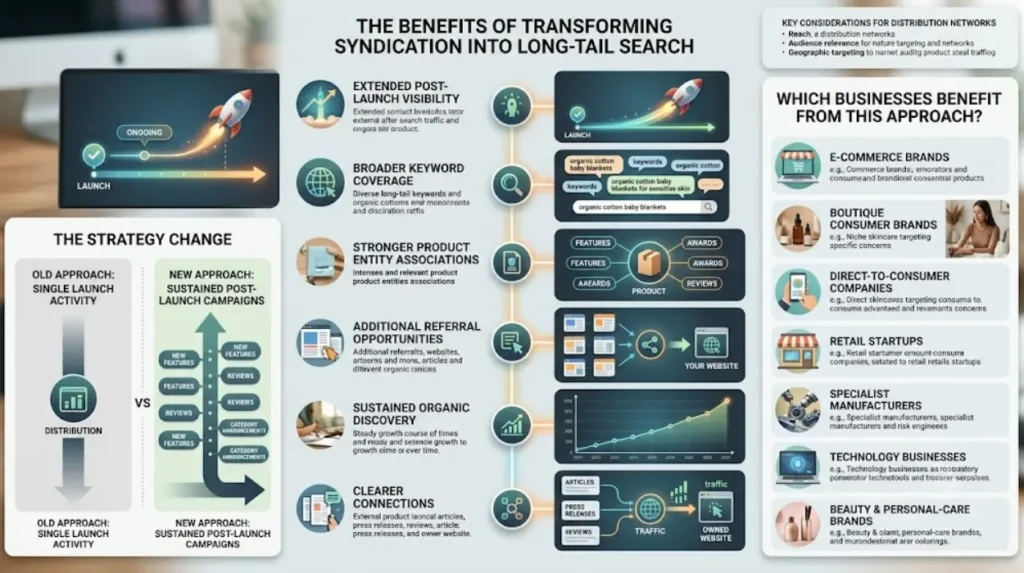
The main benefits include extended post-launch visibility, broader keyword coverage, stronger product entity associations, additional referral opportunities, sustained organic discovery, and clearer connections between external coverage and owned website content.
The strategy changes the role of syndication.
Instead of treating distribution as a single launch activity, brands can use legitimate post-launch developments to build a longer search presence.
Which businesses benefit from this approach?
This strategy is relevant to:
- E-commerce brands launching new products
- Boutique consumer brands
- Direct-to-consumer companies
- Retail startups
- Specialist manufacturers
- Technology businesses
- Beauty and personal-care brands
A niche boutique brand, for example, can use product updates and category-specific announcements to target searches that large retailers do not directly address.
For brands evaluating distribution options,
Press release distribution networks provide another consideration: reach, audience relevance, geographic targeting, reporting, and the ability to support sustained campaigns.
The key requirement is relevance. Distribution needs to reach publications and audiences connected to the product category.
Explore More Expert Insights:
Designing a Press Distribution Strategy for Strategic Co-Branded Retail Partnerships
Timing Your Campaign: How to Synchronize Press Releases with Major Seasonal Sales Events
How can brands build a sustainable post-launch syndication strategy?
A sustainable strategy combines genuine news, consistent product terminology, long-tail keyword targeting, relevant distribution, internal linking, and performance measurement. The objective is sustained discovery through useful content rather than repeated publication of identical launch announcements.
The process starts with the product entity and its search demand.
Brands then identify related long-tail queries, map those queries to legitimate post-launch developments, distribute relevant content, connect coverage with owned pages, and measure resulting search behaviour.
This approach supports both users and search engines.
It also creates a clear progression from launch visibility to sustained discovery. Each new development adds another relevant reason for audiences to encounter the product.
Post-launch momentum therefore depends on more than publishing frequency. It depends on the quality, relevance, consistency, and search alignment of every piece of syndicated content.