

A public sector wire is a specialised press distribution channel designed for government, charity, and public interest announcements requiring accuracy, compliance, and targeted media delivery across regulated information environments.
A public sector wire distributes official announcements to journalists, public sector publications, trade media, regional outlets, and digital news platforms. It supports organisations announcing government grants, funding programmes, public initiatives, and community investment projects.
Large government grant announcements require structured communication because they involve public funds, regulatory requirements, and stakeholder accountability. A standard press distribution approach often lacks the targeting and compliance controls required for public sector communication.
A compliant public sector wire connects grant announcements with relevant audiences while maintaining factual accuracy. It ensures that funding details, eligibility information, timelines, and organisational responsibilities appear correctly across media channels.
Public sector announcements include:
- Government-backed funding programmes
- Charity grant awards
- Local authority investment announcements
- Research and innovation funding
- Infrastructure development grants
A structured media footprint also supports organisations seeking future funding opportunities. The earlier stages of this process connect with topics covered in:
Structured media footprint, where organisations build credibility before approaching major funding announcements.
Why do government grant announcements require a compliance checklist?
Government grant announcements require compliance checklists because public funding communication must provide accurate financial information, transparent eligibility details, regulatory alignment, and consistent messaging across all distribution channels.
Public sector communication operates under higher accountability standards than general corporate announcements. Grant recipients, government departments, charities, and public bodies communicate information that affects communities, businesses, and taxpayers.
A compliance checklist reduces errors before distribution. It confirms that every announcement contains essential information required by journalists, stakeholders, and public sector audiences.
What information must a government grant announcement include?
A compliant grant announcement includes:
- Grant provider name
- Funding amount
- Purpose of funding
- Recipient organisation details
- Geographic impact area
- Project timeline
- Eligibility criteria
- Contact information
- Official statements from authorised representatives
For example, a UK charity receiving a £2 million community development grant needs to clearly identify the funding source, project objectives, delivery timeline, and expected public benefit.
Why does accuracy matter in public sector media distribution?
Accuracy protects institutional credibility. Incorrect funding figures, unclear project descriptions, or missing compliance information create confusion among journalists and stakeholders.
Public sector announcements often receive attention from:
- Local newspapers
- Government publications
- Sector-specific media
- Community organisations
- Policy-focused journalists
Each audience requires precise information that supports verification and responsible reporting.
How do organisations select the right public sector wire for grant announcements?
Organisations select a public sector wire by evaluating media reach, compliance features, sector targeting, reporting capability, distribution networks, and experience handling government-related announcements.
Choosing a wire service requires more than measuring the number of media contacts available. Public sector announcements need targeted delivery to relevant journalists and publications.
A suitable distribution partner understands UK public sector communication requirements. It provides access to media categories connected with government, charities, education, healthcare, housing, infrastructure, and community development.
What factors define a reliable public sector wire?
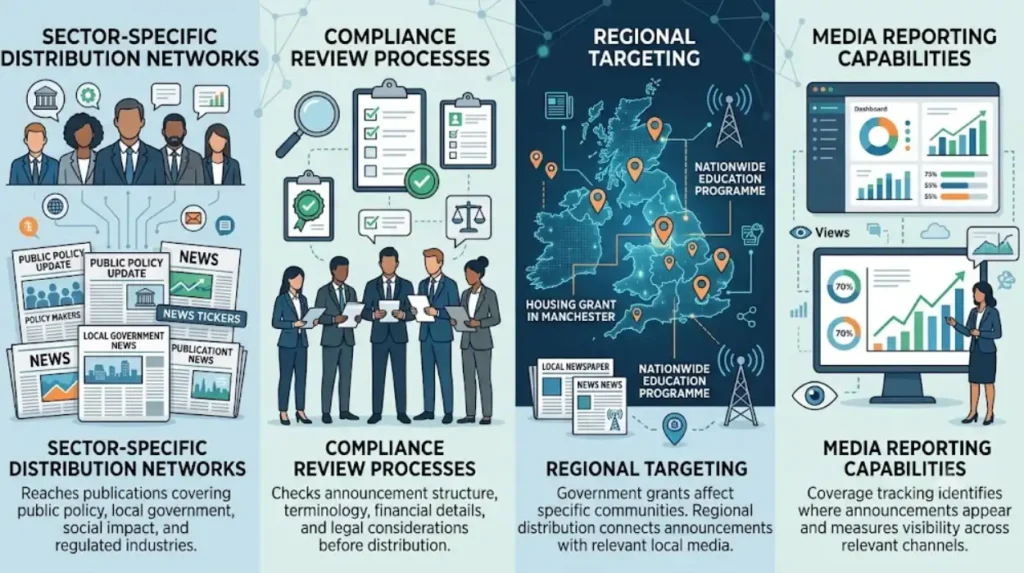
Key selection factors include:
Sector-specific distribution networks
A suitable wire reaches publications covering public policy, local government, social impact, and regulated industries.
Compliance review processes
A reliable service checks announcement structure, terminology, financial details, and legal considerations before distribution.
Regional targeting
Government grants often affect specific communities. Regional distribution connects announcements with relevant local media outlets.
For example, a housing regeneration grant in Manchester requires different media targeting from a nationwide education funding programme.
Media reporting capabilities
Coverage tracking identifies where announcements appear and measures visibility across relevant channels.
Why is UK media targeting important for government grant announcements?
The UK media environment includes national, regional, and specialist publications. Each channel serves different public sector audiences.
National outlets provide broad awareness. Regional publications highlight local impact. Trade publications reach professional communities connected with specific sectors.
A public sector wire must match distribution routes with announcement objectives.
What compliance checks are required before distributing a government grant press release?
Compliance checks confirm that grant announcements contain verified information, approved statements, accurate financial details, and appropriate messaging before reaching journalists and public audiences.
Pre-distribution checks reduce communication risks. They ensure that organisations publish information that aligns with funding agreements and public communication standards.
Which legal and factual details require verification?
Organisations verify:
- Funding amounts
- Grant provider identity
- Recipient information
- Dates and deadlines
- Project locations
- Official quotations
- Supporting statistics
Every figure requires confirmation. A funding announcement containing incorrect financial information damages trust and creates reporting problems.
How does approval management support compliance?
Approval management ensures authorised individuals review the announcement before publication.
Typical approval stages include:
- Draft preparation
- Internal fact checking
- Stakeholder approval
- Compliance review
- Final distribution
Government departments, charities, and funded organisations often involve multiple teams in approval processes. Clear responsibility prevents conflicting messages.
Why does language matter in public sector announcements?
Public sector language requires clarity and neutrality. Announcements must explain public benefits without creating misleading claims.
For example, a grant announcement must distinguish between confirmed funding and future project outcomes. Accurate terminology supports responsible journalism.
How does a public sector wire distribute large government grant announcements?
A public sector wire distributes grant announcements through targeted media networks, journalist databases, online news channels, regional publications, and sector-specific communication platforms.
Distribution begins after compliance approval. The wire service formats the announcement according to media requirements and delivers it to selected audiences.
What are the main stages of public sector wire distribution?
The distribution process includes:
1. Announcement preparation
The organisation prepares a press release containing verified grant information, supporting statements, and relevant background details.
2. Audience targeting
The distribution team identifies suitable media categories.
Examples include:
- Local government journalists
- Charity sector reporters
- Public policy editors
- Education correspondents
- Infrastructure publications
3. Media delivery
The press release reaches selected journalists and publications through established distribution networks.
4. Coverage monitoring
Organisations track published articles, mentions, backlinks, and audience engagement.
5. Reporting analysis
Coverage reports demonstrate media performance and communication outcomes.
A structured reporting approach connects announcement distribution with measurable visibility. Organisations reviewing advanced distribution strategies can explore [public sector wire distribution] to understand how professional services support high-value announcements.
What features separate premium public sector wire services from basic distribution platforms?
Premium public sector wire services provide specialist targeting, compliance support, detailed reporting, and sector-focused media access compared with basic platforms offering limited publication reach.
Basic distribution platforms focus on sending announcements widely. Premium services focus on reaching the correct audiences with controlled messaging.
Large government grant announcements require quality distribution because the information affects public stakeholders and institutional reputation.
Which service features support better grant announcement outcomes?
Important features include:
Government and policy media access
Specialist databases connect announcements with journalists covering public affairs and social impact.
Regional publication targeting
Local impact stories reach communities directly affected by funding decisions.
Editorial support
Professional review improves clarity, structure, and compliance before publication.
Coverage measurement
Detailed reporting shows where announcements appear and which audiences receive the information.
Why does specialist distribution matter for charities and public organisations?
Charities and public organisations often compete for attention among many funding-related announcements. Specialist distribution helps their announcements reach relevant media sectors.
A structured communication approach also supports future credibility. Organisations developing awareness strategies can review [media distribution planning] to understand how announcement timing and audience targeting influence visibility.
How does timing affect government grant announcement success?
Timing affects government grant announcement success because media availability, public events, policy schedules, and sector awareness periods influence journalist interest and audience attention.
Public sector announcements require strategic timing. Organisations consider government calendars, parliamentary activity, sector events, and relevant awareness periods.
A grant announcement released during a major policy event often receives different media attention compared with a release distributed during a quiet news period.
Which timing factors influence public sector announcements?
Key timing considerations include:
- Government funding cycles
- Budget announcements
- Parliamentary schedules
- Industry conferences
- National awareness campaigns
- Regional events
For example, an environmental grant announcement gains stronger relevance when connected with recognised sustainability discussions and sector developments.
Organisations planning announcement schedules can explore:
Timing your announcement to understand how distribution timing connects with broader media opportunities.
How can organisations measure the impact of a government grant announcement?
Organisations measure grant announcement impact through media coverage analysis, audience reach, publication quality, stakeholder engagement, and visibility across relevant public sector communication channels.
Measurement demonstrates whether the announcement reached intended audiences and created meaningful awareness.
A professional coverage report evaluates more than the number of published articles. It analyses the relevance and authority of media placements.
Which metrics measure public sector announcement performance?
Common measurement areas include:
- Number of media mentions
- Publication authority
- Regional coverage
- Audience relevance
- Website referral traffic
- Stakeholder engagement
- Search visibility
For example, a national infrastructure grant announcement requires measurement across construction media, regional newspapers, and policy publications.
Why is reporting important after distribution?
Reporting creates accountability. It shows stakeholders how communication investment supports transparency and public awareness.
Organisations use coverage reports to improve future announcements, refine targeting, and strengthen communication strategies.
What is the final checklist for selecting a public sector wire?

The final checklist evaluates compliance controls, media targeting, reporting features, sector expertise, and distribution capability before selecting a public sector wire for major government grant announcements.
Before choosing a distribution provider, organisations review essential requirements.
A complete checklist includes:
- Verified public sector media network
- UK regional targeting capability
- Compliance review process
- Government and charity sector experience
- Transparent reporting system
- Journalist targeting options
- Editorial support
- Coverage measurement tools
Explore More Expert Insights:
Enterprise Non-Profit PR: Evaluating Time Intelligence Media Group vs. Low-Tier Commercial Wires
Selecting the correct public sector wire ensures that large government grant announcements reach appropriate audiences with accurate information.
A professional distribution approach supports visibility, accountability, and public trust. It transforms grant communication from a simple announcement into a structured information process connecting organisations, journalists, and communities.



