B2B sponsored content gives UK businesses a structured way to publish commercial messages through established news and media environments. It combines brand messaging, audience targeting, editorial-style presentation, search visibility, and measurable distribution within a paid media placement.
For companies targeting business owners, executives, procurement teams, investors, and senior decision-makers, placement quality matters. The publication, topic, format, links, audience relevance, and distribution strategy all influence the commercial value of sponsored content.
Time Intelligence Media Group provides B2B sponsored content for brands seeking publication opportunities across relevant media environments. The service supports businesses that need controlled content placement, targeted exposure, and a clear publishing process.
What is B2B sponsored content?
B2B sponsored content is paid business-focused material published through a media platform to reach a defined professional audience, communicate a commercial message, strengthen brand visibility, and support measurable marketing objectives through structured distribution.
B2B stands for business-to-business. It describes products and services sold from one organisation to another organisation. Typical B2B buyers include company directors, procurement managers, finance leaders, marketing teams, technology managers, and department heads.
Sponsored content is paid media content created or commissioned by a brand and published through a media outlet or publishing platform. It differs from traditional editorial coverage because the business controls the commercial content and pays for placement.
A B2B sponsored article can explain a service, introduce a business, discuss an industry development, present research, or communicate a company announcement. The format remains informative while supporting a defined commercial objective.
What does B2B sponsored content include?
Common formats include:
- Sponsored articles
- Brand-led industry features
- Company announcements
- Expert commentary
- Research-led content
- Product or service explainers
- Executive thought leadership
- Industry trend articles
- Business case studies
For example, a UK cybersecurity provider can publish an article explaining new security requirements for SMEs while positioning its expertise within the subject.
Businesses entering the consideration stage can also review how B2B decision-makers engage with sponsored media content before selecting a publishing solution.
How does B2B sponsored content by Time Intelligence Media Group work?
Time Intelligence Media Group follows a structured sponsored content process covering content requirements, publication selection, article preparation, compliance review, media placement, publication confirmation, and post-publication reporting for UK-focused B2B campaigns.
The process starts with campaign requirements. These requirements establish the business objective, target audience, topic, preferred publication environment, content format, and campaign timing.
The next stage focuses on content preparation. The article needs a clear subject, factual claims, relevant terminology, and a defined commercial purpose. Content quality directly affects reader engagement and publication suitability.
Publication selection follows the campaign requirements. A B2B technology company requires different media relevance from a property consultancy, financial services provider, or professional training organisation.
Once the content and publication requirements are confirmed, the material moves through the publishing process. Publication details establish where the article appears and how the audience accesses it.
What happens after publication?
The published article becomes a permanent media asset according to the publication’s terms. Businesses can use the published coverage in marketing activity, sales communications, investor materials, social media, and internal reporting.
Post-publication information also provides evidence of delivery. This helps marketing teams record where the content appeared and how the campaign contributes to wider visibility objectives.
What does a B2B sponsored content campaign include?
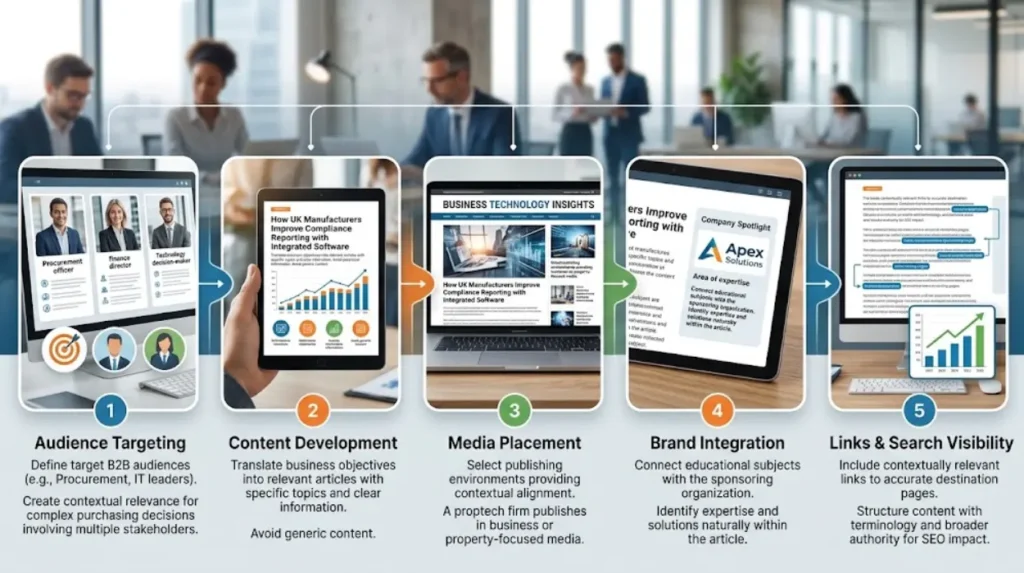
A B2B sponsored content campaign includes a defined audience, commercial objective, content asset, relevant media placement, publication requirements, brand messaging, search considerations, links, and reporting criteria that establish campaign value.
Audience targeting
Audience definition establishes who the campaign needs to reach. A B2B campaign can target procurement professionals, business leaders, finance directors, technology decision-makers, HR managers, or specialist industry audiences.
Audience relevance matters because B2B purchasing decisions involve multiple stakeholders. Content reaching the correct professional environment creates stronger contextual relevance than content distributed without a defined audience.
Content development
Content development translates the business objective into an article suitable for the selected publication.
A strong B2B article uses a specific topic and clear information. For example, a software provider can explain how UK businesses manage compliance reporting instead of publishing a generic article about software.
Media placement
Media placement determines the publishing environment. Relevant business publications provide contextual alignment between the subject and the intended audience.
A property technology company, for example, benefits from content placed within a business or property-focused media environment where readers already engage with related subjects.
Brand integration
Brand integration connects the educational subject with the sponsoring organisation. The brand remains relevant to the article rather than appearing as an unrelated promotional insertion.
Effective integration identifies the company, its area of expertise, and the solution connected to the article’s subject.
Links and search visibility
Sponsored content can contain links according to the publisher’s rules. Link placement needs contextual relevance and accurate destination pages.
Search visibility also depends on the article’s subject, terminology, structure, publication environment, and broader website authority. A sponsored article is one component of a wider SEO strategy.
Why do UK B2B companies use sponsored content?
UK B2B companies use sponsored content to control their message, access relevant professional audiences, establish media visibility, support campaigns, communicate expertise, and create published assets that contribute to wider marketing and search strategies.
B2B buying cycles often involve research before direct contact with a supplier. Decision-makers review company information, industry developments, service explanations, customer evidence, and specialist viewpoints before progressing to commercial conversations.
Sponsored content provides a controlled environment for communicating these messages.
A company also controls the core narrative. Traditional editorial coverage depends on independent newsroom decisions. Sponsored content gives the business greater control over the topic, positioning, key information, and campaign timing.
Which B2B sectors use sponsored content?
Sponsored content applies across sectors with professional audiences. Examples include:
- Financial services
- Fintech
- Technology
- Cybersecurity
- Professional services
- Property
- Construction
- Healthcare
- Manufacturing
- Recruitment
- Training and education
- Business consulting
A UK fintech company can use sponsored content to explain payment infrastructure. A construction consultancy can publish guidance about project compliance. A professional training provider can publish content about workforce development.
Each campaign uses subject relevance to connect the brand with its intended business audience.
How does sponsored content reach B2B decision-makers?
Sponsored content reaches B2B decision-makers through relevant publication environments, subject-specific content, professional terminology, targeted media placement, search visibility, and distribution channels that connect business information with active commercial audiences.
Decision-makers consume information across multiple channels. These include business publications, trade media, search engines, company websites, newsletters, professional networks, and industry resources.
Sponsored content enters this research environment through established publishing channels.
The subject also determines audience relevance. A procurement manager searching for supplier evaluation guidance responds to different content from a technology director researching cloud security.
This is why topic selection forms an important part of B2B sponsored content strategy.
Businesses evaluating audience behaviour can explore:
B2B Brands to understand the role of sponsored content within the wider B2B marketing journey.
What makes content relevant to decision-makers?
Relevant content answers a defined business question.
Examples include:
- How a new regulation affects UK companies
- How businesses evaluate a technology solution
- How procurement teams compare suppliers
- How finance departments manage operational costs
- How organisations implement a new business process
Specific questions create stronger informational relevance than broad promotional statements.
What business outcomes can B2B sponsored content support?
B2B sponsored content supports brand awareness, professional audience reach, thought leadership, website visibility, campaign communication, search discovery, referral traffic, and sales enablement when content, placement, and measurement align with defined business objectives.
The outcome depends on the campaign objective.
A brand awareness campaign prioritises visibility and audience exposure. A thought leadership campaign prioritises expertise and subject authority. A demand-generation campaign connects educational content with relevant commercial resources.
Sponsored content also creates reusable marketing assets.
How can published content support sales teams?
Sales teams can use published articles as supporting resources during prospect conversations.
For example, a UK technology provider can share a published article explaining an industry challenge with a prospect researching that subject. The article provides external media context for the conversation.
Marketing teams can also repurpose published coverage across campaign materials, social posts, newsletters, presentations, and company communications, subject to publisher rights and usage terms.
What should businesses check before buying B2B sponsored content?
Businesses should check publication relevance, audience alignment, content requirements, disclosure rules, link policies, publication timing, reporting, pricing, revision limits, and campaign deliverables before purchasing B2B sponsored content from any media provider.
Is the audience relevant?
Audience relevance comes first. A high-traffic publication does not automatically provide strong B2B value if its readership does not match the campaign.
What are the publication requirements?
Businesses need to understand article length, image specifications, topic restrictions, approval procedures, disclosure requirements, and publishing timelines.
What links are permitted?
Link policies differ between publishers. Businesses need clear information about destination URLs, anchor text, link attributes, and placement rules.
What reporting is provided?
Reporting establishes whether the contracted placement was delivered. Useful reporting records publication details, URLs, dates, and available performance information.
What does the service cost?
Pricing depends on publication selection, content requirements, distribution scope, campaign complexity, and additional services. Businesses need a defined deliverable before comparing prices.
Why choose Time Intelligence Media Group for B2B sponsored content?
Time Intelligence Media Group provides B2B sponsored content with a structured publishing process, UK market focus, campaign-led content requirements, media placement support, and publication delivery designed for businesses targeting professional decision-makers.
The service is designed for companies that require a controlled route into sponsored media publishing.
Time Intelligence Media Group supports the process from campaign planning through publication. Businesses define the subject, audience, messaging, and publishing requirements before content moves into production and placement.
This structure creates a clear commercial workflow.
Who can use the service?
The service fits B2B organisations seeking sponsored media exposure. Examples include technology companies launching solutions, financial brands communicating industry expertise, professional services firms building visibility, and UK SMEs promoting specialist offerings.
The campaign remains connected to the company’s business objective rather than operating as a standalone publishing exercise.
Explore More Expert Insights:
How Sponsored Content Builds 15 Backlinks for UK Brands
How to Write Sponsored Content That Ranks and Converts
How can a business start a B2B sponsored content campaign?
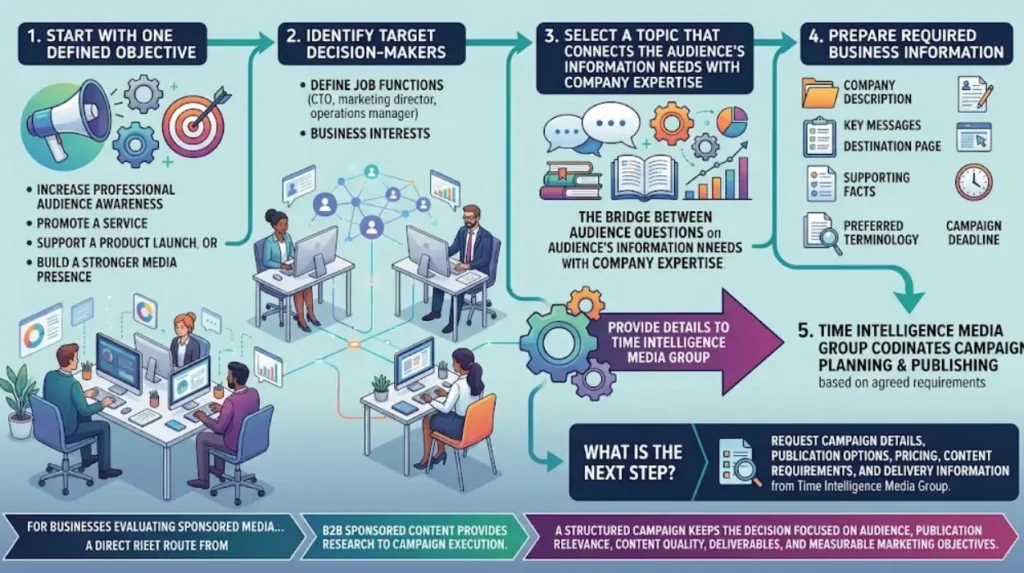
A business can start by defining its audience, objective, topic, preferred publication environment, content requirements, links, timing, and reporting needs, then provide these details to Time Intelligence Media Group for campaign planning and publishing coordination.
Start with one defined objective. Examples include increasing professional audience awareness, promoting a service, supporting a product launch, or building a stronger media presence.
Next, identify the target decision-makers. Define their job functions and business interests.
Then select a topic that connects the audience’s information needs with the company’s expertise.
Prepare the required business information, including company description, key messages, destination page, supporting facts, preferred terminology, and campaign deadline.
Time Intelligence Media Group can then coordinate the sponsored content publishing process based on the agreed campaign requirements.
What is the next step?
The next step is to request campaign details, publication options, pricing, content requirements, and delivery information from Time Intelligence Media Group.
For businesses already evaluating sponsored media as part of a broader acquisition strategy,
B2B sponsored content provides a direct route from research to campaign execution.
A structured campaign keeps the decision focused on audience, publication relevance, content quality, deliverables, and measurable marketing objectives.