

Sponsored articles are paid editorial-style pieces created to communicate a brand, product, service, or expertise through a publisher’s audience. Lead-generating sponsored content combines relevant information, clear audience intent, credible messaging, and a focused conversion path that moves readers towards measurable action.
What makes a sponsored article effective for lead generation?
A sponsored article generates leads when it addresses a defined audience problem, provides useful information, establishes credibility, presents a relevant solution, and directs readers towards one clear next step that captures identifiable interest and supports measurable conversion activity.
Lead generation starts with relevance. Readers engage when the article addresses a problem connected to their professional or purchasing responsibilities.
A sponsored article also needs a clear purpose. Awareness content explains an issue. Lead-generation content connects that issue with an identifiable action, such as requesting information, downloading a resource, registering for an event, or completing an enquiry form.
The article must also match reader intent. A person researching compliance requirements has different expectations from someone comparing software providers. Content that reflects this difference produces stronger engagement.
The publisher context also matters. A business technology article placed within a technology-focused publication reaches readers with stronger topical relevance than the same article placed within an unrelated category.
Why does audience relevance influence sponsored article conversions?
Audience relevance influences conversions because readers who recognise their industry, role, challenge, and purchasing context in an article have stronger reasons to continue reading, evaluate the information, and complete a relevant action after consuming the sponsored content.
Audience definition requires more than selecting an industry.
A B2B sponsored article can target:
- Procurement managers researching supplier solutions
- Finance directors evaluating cost controls
- Marketing managers assessing lead-generation channels
- Technology leaders reviewing software options
- Human resources managers investigating workforce solutions
Each audience has different information requirements.
For example, a finance director evaluating financial software focuses on reporting, integration, compliance, cost control, and operational efficiency. A marketing manager evaluating the same category focuses on attribution, campaign performance, customer acquisition, and reporting.
Sponsored content converts more effectively when the subject, examples, terminology, and information depth match the intended reader.
Audience relevance also affects traffic quality. High traffic from unrelated readers produces weaker lead-generation results than smaller volumes of visitors with strong commercial relevance.
How does the structure of a sponsored article affect lead generation?
Article structure affects lead generation by controlling how readers discover the problem, understand its impact, evaluate relevant information, and reach the conversion point without losing context, attention, or confidence during the reading journey.

A strong structure follows a logical information sequence.
Problem identification
The opening establishes the issue. It defines what the reader needs to understand and why the topic matters.
Context and evidence
The article explains the wider situation. It includes facts, industry terminology, processes, examples, and measurable information.
Solution relevance
The content explains the categories of solutions available without turning the article into a sales page.
Action point
The final section provides a relevant next step. The action must connect directly to the information presented earlier.
This structure reduces unnecessary movement between unrelated topics.
For example, an article about reducing procurement costs can begin with cost-control challenges, explain common sources of procurement inefficiency, examine evaluation methods, and then direct readers towards a relevant resource.
The article structure itself creates the conversion pathway.
Readers understand the problem first. They then understand the available approach. The final action becomes a logical continuation of the information.
For a deeper explanation of article architecture, see:
Which elements make sponsored content more credible?
Credibility increases when sponsored content uses accurate information, transparent commercial context, specific evidence, expert terminology, relevant examples, and balanced explanations that help readers understand the subject before presenting any commercial conversion opportunity.
Credibility is essential because sponsored content has a commercial purpose.
Readers evaluate whether the information appears useful and trustworthy before engaging with an action.
Several elements support credibility.
Specific information
Specific figures, dates, processes, standards, and definitions provide greater informational value than general claims.
Relevant expertise
Technical subjects require accurate terminology. For example, a cybersecurity article needs to distinguish between phishing, ransomware, endpoint security, identity management, and network security.
Evidence
Research findings, industry statistics, documented processes, and clearly attributed expert statements strengthen informational quality.
Transparency
Sponsored content needs clear disclosure that the article is sponsored. Transparency establishes the commercial context rather than disguising it.
Consistency
The headline, article body, examples, and final action need to address the same subject. A mismatch between the article topic and conversion destination creates friction.
Credibility does not require removing commercial intent. It requires placing commercial information within a useful and relevant editorial context.
How does the headline influence sponsored article lead generation?
The headline influences lead generation by establishing the article’s subject, audience relevance, and expected information value before a reader opens the content, making precise wording essential for attracting qualified readers rather than generating irrelevant clicks.
A headline determines the initial expectation.
Effective sponsored article headlines identify a clear subject or problem. They avoid vague promotional language and communicate a defined information benefit.
For example:
- “How UK Businesses Reduce Procurement Costs”
- “What Finance Teams Need to Know About Digital Reporting”
- “How Manufacturers Improve Supply Chain Visibility”
- “What HR Leaders Need to Know About Workforce Planning”
These headlines establish context immediately.
The headline also affects traffic quality. A broad headline can attract high volumes of unrelated visitors. A specific headline filters the audience before the article begins.
Keyword relevance is another consideration. Search-oriented sponsored content benefits from terminology that reflects how the intended audience describes the subject.
However, keyword inclusion must remain natural. Repeating a target phrase without adding contextual meaning reduces readability and weakens topical clarity.
The headline, introduction, subheadings, and article body need to reinforce the same central entity and topic.
What role does the call to action play in sponsored article conversions?
A call to action converts reader interest into measurable behaviour by identifying one relevant next step, such as downloading information, requesting details, registering for an event, or submitting an enquiry related directly to the article topic.
A call to action, often abbreviated as CTA, is an instruction that tells a reader what to do next.
Sponsored articles benefit from focused CTAs.
Common examples include:
- Download the industry guide
- Request further information
- Register for the webinar
- Explore the research report
- Submit an enquiry
- Book a consultation
The action needs to match the reader’s stage of awareness.
An educational article about supply chain risks can direct readers towards a detailed research report. An article explaining a specific technology category can direct readers towards product information.
Multiple competing CTAs create unnecessary choice. A reader presented with several unrelated actions has less clarity about the intended next step.
CTA placement also matters. The action can appear after sufficient context has been provided. The article first establishes relevance and information value. The CTA then provides a logical continuation.
The conversion destination must also match the promise made by the CTA. A link labelled “Download the guide” needs to lead to the stated guide.
Which factors determine whether sponsored article leads are qualified?
Lead quality depends on audience fit, topic relevance, intent, conversion requirements, and the information captured during the action, because lead volume alone does not demonstrate that sponsored content has attracted commercially relevant prospects.
A lead is not automatically a qualified prospect.
Lead qualification evaluates whether a person matches defined business criteria.
Important factors include:
Audience fit
The individual works within the intended market, organisation type, or professional role.
Topic intent
The individual demonstrates interest in the subject connected to the offering.
Conversion behaviour
The individual completes a meaningful action rather than simply visiting the article.
Information quality
The conversion process captures useful information, such as business email address, organisation, job role, or stated requirement.
Commercial relevance
The enquiry relates to a genuine business requirement.
For example, 500 article visitors can produce less commercial value than 80 visitors from procurement professionals actively researching supplier management.
Lead quality therefore requires measurement beyond page views.
Useful metrics include:
- Article traffic
- Engaged sessions
- Average engagement time
- CTA clicks
- Conversion rate
- Form completions
- Download completions
- Qualified leads
- Cost per qualified lead
These metrics connect sponsored content performance with lead-generation outcomes.
When does sponsored content work best for lead generation?
Sponsored content works best for lead generation when the publisher audience matches the target market, the topic addresses an active information need, the article provides substantive value, and the conversion action directly follows the reader’s information journey.
Sponsored articles suit several lead-generation situations.
New category education
Businesses introducing unfamiliar technologies or services can use sponsored content to explain the category before readers evaluate providers.
Complex B2B purchases
Longer purchasing cycles require information. Articles can explain terminology, processes, risks, evaluation criteria, and implementation considerations.
Industry-specific problems
Specialised audiences respond to content addressing defined operational challenges. Examples include financial compliance, healthcare technology, construction management, cybersecurity, and procurement.
Research-led campaigns
Reports, surveys, and original research provide natural conversion opportunities. Readers access the research after engaging with its key findings.
Event promotion
Conference and webinar content can explain the event topic, audience relevance, speakers, and learning outcomes before directing readers towards registration.
The strongest applications share one characteristic: the article provides information that naturally leads to a measurable action.
What should businesses measure after publishing a sponsored article?
Businesses need to measure traffic quality, engagement, conversion activity, lead quality, and cost efficiency to determine whether sponsored content creates meaningful demand rather than simply producing impressions, page views, or short-term website traffic.
Measurement starts before publication.
Campaign objectives define the metrics used to evaluate performance.
For lead generation, the measurement framework can include:
- Reach: Number of article impressions and visitors.
- Engagement: Time spent, scroll depth, and interaction levels.
- Interest: CTA clicks and destination-page visits.
- Conversion: Form submissions, registrations, or downloads.
- Lead quality: Percentage matching predefined audience criteria.
- Efficiency: Cost per lead and cost per qualified lead.
Tracking also requires consistent attribution.
UTM parameters identify traffic generated by specific sponsored campaigns. Conversion tracking connects article visitors with completed actions. CRM records connect those actions with subsequent sales activity.
This approach creates a clearer relationship between content exposure and business outcomes.
A sponsored article is therefore more than a published page. It is a measurable content asset with identifiable audience, information, engagement, and conversion stages.
Explore More Expert Insights:
Why B2B Brands Prefer News-Site Sponsored Content
How Sponsored Content Builds Backlinks and SEO Authority
How can sponsored articles create a complete lead-generation journey?
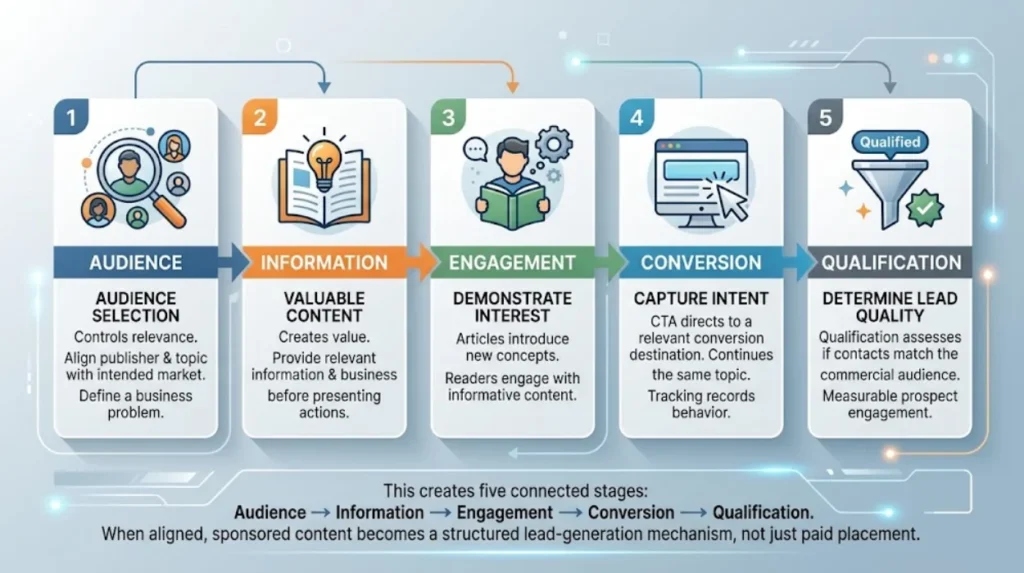
A complete sponsored article journey connects audience targeting, informative content, credible evidence, relevant messaging, focused calls to action, conversion tracking, and lead qualification into one continuous process from initial awareness through measurable prospect engagement.
The process begins with audience selection.
The publisher and topic need to align with the intended market. The article then defines a problem and explains its business context.
The content introduces relevant information before presenting the next action. The CTA directs readers towards a conversion destination that continues the same topic.
Tracking records the resulting behaviour. Lead qualification then determines whether the resulting contacts match the intended commercial audience.
This creates five connected stages:
Audience → Information → Engagement → Conversion → Qualification
Each stage has a specific function.
Audience selection controls relevance. Information creates value. Engagement demonstrates interest. Conversion captures measurable intent. Qualification determines lead quality.
When these stages remain aligned,
Sponsored content becomes a structured lead-generation mechanism rather than simply a paid article placement.
The central principle is straightforward: a sponsored article converts into leads when every part of the reader journey supports the same audience need and the same measurable objective.



