

Sponsored content that ranks and converts combines search-focused structure, useful information, clear commercial relevance, and strong calls to action. It answers search intent, satisfies readers, establishes topical relevance, and moves qualified visitors towards a defined business action.
Sponsored content is paid editorial-style content created to promote a brand, product, service, or business objective. Unlike a traditional advertisement, it uses an article format to provide information while supporting a commercial goal.
Ranking depends on more than placing a target keyword in the headline. Search visibility depends on relevance, content depth, information quality, page structure, internal relationships, and alignment with the query.
Conversion adds another requirement. The article needs a clear next step. That action can involve requesting information, comparing solutions, downloading a resource, contacting a provider, or visiting a service page.
For readers developing a stronger understanding of search-focused sponsored content, ranking sponsored content provides useful context on the factors that influence Google visibility.
How do you define the search intent before writing?
Search intent defines the information or action a user expects from a query. Sponsored content performs better when its topic, structure, terminology, examples, and commercial direction match the intent behind the target search.
Start by identifying the primary query. Then classify the intent. Common categories include informational, commercial investigation, navigational, and transactional intent.
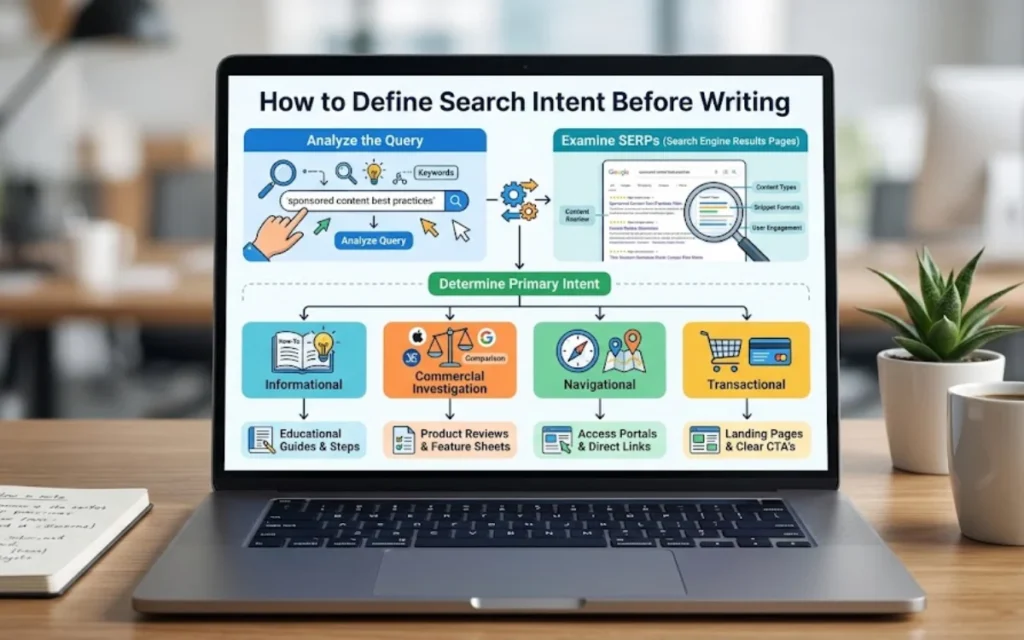
For example, the query “how to write sponsored content” has an informational focus. The searcher wants a process. The query “best sponsored content distribution service UK” has commercial investigation intent. The searcher wants to evaluate available solutions.
How does intent affect the article structure?
Intent determines the questions the article answers.
An informational sponsored article needs definitions, processes, examples, and explanations. A commercial investigation article needs comparisons, evaluation criteria, costs, capabilities, and decision factors.
The content structure must reflect the expected journey. A user searching for a writing process needs practical guidance before commercial information.
How do you identify the conversion objective?
Define one primary conversion before drafting.
Examples include:
- Requesting a sponsored content campaign
- Contacting a media distribution provider
- Reviewing publication options
- Downloading a campaign guide
- Visiting a relevant service page
A single primary objective prevents competing calls to action from weakening the page.
What content structure helps sponsored content rank?
A ranking-focused sponsored article uses a clear hierarchy built around the primary query, supporting questions, related entities, factual explanations, examples, and useful subtopics. Structure makes the content easier for users and search systems to interpret.
A strong structure follows the user’s information journey:
- Define the subject.
- Explain the search problem.
- Present the writing process.
- Explain important content components.
- Show how ranking and conversion work together.
- Address practical use cases.
- Provide an appropriate next step.
Which elements belong near the beginning?
The opening section needs a direct definition and clear relevance.
Do not begin with general statements about digital marketing. Start with the subject. Explain what sponsored content is and what ranking and conversion mean within that context.
This improves topical clarity and gives readers immediate information.
How should supporting topics be organised?
Group related concepts into semantic clusters.
For sponsored content, relevant entities include:
- Search intent
- Keyword research
- Search engine results pages
- Editorial quality
- Content structure
- Internal linking
- Calls to action
- Conversion paths
- Audience relevance
- Media publication
- Brand visibility
- Search visibility
These terms establish the subject context without forcing repetitive keyword placement.
How should you use keywords in sponsored content?
Keywords identify the search topic, but useful sponsored content uses them as part of a broader semantic framework. Primary, secondary, and related terms appear naturally within headings, paragraphs, examples, and supporting sections.
For this topic, useful variations include “sponsored content SEO”, “SEO sponsored articles”, “sponsored content marketing”, “sponsored article strategy”, “ranking sponsored content”, and “sponsored content conversion”.
How many times should the primary keyword appear?
There is no useful fixed repetition target. Forced repetition reduces readability and creates unnatural language.
Use the primary keyword where it provides clarity. Use semantic variations where they provide greater precision.
For example, a section about conversion does not need to repeat “sponsored content that ranks and converts” in every paragraph. Terms such as “commercial intent”, “conversion path”, and “call to action” communicate the same topical relationship more effectively.
How do examples improve keyword relevance?
Examples demonstrate the meaning of a concept.
Instead of stating that sponsored content needs commercial relevance, describe a UK technology company publishing an article explaining how its software addresses a specific operational problem.
The example connects the entity, problem, audience, product category, and search intent.
What makes sponsored content useful to readers?
Useful sponsored content answers a specific problem with accurate information, clear organisation, relevant examples, and practical detail. Commercial messaging remains connected to the subject instead of interrupting the reader’s information journey.
Readers need evidence that the article addresses their query.
A useful article defines technical terms, explains processes, identifies decision factors, and gives examples. It avoids unsupported claims and unnecessary promotional language.
How does editorial quality affect performance?
Editorial quality affects trust and engagement.
Strong sponsored content uses accurate facts, clear sentences, descriptive headings, relevant examples, and consistent terminology. It separates educational information from promotional claims.
For UK audiences, localisation also matters. British spelling, UK terminology, relevant regulations, local market references, and UK-specific examples improve contextual relevance.
Why does original information matter?
Original information gives readers a reason to consume the article.
Original value can come from a structured process, industry-specific examples, proprietary observations, campaign data, expert commentary, or detailed comparisons.
A generic article that repeats information available across hundreds of pages provides limited differentiation.
How do you write sponsored content that converts without over-selling?
Conversion-focused sponsored content connects the reader’s problem to a relevant solution, explains the solution clearly, establishes its practical value, and presents one logical next action without turning the article into a continuous sales message.
The commercial section belongs after sufficient educational context.
For example, an article about sponsored content can explain search intent, structure, keyword use, editorial standards, and conversion principles before introducing professional content distribution as one solution type.
Where should the call to action appear?
Place the main call to action after the article establishes relevance.
A secondary contextual link can appear earlier when it supports the reader’s current question. The final call to action provides a clear decision point.
Avoid placing multiple competing actions in every section.
What makes a call to action effective?
A strong CTA describes the next action clearly.
Examples include:
- Review sponsored content options
- Request a campaign assessment
- Explore ranking-focused content services
- Discuss UK media publication requirements
The CTA needs to match the article’s funnel stage. MOFU readers are evaluating approaches rather than making an immediate purchase.
How do internal links strengthen sponsored content?
Internal links connect related pages into a clear topical structure. They help users discover supporting information while establishing relationships between educational, evaluation, and commercial content within the same website.
Internal links work best when the destination directly supports the surrounding topic.
Use descriptive anchor text. Avoid generic anchors such as “click here”.
When readers move from education into solution evaluation, ranking sponsored content services provides a commercial next step.
The links form a funnel:
Education → Evaluation → Commercial decision
This structure supports both user navigation and topical relationships between pages.
Which elements improve conversion rates in sponsored articles?
Conversion improves when the article addresses a defined audience, demonstrates relevance, explains the solution, reduces uncertainty, and provides a clear next action. Search visibility attracts visitors, while content quality moves relevant visitors towards conversion.
Several elements work together.
Audience specificity
Define the reader clearly.
A sponsored article targeting UK fintech companies uses different terminology and examples from an article targeting hospitality businesses.
Problem clarity
State the business problem directly.
Examples include limited search visibility, weak media exposure, low qualified traffic, poor campaign attribution, or insufficient brand awareness.
Solution relevance
Connect the solution to the stated problem.
The transition needs to follow the article’s subject. A sudden promotional paragraph creates a disconnect between search intent and commercial intent.
Proof and evidence
Use specific evidence where available.
Relevant evidence includes publication numbers, campaign metrics, audience figures, process stages, delivery timelines, and documented outcomes.
Avoid unsupported superlatives such as “best”, “leading”, or “number one” unless verifiable evidence supports them.
When should businesses use sponsored content for search and conversion goals?
Businesses use sponsored content when they need to combine educational search visibility with commercial messaging. It fits campaigns targeting defined audiences, specific search topics, brand authority, product education, and measurable commercial journeys.
Sponsored content suits several UK business scenarios.
B2B lead generation
A B2B company can publish educational content addressing a problem that decision-makers actively research. The article then introduces a relevant solution.
Product education
Complex products require explanation before purchase. Sponsored content provides space for definitions, features, use cases, and evaluation criteria.
Brand visibility
Brands entering a competitive market can use sponsored content to establish contextual visibility around relevant subjects and industry entities.
Media-led campaigns
Businesses seeking publication across relevant media environments can combine editorial-style content with a defined search topic and conversion objective.
How do you measure whether sponsored content ranks and converts?
Measure sponsored content using separate visibility and conversion metrics. Rankings and organic impressions indicate search performance, while clicks, engagement, enquiries, and completed actions indicate commercial performance.
Track the article after publication.
Useful search metrics include:
- Keyword rankings
- Organic impressions
- Organic clicks
- Click-through rate
- Indexed status
- Search query coverage
Useful conversion metrics include:
- CTA clicks
- Landing-page visits
- Form submissions
- Qualified enquiries
- Conversion rate
- Assisted conversions
Why should ranking and conversion metrics remain separate?
A page can attract search traffic without generating qualified leads. Another page can generate conversions from a smaller but highly relevant audience.
Separate measurement identifies the actual weakness.
Low impressions indicate a visibility problem. Strong impressions with low clicks indicate a search-result presentation problem. Strong traffic with weak conversions indicates a content or offer problem.
This distinction creates a more accurate optimisation process.
What is the complete process for writing ranking sponsored content?
The complete process starts with search intent and audience definition, then moves through topic research, content architecture, drafting, optimisation, conversion planning, publication, measurement, and refinement based on observed search and user behaviour.
A practical workflow contains eight stages:
- Define the target audience.
- Identify the primary search intent.
- Research primary and semantic keywords.
- Write factual and useful sections.
- Add relevant commercial context and CTAs.
- Apply internal links and on-page SEO.
- Measure rankings, traffic, and conversions.
Each stage supports the next. Keyword research informs structure. Structure informs drafting. Drafting creates the information layer. Commercial context creates the conversion path.
The result is sponsored content designed for both discovery and action.
What is the key to sponsored content that ranks and converts?

The key is alignment. Search intent, content structure, semantic relevance, editorial quality, audience needs, commercial messaging, internal linking, and conversion objectives must all support the same user journey from search query to business action.
Ranking and conversion are connected but distinct objectives.
Search optimisation brings relevant users to the article. Useful content keeps the user engaged. Commercial relevance explains the available solution.
Explore More Expert Insights:
How Manchester Brands Publish Sponsored Content Fast
How London Sponsored Content Reaches UK National Readers
For UK businesses, strong sponsored content therefore requires more than keyword placement. It requires a defined search purpose, structured information, local relevance, credible detail, and a controlled conversion path.
This approach turns a sponsored article from a simple promotional placement into a structured search and marketing asset.



