
B2B sponsored content is paid content published through a media platform to communicate a business message to a defined professional audience. In the United Kingdom, this format connects brands with decision-makers through trusted news environments, industry publications, business websites, and specialist media channels.
Unlike conventional advertising, sponsored content uses an editorial-style format. It can present research, market analysis, executive insights, product information, case studies, or industry commentary. The content remains clearly identified as sponsored while using a structure familiar to professional readers.
For B2B marketers, the central objective is audience access. Decision-makers rarely consume business information from one source. They read national news, trade publications, specialist websites, professional newsletters, and industry analysis. Sponsored content places a controlled brand message within those established information environments.
Businesses considering this approach first need to understand why the format works, how distribution reaches relevant professionals, which content elements influence engagement, and where sponsored content fits within a wider B2B marketing strategy.
What is B2B sponsored content?
B2B sponsored content is paid media content created for professional audiences and distributed through relevant publishers, allowing businesses to communicate expertise, solutions, research, and commercial information directly within established media environments.
B2B stands for business-to-business. It describes transactions and relationships between organisations rather than direct sales to individual consumers.
Sponsored content is paid publication space containing branded editorial-style material. The publisher provides access to its audience, while the business supplies or approves the content according to the publication’s requirements.
Common B2B sponsored content formats include:
- Expert articles
- Industry reports
- Executive interviews
- Business case studies
- Research-led features
- Market commentary
- Product-led educational articles
- Company announcements
The format works particularly well when the purchasing process involves multiple stakeholders. A software purchase, financial service, consultancy agreement, or technology contract often involves executives, procurement teams, technical specialists, and department heads.
Sponsored content gives each audience group access to relevant information within a professional media context.
How does sponsored content reach B2B decision-makers?
Sponsored content reaches B2B decision-makers through publisher audiences, industry-specific distribution, relevant topics, search visibility, professional media channels, and targeted editorial environments where executives and purchasing stakeholders already consume business information.
Audience relevance starts with publication selection. A technology company targeting chief information officers requires a different media environment from a construction company targeting commercial directors.
Publishers organise audiences around subjects, sectors, locations, and professional interests. Examples include fintech publications, property websites, manufacturing media, healthcare business publications, and technology news platforms.
Audience targeting
Audience targeting identifies the professional group most relevant to the commercial objective.
A UK cybersecurity provider, for example, can focus content on publications read by technology leaders, security professionals, and business executives. A property consultancy can target commercial property audiences through specialist real estate publications.
This approach creates contextual relevance before a reader reaches the article.
Topic alignment
The subject of the sponsored article also determines audience relevance.
A generic article about business growth creates broad relevance. An article about UK fintech compliance creates a narrower professional audience. Narrower subjects often align more closely with specific decision-making roles.
The content therefore needs a clear relationship between the topic, audience, sector, and business objective.
Which content elements attract B2B decision-makers?

B2B decision-makers respond to content containing specific evidence, useful industry information, credible expertise, clear business implications, relevant examples, and practical details that support evaluation without relying on exaggerated promotional claims.
Decision-makers use professional content to evaluate information before taking commercial action. Content quality therefore depends on information value.
Evidence and data
Statistics provide measurable context. A technology company discussing cloud adoption can include adoption rates, implementation costs, security considerations, or operational metrics.
Specific figures provide stronger information value than statements such as “many businesses” or “rapid growth”.
Expert insight
Executive commentary gives sponsored content an identifiable professional perspective. A finance director discussing operational efficiency provides a different information layer from a generic product description.
The expert needs to explain a business issue rather than simply promote a company.
Practical information
Decision-makers require information that supports evaluation.
For example, a procurement audience researching contract management software needs information about implementation, integration, security, reporting, costs, and governance.
Content addressing these areas creates stronger relevance than an article focused entirely on brand promotion.
Why does publisher credibility matter for B2B audiences?
Publisher credibility matters because professional readers use established media environments to discover business information, assess industry developments, compare viewpoints, and identify relevant organisations before entering deeper research or commercial evaluation processes.
Publisher credibility influences the environment surrounding sponsored content.
Established UK business publications and specialist trade websites have defined audiences. Their readers visit for industry news, market developments, professional analysis, and company information.
Sponsored content does not convert a publication into an independent endorsement. The content remains paid media and needs appropriate disclosure. Its value comes from audience access and contextual placement.
Trust and transparency
Clear sponsored labels protect editorial transparency. Professional readers understand that the business funded publication of the content.
Transparent disclosure also separates sponsored material from independent editorial coverage.
Industry relevance
A specialist publication can provide stronger contextual relevance than a general website.
For example, a construction technology provider publishing through a construction-focused business publication reaches an audience already interested in construction operations, project management, procurement, and technology.
This creates a direct connection between subject matter and professional interest.
How does sponsored content support the B2B buying journey?
Sponsored content supports the B2B buying journey by introducing problems, explaining solutions, demonstrating expertise, answering evaluation questions, and directing interested professionals toward deeper information during research and consideration stages.
B2B purchasing involves several stages. These include problem recognition, research, solution comparison, supplier evaluation, internal approval, procurement, and purchase.
Sponsored content fits particularly well into the research and consideration stages.
Awareness
At the awareness stage, a decision-maker identifies a business problem.
For example, a finance leader recognises inefficient reporting across multiple business units. A sponsored article can explain the causes of fragmented reporting and establish the business context.
Consideration
During consideration, the reader evaluates possible approaches.
Content can explain implementation models, technology categories, operational requirements, compliance considerations, and selection criteria.
This stage creates a natural connection between educational content and solution awareness.
For readers moving beyond general education,
Why B2B Brands Prefer News-Site Sponsored Content provides a relevant next step into the wider role of sponsored content for B2B brands.
Evaluation
At the evaluation stage, decision-makers investigate specific providers.
This is where detailed case studies, technical explanations, service information, and evidence become more important.
A commercial audience can then move from media content to a dedicated solution page. For readers evaluating a provider directly,
B2B Sponsored Content by Time Intelligence Media Group creates a relevant transition into a specific sponsored content solution.
How can B2B brands measure sponsored content performance?
B2B brands measure sponsored content through publication reach, page views, engagement, referral traffic, branded searches, assisted conversions, lead activity, and content interactions linked to defined campaign objectives and tracking systems.
Measurement starts before publication. The campaign needs defined objectives and measurable outcomes.
Useful metrics include:
- Published media placements
- Article views
- Referral sessions
- Average engagement time
- Click-through rate
- Landing-page visits
- Lead submissions
- Branded search activity
- Assisted conversions
- Content-assisted revenue
Traffic measurement
UTM parameters connect referral traffic to specific sponsored content campaigns. Analytics platforms then identify sessions originating from publisher placements.
For example, a UK B2B software company can track traffic from a sponsored article separately from organic search, paid search, email, and social media.
Conversion measurement
Conversion tracking connects content exposure with business actions.
A conversion can involve a demo request, consultation enquiry, report download, registration, or contact form submission.
B2B attribution requires longer measurement periods because purchasing decisions often involve multiple interactions.
Which B2B sectors use sponsored content?
B2B sponsored content serves sectors where professional audiences research complex products, services, regulations, technologies, and business challenges before making purchasing decisions across multiple stakeholders and extended commercial buying cycles.
Sponsored content applies across technology, finance, professional services, property, construction, healthcare, manufacturing, education, logistics, energy, and business services.
Technology
Technology companies use sponsored content to explain software categories, cybersecurity risks, artificial intelligence applications, cloud infrastructure, and digital transformation.
Financial services
Financial brands use specialist business media to communicate market information, regulatory developments, investment perspectives, and financial technology developments.
Professional services
Consultancies and advisory firms use content to demonstrate expertise around tax, legal services, management, strategy, compliance, and operational improvement.
Property and construction
Property and construction businesses use sector publications to discuss development, investment, sustainability, project delivery, procurement, and construction technology.
The common factor is information complexity. Decision-makers require detailed information before committing organisational resources.
How should businesses choose a sponsored content strategy?
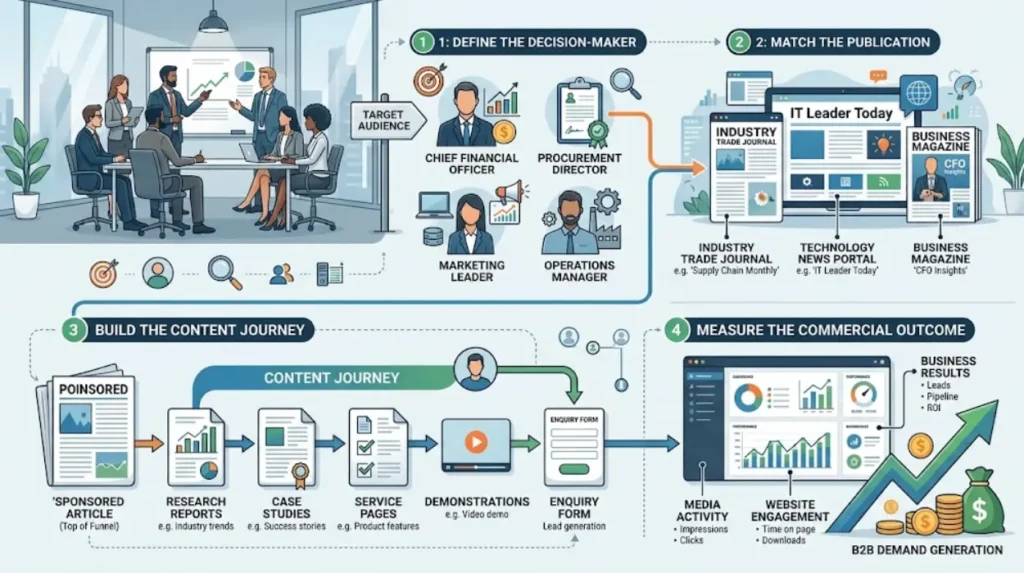
Businesses need to align publisher selection, audience roles, content topics, distribution objectives, tracking methods, and conversion pathways so every sponsored content placement contributes to a defined stage of the B2B buying journey.
The strategy begins with the audience rather than the publication.
First, identify the decision-makers and influencers involved in the purchase. Next, identify the questions they ask during research. Then select publications whose audiences match those professional roles.
Define the decision-maker
A B2B campaign needs a specific audience definition.
Examples include chief financial officers, procurement directors, marketing leaders, technology executives, operations managers, or business owners.
Match the publication
The publication needs an audience aligned with that role.
A single campaign can use multiple media environments when different stakeholders require different information.
Build the content journey
One sponsored article rarely provides every piece of information required for a complex purchase.
A stronger content journey connects media exposure with supporting resources such as research reports, case studies, service pages, demonstrations, and enquiry forms.
Measure the commercial outcome
Performance measurement needs to connect media activity with website engagement and business results.
This creates a clearer view of how sponsored content contributes to B2B demand generation.
What is the role of sponsored content in UK B2B marketing?
Sponsored content gives UK B2B brands a controlled way to reach professional audiences through relevant media environments, combining publisher distribution, specialist topics, measurable traffic, and structured information for complex purchasing decisions.
The strongest application is strategic rather than purely promotional. Sponsored content gives businesses control over the message, topic, timing, destination, and audience environment.
For UK brands, publication selection also provides regional and sector relevance. A London-focused business, a Manchester technology company, and a UK-wide financial services provider can select media environments aligned with their geographic and professional audiences.
The result is a structured media touchpoint within the wider B2B buying journey.
Explore More Expert Insights:
How Sponsored Content Builds 15 Backlinks for UK Brands
How to Write Sponsored Content That Ranks and Converts
Sponsored content does not replace search, email, events, organic editorial coverage, sales activity, or other demand-generation channels. It operates as one controlled component of a broader marketing system.
For businesses evaluating this channel, the key questions are straightforward: Who needs to see the content? Which publication reaches them? What information do they need? Where does the article send them? How will the resulting activity be measured?
Answering these questions creates a measurable B2B sponsored content strategy focused on reaching decision-makers with relevant information at the right stage of their research process.