

What Are Time Intelligence Media Group Research and Reports Services for UK Energy Brands?
Time Intelligence Media Group Research and Reports Services for UK Energy Brands deliver end-to-end original data generation, regulatory analysis, and media-ready report publication. These services enable UK energy suppliers, renewable developers, and utility technology providers to convert complex market data into authoritative industry publications.
Core Service Definition and Scope
Time Intelligence Media Group operates as an intelligence and media production agency for the United Kingdom energy sector. The research and reports division designs, executes, and publishes proprietary market studies. The service covers primary data collection across 5,000 UK domestic consumers or 1,000 commercial energy decision-makers, statistical modelling, graphic visualisation, and distribution to national and trade journalists.
The primary function of these services is establishing category authority. UK energy brands operate in a heavily regulated market governed by the Office of Gas and Electricity Markets (Ofgem). Establishing credibility requires verifiable data rather than promotional assertions. Time Intelligence Media Group provides the methodology, analytical rigour, and editorial framework necessary to meet the standards of major news outlets and institutional stakeholders.
Primary Service Offerings
- Market Sentiment and Consumer Research: Quantitative surveys tracking domestic and business energy consumption habits, tariff preferences, and sustainability adoption across England, Scotland, and Wales.
- Regulatory Impact Intelligence: Analytical reports evaluating the operational impact of Ofgem price cap adjustments, Smart Energy GB rollout benchmarks, and national grid connection queues.
- B2B Energy Transition Studies: Technical whitepapers examining commercial decarbonization strategies, industrial heat pump adoption rates, and corporate Power Purchase Agreement (PPA) trends.
- Media-Ready Executive Summaries: Condensed statistical briefs produced specifically for rapid newsroom distribution and financial analyst citation.
By engaging these services, energy companies move beyond traditional corporate public relations. They publish structured intelligence that journalists cite, regulators reference, and corporate buyers evaluate during procurement cycles.
How Does the Time Intelligence Media Group Research and Reports Process Work?
The Time Intelligence Media Group process follows a five-stage deployment methodology spanning eight to twelve weeks. This system includes research design, data collection, analytical modelling, editorial composition, and multi-channel media distribution across the United Kingdom market.
Stage 1: Hypothesis and Methodology Design
The process begins by establishing the primary research objective. Time Intelligence Media Group analysts work with internal brand teams to isolate critical industry questions. During this phase, the team determines sample sizes, geographic demographics, and statistical parameters. Research methodologies adhere to the standards of the Market Research Society (MRS).
Stage 2: Data Collection and Fieldwork
Data collection utilises two primary channels:
- Quantitative Consumer Panels: Nationally representative sampling across 2,000 to 10,000 UK households to evaluate consumer sentiment, smart meter utilisation, and energy poverty metrics.
- Qualitative B2B Interviews: In-depth consultations with senior executives, such as Chief Sustainability Officers at FTSE 250 firms or Operations Directors at independent distribution network operators (IDNOs).
Stage 3: Analytical Modelling and Validation
Raw survey results and industry datasets undergo double-blind statistical validation. Data scientists remove outliers and verify margins of error (typically held to $\pm 2.5\%$ at a 95% confidence level). The team cross-references primary survey data with public energy datasets, including Ofgem historical statistics, Elexon settlement data, and Department for Energy Security and Net Zero (DESNZ) publications.
Stage 4: Editorial Composition and Report Design
Once validated, the data moves to specialised energy journalists and graphic designers. The production team creates:
- Comprehensive PDF reports (30 to 60 pages) containing full methodology notes and statistical appendices.
- Executive key-findings dashboards optimised for executive reading.
- Infographic assets formatted for digital press kits and corporate social channels.
Stage 5: Distribution and Media Syndication
The final stage deploys the completed report to targeted media and institutional lists. Time Intelligence Media Group coordinates direct briefings with energy correspondents at national outlets, including The Financial Times, BBC News, and The Telegraph, alongside trade publications such as Utility Week and Energy Voice. To understand why companies invest in this initial positioning stage, review the insights on market change research.
What Are the Key Components of an Energy Market Research Report?
An energy market research report contains six vital components: a defined methodology section, raw survey findings, regulatory context, predictive data models, executive summary notes, and press-ready media statistics. Together, these elements ensure technical validity and media accessibility.
1. Transparent Methodology Section
Every report includes full disclosure of sampling methods, field dates, participant demographics, and statistical confidence intervals. Journalists and institutional analysts require transparent methodology before citing third-party data. Without this component, external publications reject research as unverified corporate marketing.
2. Empirical Findings and Data Visualisations
The core of the report presents primary research data using direct quantitative metrics. Visual elements focus on clear data representation:
- Regional breakdowns of domestic energy costs across 12 UK statistical regions.
- Percentage shifts in consumer switching behaviour over 12-month periods.
- Comparative adoption statistics for low-carbon technologies, such as solar photovoltaic (PV) panels, residential battery storage, and electric vehicles (EVs).
3. Regulatory and Market Contextualization
Data points require ground-truth alignment with current United Kingdom policies. Reports contextualise primary findings within active policy frameworks, such as the UK Net Zero Strategy, the Contracts for Difference (CfD) scheme, and Ofgem’s RIIO-2 regulatory framework. Contextual mapping demonstrates how consumer or business behaviours respond directly to government policy changes.
4. Forward-Looking Predictive Models
High-value research includes forward-looking scenario modelling. Analysts construct three-year to five-year projections based on current empirical trends. For example, a report on commercial fleet electrification projects national grid demand increases based on fleet manager purchase commitments gathered during the research phase. For detailed guidance on transforming raw data into these structured formats, examine the guide on turning energy market data into a research report.
What Are the Strategic Benefits of Publishing Media-Ready Research Reports?
Publishing media-ready research reports yields four quantifiable business benefits: accelerated brand authority, high-authority backlink acquisition from Tier-1 national media, direct sales enablement for enterprise accounts, and increased executive thought leadership visibility.
Measurable PR and SEO Impact
Trade and national media outlets require empirical data to substantiate news stories. When a UK energy brand provides proprietary, verified market research, journalists cite the publishing company as the primary source. This media coverage generates direct brand mentions and high-authority contextual backlinks from domain authority (DA) 80+ media domains.
Original Data Generation
  └──> Media Distribution to Targeted Outlets
        └──> Inbound Citation & Backlinks
              └──> Domain Authority & Organic Search Growth
Enterprise Sales Enablement
For B2B energy brands, research reports serve as high-converting middle-stage and bottom-stage content assets. Enterprise sales teams utilise custom research to initiate conversations with corporate procurement directors. Demonstrating deep market understanding through empirical research shortens enterprise sales cycles by providing immediate value before commercial negotiations begin.
Specific Outcomes Achieved by UK Energy Brands
- Top-Tier Media Citations: Energy brands publishing through Time Intelligence Media Group secure average coverage footprints of 15 to 35 national and trade press citations per report campaign.
- Organic Search Dominance: Reports indexed on client domains rank for high-intent semantic keywords related to UK energy metrics, driving recurring organic traffic from corporate decision-makers.
- Regulatory Engagement: Empirical research documents published by energy brands are regularly submitted as evidence during Ofgem policy consultation periods, placing the brand directly into regulatory discussions.
How Are UK Energy Brands Using Time Intelligence Media Group Services?
UK energy brands use Time Intelligence Media Group services across three specific operational scenarios: consumer tariff shifts, B2B decarbonization benchmarking, and infrastructure investment announcements. These applications deliver targeted outcomes across distinct market sectors.
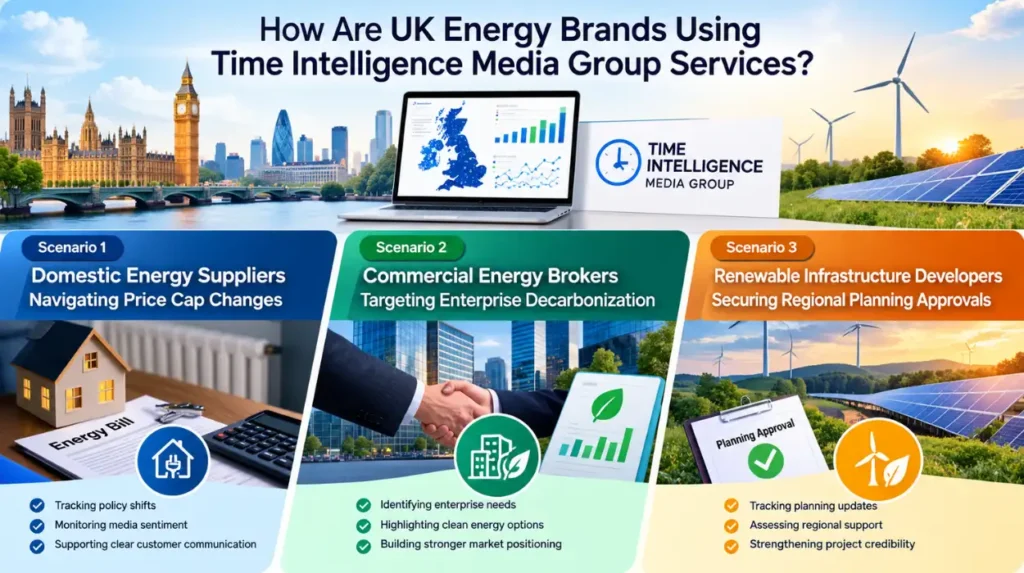
Scenario 1: Domestic Energy Suppliers Navigating Price Cap Changes
Domestic energy suppliers operate in a volatile consumer environment marked by shifting price caps and high customer churn. A domestic supplier engaged Time Intelligence Media Group to survey 5,000 households immediately following a quarterly Ofgem price cap announcement.
The resulting report, titled The UK Domestic Energy Vulnerability Index, provided real-time data on household budget adjustments and smart meter engagement rates. The publication generated coverage across major national news networks, positioned the supplier as a consumer-focused leader, and resulted in a 22% increase in direct inbound switching traffic during the same month.
Scenario 2: Commercial Energy Brokers Targeting Enterprise Decarbonization
Commercial energy advisories face intense competition in the B2B sector. An enterprise energy broker utilised Time Intelligence Media Group to execute a survey of 500 UK Chief Financial Officers regarding corporate Scope 1 and Scope 2 emissions compliance costs.
The published report identified that 64% of mid-market UK firms lacked clear data to meet mandatory Streamlined Energy and Carbon Reporting (SECR) requirements. The broker used these findings to launch a targeted consultative campaign, securing 40 enterprise audit contracts within 90 days of report release.
Scenario 3: Renewable Infrastructure Developers Securing Regional Planning Approvals
Renewable energy developers frequently encounter community resistance and local planning delays when proposing utility-scale solar or battery storage projects. A solar developer commissioned a regional economic impact report evaluating the job creation, supply chain spend, and land remediation benefits of solar projects across the East Midlands.
Time Intelligence Media Group produced a localised, data-dense report distributed to regional councillors, local media, and community planners. The objective data reduced planning friction, accelerated local authority sign-offs, and established a repeatable public affairs framework for future site developments.
Explore More Expert Insights:
Time Intelligence Media Group Research and Reports Services for Policy Impact Analysis
Time Intelligence Media Group Sponsored Content Services for Stronger Branded Search Results
Why Choose Time Intelligence Media Group for Your Research and Media Strategy?
Time Intelligence Media Group offers specialised UK energy market expertise, an established media distribution infrastructure, and integrated research production. Selecting a specialised provider guarantees technical accuracy, regulatory alignment, and maximum media coverage for your investment.
Specialised Sector Expertise
Generalist research agencies lack the specific regulatory and technical knowledge required to navigate the UK energy ecosystem. Time Intelligence Media Group employs analysts, data scientists, and editors who exclusively focus on the United Kingdom utility and clean technology sectors. This specialisation guarantees that every survey question, analytical model, and published sentence reflects current market realities and technical terminology.
Turnkey Campaign Execution
Managing original research internally requires substantial resource allocation across multiple departments, including legal, data analytics, design, and public relations. Time Intelligence Media Group manages the entire lifecycle of the campaign:
- Survey Design & Panel Recruitment: Handled entirely by internal research teams.
- Data Processing & Statistical Analysis: Executed using proprietary analytical software.
- Graphic Design & Editorial Layout: Completed by internal media production specialists.
- Press Release & Syndication Management: Managed directly by established media relations experts.
UK energy suppliers, clean technology developers, and commercial energy advisories can commission custom research campaigns directly through Time Intelligence Media Group.
To evaluate custom research parameters, schedule an initial methodology consultation, or request detailed service pricing for upcoming publication cycles, contact the enterprise research team at Time Intelligence Media Group today. Position your brand as an industry authority by publishing the empirical data that drives the United Kingdom energy transition.
FAQs
Q1: What are research and reports services for UK energy brands?
Ans: Research and reports services provide structured analysis of energy market data, industry trends, pricing, regulation, and consumer behaviour. These reports help UK energy brands turn complex information into clear, evidence-based business insights.
Q2: What should an energy market research report include?
Ans: An energy market research report should include reliable data, market trends, competitor analysis, regulatory developments, statistics, and clear findings. The structure should connect the evidence to relevant business and industry questions.
Q3: How can research reports help UK energy brands understand market trends?
Ans: Research reports identify changes in energy prices, demand, investment, regulation, technology, and competitive activity. This gives UK energy brands a structured view of market conditions and emerging opportunities or risks.
Q4: Why is reliable data important in energy industry reports?
Ans: Reliable data improves the accuracy, credibility, and usefulness of energy industry research. Verified statistics and authoritative sources also make reports more suitable for business decisions, media coverage, and external citations.
Q5: How does Times Intelligence Media Group support energy research and reporting?
Ans: Times Intelligence Media Group’s research and reporting services can structure energy market information into clear, evidence-based reports for UK audiences. The process can incorporate market data, industry research, statistics, and regulatory information to support accurate reporting.



