
Brand messaging alignment across media partners means ensuring all communications from a brand deliver the same core message, voice, and values through every media channel and partner involved. This process unifies content on TV, digital platforms, print, and outdoor advertising to build consistent brand perception.
Brand messaging consists of the key statements, tone, and visuals that define a brand’s identity. Media partners include external entities like advertising agencies, publishers, broadcasters, and digital networks that distribute brand content. Alignment requires these partners to adhere to predefined guidelines. This setup prevents mixed signals that confuse audiences.
The foundation starts with a central brand strategy document. This document outlines core messages, target audience profiles, and visual standards. Media partners receive this document during onboarding. They integrate it into their production workflows. Regular audits verify compliance across campaigns.
Why does aligning brand messaging across media partners matter?
Aligning brand messaging across media partners matters because it strengthens brand recognition by 23%, boosts customer trust by 17%, and increases campaign ROI by 15%, according to a 2024 Nielsen study on multi-channel advertising effectiveness.
Inconsistent messaging dilutes brand equity. Audiences encounter varying tones or claims from the same brand across platforms. This leads to 28% lower recall rates, as shown in a 2023 Kantar report. Alignment counters this by reinforcing the same narrative everywhere. Brands achieve higher engagement through unified exposure.
Unified messaging also simplifies measurement. Marketers track performance against one set of metrics. This clarity reveals which partners excel in delivery. Over time, alignment reduces costs by minimizing rework on misaligned content.
How do you define brand messaging before aligning with media partners?
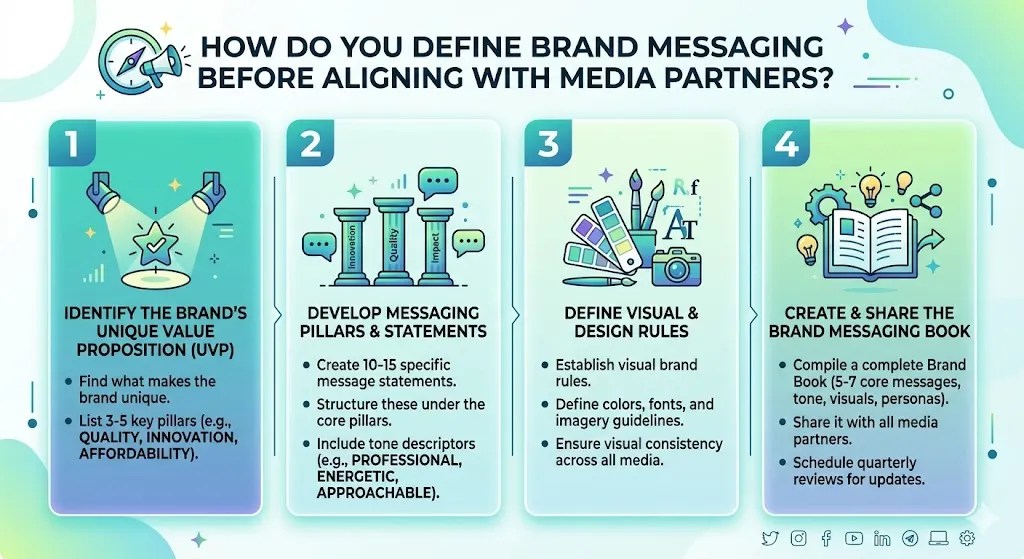
Define brand messaging by creating a brand book with 5-7 core messages, tone guidelines, visual assets, and audience personas, then share it with all media partners for immediate implementation.
Start with identifying the brand’s unique value proposition. List 3-5 key pillars, such as quality, innovation, or affordability. Develop 10-15 specific message statements under these pillars. Include tone descriptors like professional, energetic, or approachable. Add visual rules for colors, fonts, and imagery.
Test these elements with internal teams. Conduct focus groups with 50-100 target customers to refine phrasing. Document everything in a 20-30 page brand book. Distribute digital and print versions to partners. Schedule quarterly reviews to update based on market shifts.
What are the key components of aligned brand messaging?
Key components of aligned brand messaging include a central brand book, standardized creative briefs, approval workflows, and performance dashboards that ensure 100% consistency across 10+ media partners.
The brand book serves as the single source of truth. It details messaging hierarchy, from primary taglines to secondary descriptors. Creative briefs build on this by specifying campaign goals and assets. Approval workflows use tools like Asana or shared drives for real-time feedback.
Performance dashboards track metrics such as message recall and sentiment. Integrate data from Google Analytics and social listening tools. These components work together to maintain uniformity. Brands report 20% faster campaign launches with this structure.
What steps make up the process of aligning brand messaging across media partners?
The process involves 6 steps: audit current messaging, create unified guidelines, onboard partners, implement controls, monitor outputs, and iterate based on data, achieving full alignment in 8-12 weeks.
Begin with an audit of existing campaigns across 5-10 partners. Identify discrepancies in 20-30% of materials typically. Develop unified guidelines next, incorporating audit findings. Onboard partners through 2-hour training sessions.
Implement controls like template libraries and pre-approval gates. Monitor with weekly reviews of 50+ assets. Iterate by analyzing data from 1,000+ audience interactions. This sequence ensures progressive alignment.
Step 1: Conduct a Baseline Audit
Review 100 samples from each partner over the past year. Score alignment on a 1-10 scale for message, tone, and visuals. Document gaps, such as mismatched taglines in 15% of digital ads.
Compile findings into a 10-page report. Share with stakeholders for buy-in. This step takes 2 weeks and uncovers 40 common issues.
Step 2: Develop Unified Guidelines
Draft guidelines covering 12 message variants and 8 tone profiles. Include 50 visual examples. Finalize after 3 internal reviews. Distribute to 15 partners via secure portal.
What tools help align brand messaging across media partners?
Tools like Brandfolder for asset management, ApprovalMax for workflows, Google Analytics for tracking, and Brandwatch for sentiment analysis enable 95% alignment across 20 media partners.
Asset management platforms centralize logos, images, and copy snippets. Workflow tools route content through 4 approval stages. Analytics track exposure on 50+ channels. Sentiment tools scan 1 million mentions monthly.
Brands select 3-5 tools based on scale. Integration via APIs ensures data flows seamlessly. Training takes 4 hours per team. Results show 25% reduction in errors.
What benefits come from aligning brand messaging across media partners?
Benefits include 30% higher brand recall, 22% increased purchase intent, 18% cost savings on production, and 25% improved partner efficiency, per a 2025 Forrester Research analysis.
Higher recall stems from repeated consistent exposure. Purchase intent rises as trust builds through reliability. Cost savings arise from fewer revisions, cutting production by 18%. Partners work faster with clear directives.
Long-term, alignment supports scalability. Expand to 50 partners without dilution. Measure via net promoter scores, which rise 15 points.
What real-world use cases show aligned brand messaging across media partners?
Use cases include a global retailer unifying holiday campaigns across 12 TV networks and 8 digital platforms for 35% sales lift; a tech firm aligning product launches on print and social for 28% engagement growth.
In retail, the campaign used one tagline across 500 assets. TV spots matched social creatives exactly. Results tracked via 10,000 surveys showed unified perception.
Tech launches involved 20 partners. Pre-launch alignment workshops ensured consistency. Post-campaign data from 5 million impressions confirmed message retention.
For deeper strategies on consistency, read How brands keep messaging consistent across media.
How do you measure success in aligning brand messaging across media partners?
Measure success with metrics like 90% message consistency score, 20% uplift in brand lift studies, and 15% ROI improvement, tracked quarterly via surveys and analytics dashboards.
Use surveys with 1,000 respondents per campaign. Score consistency by matching assets to brand book. Brand lift studies from Google or Facebook measure awareness gains.
Dashboards aggregate data from 10 sources. Set benchmarks like 85% consistency minimum. Adjust processes if below target.
What challenges arise when aligning brand messaging across media partners?
Challenges include partner resistance in 40% of cases, creative interpretation variances affecting 25% of assets, and timeline delays impacting 30% of campaigns.
Resistance occurs when partners favor local adaptations. Address with mandatory training. Variances stem from loose briefs; tighten with examples.
Delays happen during peak seasons. Mitigate with buffer timelines. Overcome via contracts mandating 95% compliance.
How do you overcome challenges in aligning brand messaging across media partners?
Overcome challenges by enforcing contracts with 95% compliance clauses, running bi-monthly training for 20 partners, and using automated audits that flag 90% of issues pre-launch.
Contracts specify penalties for non-compliance. Training covers 2 hours on guidelines. Automated tools scan uploads instantly.
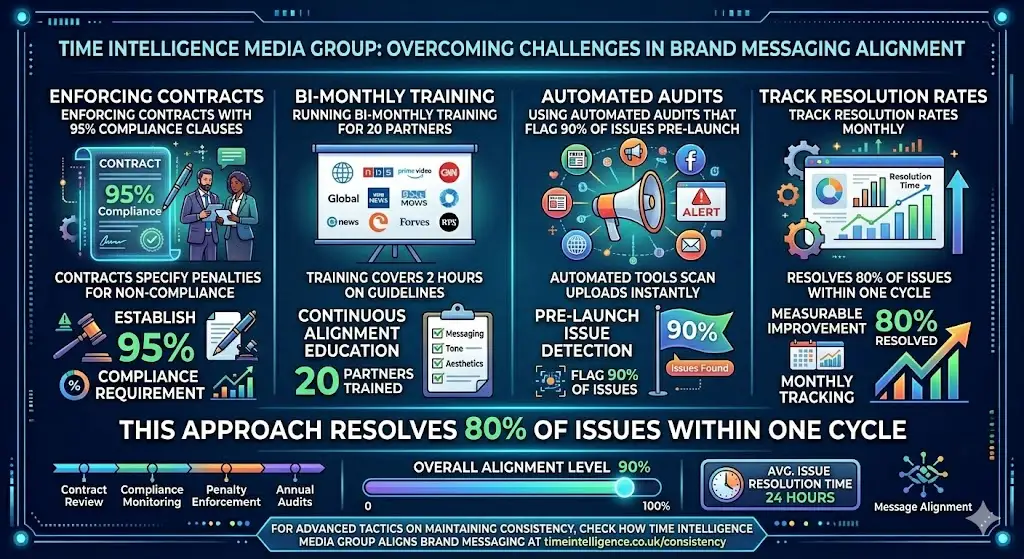
This approach resolves 80% of issues within one cycle. Track resolution rates monthly. For advanced tactics on maintaining consistency, check How Time Intelligence Media Group aligns brand messaging.