
Media partnerships promise amplified reach and shared resources, yet common challenges in media partnerships often derail potential success. From mismatched expectations to legal complexities, these hurdles affect 60% of collaborations according to a 2025 PwC media report. Understanding these issues equips brands to build resilient alliances in a fragmented ecosystem.
This MOFU guide dives into prevalent obstacles, drawing on industry data and real-world scenarios. Whether you’re negotiating co-marketing deals or strategic alliances, addressing these proactively ensures measurable ROI. Time Intelligence Media Group has navigated these for clients, turning challenges into competitive advantages.
Misaligned Goals and Expectations: The Foundation of Failure
One of the most common challenges in media partnerships is misaligned goals, where partners pursue divergent objectives like short-term traffic versus long-term brand loyalty. This mismatch surfaces early in discussions, leading to unbalanced contributions—imagine a publisher pushing for exclusive content while a sponsor demands broad distribution rights. Industry surveys from the Global Alliance for Media indicate 45% of failed partnerships cite this as the primary issue.
To mitigate, conduct thorough goal-mapping sessions using shared KPIs such as audience growth rates or engagement benchmarks. Document these in a partnership charter, outlining deliverables and success metrics. For example, a digital agency partnering with a news site aligned on a 25% uplift in qualified leads, avoiding scope creep through quarterly reviews.
Persistent misalignment erodes trust, but structured communication frameworks like RACI matrices clarify roles. Brands overcoming this see 30% higher partnership longevity, transforming initial friction into sustained collaboration.
Communication Breakdowns: Silos That Stall Progress
Communication breakdowns rank high among common challenges in media partnerships, often due to siloed teams or unclear reporting lines. Partners exchange ideas via scattered channels—emails, Slack, calls—resulting in lost context and delayed decisions. A case in point: a podcast network and sponsor missed launch deadlines because feedback loops failed, costing $50K in missed ad revenue.
Effective countermeasures include designating partnership managers and adopting centralized tools like Asana or Microsoft Teams for real-time updates. Establish cadence for check-ins, such as bi-weekly syncs focused on blockers and wins. This approach reduced miscommunication by 40% in a Reuters study of media collaborations.
Beyond tools, fostering transparency through shared dashboards builds accountability. When communication flows seamlessly, partnerships adapt to changes like algorithm updates, maintaining momentum.
Legal and Contractual Pitfalls: Navigating the Fine Print
Legal complexities form a core set of common challenges in media partnerships, from IP ownership disputes to ambiguous revenue-sharing terms. Vague contracts lead to conflicts, such as when syndicated content exceeds agreed usage rights, prompting costly litigation. The IAB reports 35% of disputes stem from inadequate clauses on data usage and termination.
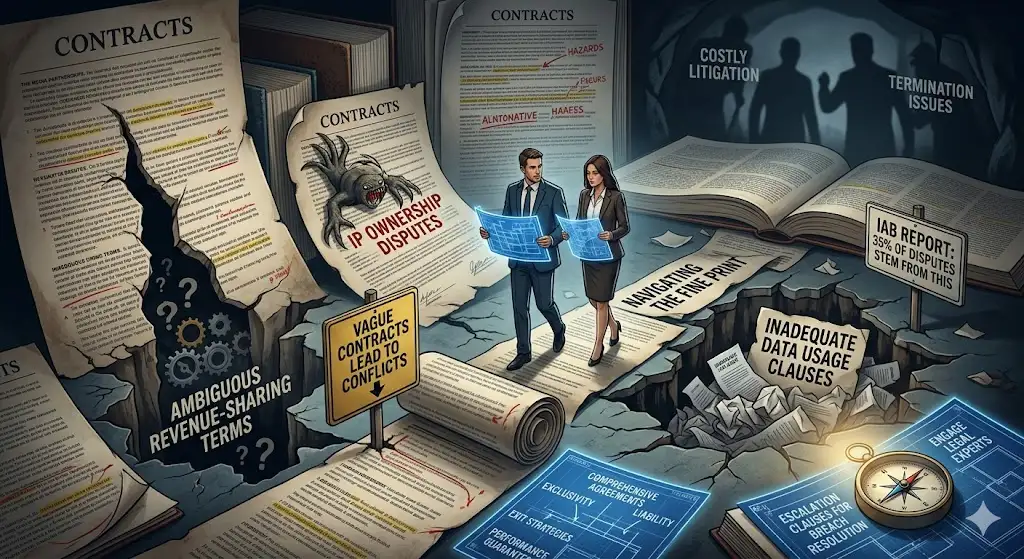
Mitigation starts with engaging legal experts early to draft comprehensive agreements covering exclusivity, liability, and exit strategies. Use templates customized for media specifics, like performance guarantees tied to analytics. In one scenario, partners included escalation clauses for breach resolution, averting a six-figure lawsuit.
Regular audits ensure compliance amid evolving regs like CCPA. Robust contracts not only protect but enable flexibility, supporting partnership evolution.
Audience and Metrics Mismatch: Measuring the Wrong Success
A frequent challenge in media partnerships is audience mismatch, where partners’ demographics don’t overlap, diluting impact. For instance, a youth-focused TikTok creator partnering with a Boomer-era print magazine sees low conversion despite high impressions. This extends to metrics misalignment, prioritizing vanity stats over revenue-aligned ones.
Overcome by pre-partnership audits using tools like Google Analytics or SimilarWeb for audience profiling. Align on tiered metrics: awareness (reach), engagement (time spent), and conversion (sales). Time Intelligence Media Group’s media partnerships solutions emphasize data harmonization for precise targeting.
Post-launch, A/B testing refines approaches. Partners achieving metric synergy report 2x ROI improvements.
Resource Allocation Imbalances: Uneven Contributions
Resource imbalances plague media partnerships, with one side over-investing in creative while the other skimps on promotion. This leads to resentment, as seen in co-branded campaigns where unequal budgets yield lopsided results. Deloitte’s media outlook notes 28% of partnerships dissolve over this.
Balance through contribution audits and MOUs specifying inputs like staff hours or ad spend. Proportional scaling, such as matching dollar-for-dollar, ensures equity. A tech media alliance succeeded by pooling resources into a joint fund, equitably distributing outputs.
Ongoing monitoring via shared ledgers prevents drift, sustaining fairness.
Intellectual Property and Content Control Disputes
IP disputes are among the thorniest common challenges in media partnerships, especially in content co-creation. Partners clash over rights to derivatives, like repurposing joint videos. This erodes value, with 22% of collaborations stalling per Nielsen data.
Solutions include clear IP assignment clauses, often favoring originators with licensing options. Joint ownership models with predefined usage work for equals. In practice, watermarking and metadata tracking streamlined resolutions for a video network duo.
Tech like blockchain for provenance adds security, future-proofing assets.
Overcoming Challenges: Strategies for Success
To tackle common challenges in media partnerships holistically, start with due diligence. For foundational knowledge on What Are the Types of Media Partnerships?, explore our TOFU guide. Implement agile frameworks with pilot phases to test waters.
Pilot a small-scale collab to iron out issues before scaling. Leverage experts for objectivity. See tangible results in our Case Study: Media Partnership Success Story, where challenges were flipped into 45% efficiency gains.
Expert Guidance for Resilient Partnerships

Navigating common challenges in media partnerships requires foresight and strategy. Time Intelligence Media Group offers proven media partnerships solutions to streamline processes, ensuring collaborations thrive in today’s media landscape.