
Research reports have become a central part of content marketing, public relations, and thought leadership in the United Kingdom. Businesses, charities, trade associations, and public sector organisations use original research to generate media coverage, support commercial decisions, and establish industry authority.
When planning a research report, organisations face one important decision. They can commission an external research provider or conduct the research internally. Both approaches produce valuable findings, but they differ in cost, expertise, speed, quality control, and resource requirements.
Understanding these differences helps organisations select the approach that aligns with their objectives, internal capabilities, and reporting standards.
What is the difference between commissioning and conducting a UK research report?
Commissioning means hiring an external research specialist to design, execute, analyse, and often publish a research project. Conducting means an organisation completes those activities using its own employees, internal data, and operational resources while maintaining full responsibility throughout every project stage.
A research report is a structured document that presents evidence collected through surveys, interviews, market analysis, or statistical datasets. It explains methodology, findings, interpretation, and conclusions.
Commissioning transfers much of the research process to specialists with dedicated expertise.
Conducting keeps every stage inside the organisation.
Both methods aim to produce reliable evidence that supports decision-making and communication.
What does commissioning involve?
Commissioning normally includes:
- Research planning
- Questionnaire development
- Sampling
- Data collection
- Statistical analysis
- Report writing
- Data visualisation
- Publication support
External researchers follow established methodologies and quality assurance processes.
What does conducting involve?
Internal research teams manage every activity directly, including:
- Defining objectives
- Creating survey questions
- Recruiting respondents
- Cleaning data
- Analysing results
- Producing the final report
This approach relies heavily on internal expertise and available resources.
How does the research process differ between the two approaches?
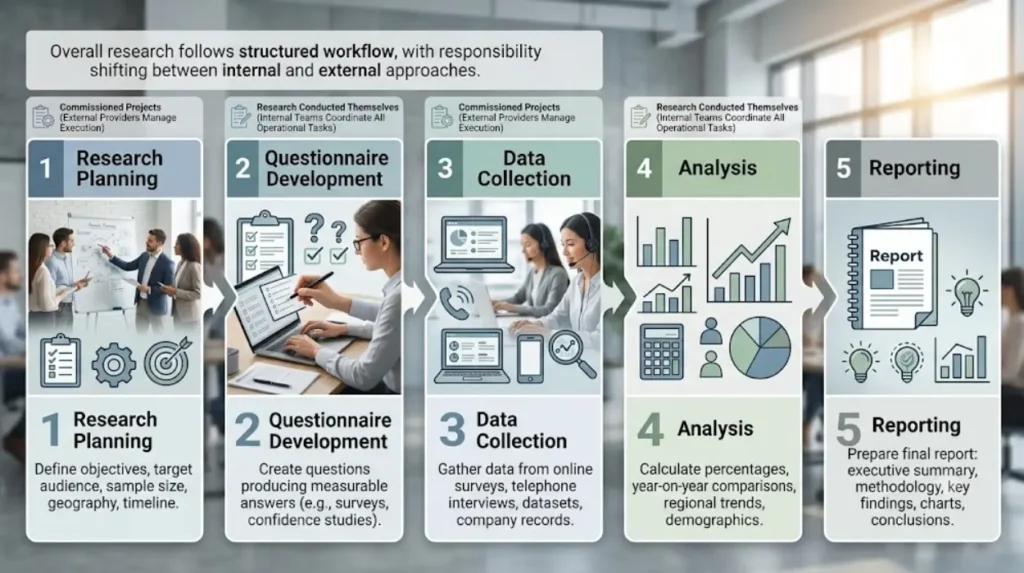
Both approaches follow similar research stages, but responsibility changes significantly. External providers manage execution during commissioned projects, while internal teams coordinate every operational task when conducting research themselves from planning through publication and post-project evaluation.
Every research report follows a structured workflow regardless of who performs the work.
Stage 1: Research planning
The project begins by defining:
- Research objectives
- Target audience
- Sample size
- Geographic coverage
- Timeline
For example, a UK retail association investigating consumer spending first identifies the demographic groups it wants to measure.
Stage 2: Questionnaire development
Questions must produce measurable answers.
Examples include:
- Customer satisfaction surveys
- Industry confidence surveys
- Employment trend studies
Poorly written questions reduce data quality.
Stage 3: Data collection
Research data comes from several sources, including:
- Online surveys
- Telephone interviews
- Public datasets
- Internal company records
The collection method affects response rates and statistical reliability.
Stage 4: Analysis
Researchers calculate:
- Percentages
- Year-on-year comparisons
- Regional trends
- Demographic differences
Analysis converts raw responses into meaningful findings.
Stage 5: Reporting
The final report presents:
- Executive summary
- Methodology
- Key findings
- Charts
- Conclusions
Reports designed for public distribution also include supporting visuals and clear source citations.
What advantages come from commissioning external research?
Commissioning gives organisations access to specialist researchers, established methodologies, advanced statistical expertise, independent analysis, and scalable resources. External delivery reduces internal workload while supporting consistent quality across complex or large-scale research projects completed within defined timelines.
External research providers specialise in designing statistically sound projects.
Access to specialist expertise
Professional research teams understand:
- Survey design
- Sampling frameworks
- Data validation
- Statistical interpretation
This expertise improves methodological consistency.
Larger respondent panels
Many research providers maintain established respondent networks.
For example:
- UK consumers
- Business decision-makers
- Healthcare professionals
- Technology buyers
Access to these audiences accelerates fieldwork.
Independent findings
External analysis creates separation between researchers and organisational stakeholders.
This independence strengthens credibility when reports receive media attention or industry scrutiny.
Reduced operational burden
Internal teams spend less time managing:
- Recruitment
- Data cleaning
- Statistical processing
- Report formatting
This allows employees to focus on core business activities.
Readers comparing external support with broader research strategies can explore:
How Times Intelligence Produces, Publishes and Distributes UK Research Reports.
What advantages come from conducting research internally?
Internal research provides complete operational control, direct access to organisational knowledge, flexible project management, and ownership of every dataset. Organisations integrate research into existing workflows without relying on external suppliers for project execution or reporting schedules.
Some organisations already employ experienced research professionals.
Internal delivery becomes practical when those resources exist.
Greater project control
Internal teams control:
- Timelines
- Objectives
- Survey revisions
- Approval processes
Changes happen immediately without supplier coordination.
Better organisational knowledge
Employees understand:
- Existing customers
- Products
- Industry terminology
- Historical business data
This context improves questionnaire relevance.
Direct ownership of research assets
Internal teams maintain direct control over:
- Raw datasets
- Survey platforms
- Documentation
- Analysis files
This simplifies future updates and longitudinal studies.
Lower long-term external spending
Organisations conducting regular research often reduce supplier expenditure by building permanent internal capability.
However, this investment includes software, training, recruitment, and ongoing operational costs.
Which factors influence the best choice for a UK organisation?
The most suitable route depends on research complexity, available expertise, project scale, available budget, reporting deadlines, data requirements, and publication objectives. Organisations evaluate these factors together before selecting either internal delivery or commissioned research support.
No single approach suits every project.
Several practical considerations influence the decision.
Research complexity
Simple customer feedback surveys often fit internal teams.
National market studies involving thousands of respondents require larger operational capacity.
Internal expertise
Experienced analysts improve:
- Survey quality
- Statistical accuracy
- Report consistency
Limited expertise increases the likelihood of methodological errors.
Available resources
Research requires dedicated staff hours.
Internal teams balance research alongside existing responsibilities.
External providers contribute additional capacity.
Publication objectives
Reports created for:
- National media
- Industry publications
- Investor communications
- Policy discussions
often require rigorous documentation and transparent methodology.
Readers looking for broader context on why original research receives increasing attention can explore:
What trade-offs exist between commissioning and conducting research?
Every approach balances cost, speed, expertise, flexibility, control, and operational workload. Understanding these trade-offs enables organisations to select the research model that aligns with strategic objectives instead of focusing on one decision factor alone.
Comparing both options highlights their practical differences.
Cost
Commissioning usually involves higher project fees.
Internal research requires investment in:
- Staff
- Software
- Training
- Data management
The cost structure differs rather than disappearing.
Speed
External providers often execute large surveys efficiently because established processes already exist.
Internal teams move quickly when projects remain small and decision-making stays centralised.
Flexibility
Internal teams revise questionnaires immediately.
Commissioned projects follow agreed research specifications to maintain methodological consistency.
Quality assurance
Professional research organisations apply structured validation procedures during:
- Sampling
- Data cleaning
- Statistical review
- Report production
Internal quality depends on available expertise and established review processes.
Scalability
External teams expand respondent numbers more easily.
Internal projects become increasingly resource-intensive as sample sizes grow.
When does each research approach work best?
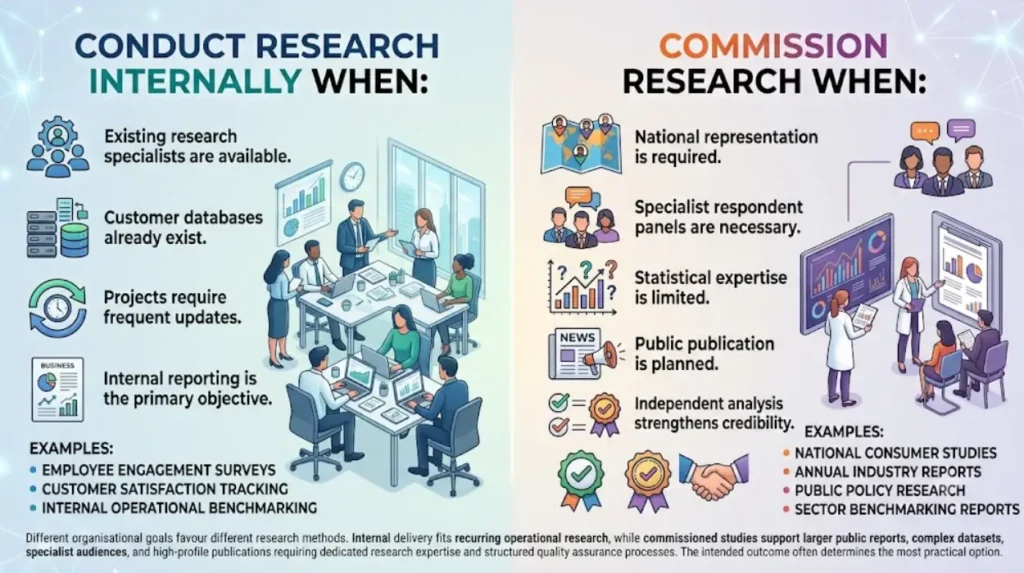
Different organisational goals favour different research methods. Internal delivery fits recurring operational research, while commissioned studies support larger public reports, complex datasets, specialist audiences, and high-profile publications requiring dedicated research expertise and structured quality assurance processes.
The intended outcome often determines the most practical option.
Conduct research internally when:
- Existing research specialists are available.
- Customer databases already exist.
- Projects require frequent updates.
- Internal reporting is the primary objective.
Examples include employee engagement surveys, customer satisfaction tracking, and internal operational benchmarking.
Commission research when:
- National representation is required.
- Specialist respondent panels are necessary.
- Statistical expertise is limited.
- Public publication is planned.
- Independent analysis strengthens credibility.
Examples include national consumer studies, annual industry reports, public policy research, and sector benchmarking reports.
How can organisations choose the right research route?
Choosing the right approach begins with clearly defining objectives, available expertise, expected audience, publication goals, and operational resources. Organisations compare these requirements against internal capabilities before deciding whether external commissioning or internal delivery provides the strongest overall fit.
A structured evaluation simplifies decision-making.
Key questions include:
- What decisions will the research support?
- Who will read the report?
- How many respondents are required?
- What statistical analysis is necessary?
- Does the organisation possess research expertise?
- How much internal time is available?
- Will the findings be published externally?
Clear answers guide organisations toward the approach that best matches their objectives.
Explore More Expert Insights:
How to Use Third-Party Research to Build Authority in a Crowded UK Niche
Structuring Your UK Industry Report for Maximum AI Search Visibility in 2026
Commissioning and conducting research represent two established approaches to producing UK research reports. Both follow the same core research process, yet they differ in responsibility, expertise, operational workload, scalability, and resource allocation.
Internal research provides greater organisational control and direct ownership of data. Commissioned research provides specialist expertise, independent analysis, and additional operational capacity for complex projects.
The most effective choice depends on research objectives, available expertise, publication plans, project scale, and internal resources. Organisations that evaluate these factors systematically produce research reports that deliver reliable evidence, support informed decisions, and contribute valuable insights to their industries.