
Startup funding announcements signal business growth, investor confidence, and market momentum. Despite this, many UK startup funding announcements receive little or no media coverage. The lack of pickup often results from news selection criteria, weak storytelling, poor timing, and mismatched distribution strategies rather than the size of the investment itself.
Understanding how journalists evaluate funding news helps founders, marketing teams, and communications professionals create announcements that match editorial expectations. This article explains why funding announcements are overlooked, how the news selection process works, which factors influence media interest, and when startup funding stories gain stronger attention.
Why do most UK startup funding announcements receive no media pickup?
Most UK startup funding announcements receive no pickup because they lack news value, measurable business impact, clear supporting data, relevant market context, and targeted distribution. Journalists prioritise stories that demonstrate significance, originality, industry relevance, and verified evidence rather than funding alone.
Every week, hundreds of startups announce seed rounds, Series A investments, grants, and venture capital funding. Newsrooms receive significantly more announcements than they can publish.
Editors evaluate every funding announcement against editorial priorities.
Common reasons announcements fail include:
- No explanation of why the funding matters.
- No measurable customer or revenue growth.
- Generic company descriptions.
- Missing market context.
- Weak supporting evidence.
- Poorly written press releases.
- Distribution to irrelevant publications.
- Publication during high-volume news periods.
A funding announcement stating that a company raised £2 million tells journalists very little by itself. An announcement explaining that the investment enables expansion into five UK regions, creates 80 jobs, and serves 250,000 additional customers provides meaningful context.
What makes funding newsworthy?
Funding becomes newsworthy when it demonstrates business significance.
Examples include:
- National market expansion.
- Product launches.
- Employment growth.
- Regulatory milestones.
- International partnerships.
- Industry-first technology.
- Major customer acquisition.
The investment supports these developments rather than acting as the story itself.
How do journalists decide whether a startup funding announcement deserves coverage?
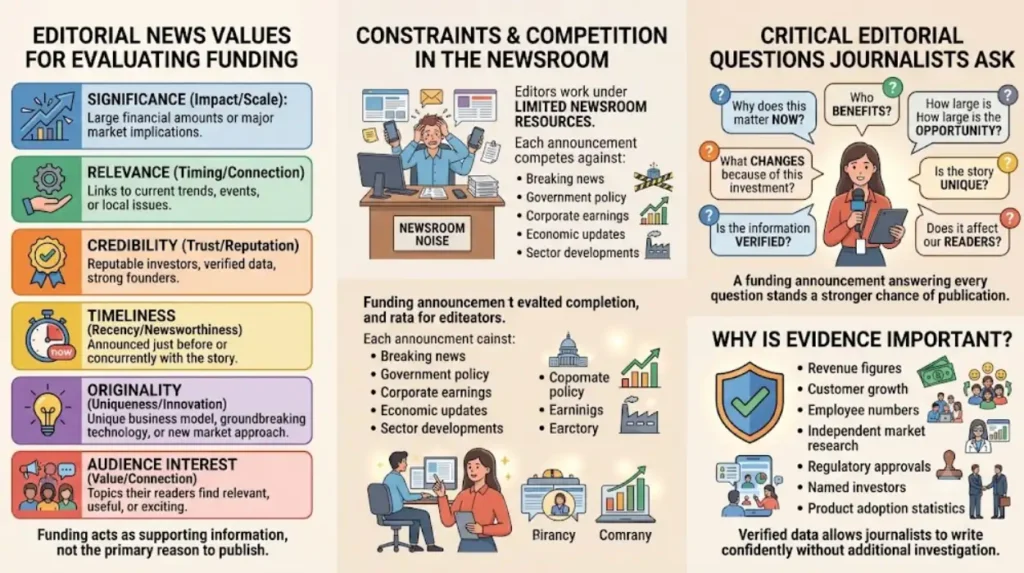
Journalists evaluate startup funding announcements using editorial news values including significance, relevance, credibility, timeliness, originality, and audience interest. Funding acts as supporting information rather than the primary reason to publish a story.
Editors work under limited newsroom resources.
Each announcement competes against breaking news, government policy, corporate earnings, economic updates, and sector developments.
Which editorial questions do journalists ask?
Editors commonly ask:
- Why does this matter now?
- Who benefits?
- What changes because of this investment?
- How large is the opportunity?
- Is the information verified?
- Is the story unique?
- Does it affect our readers?
A funding announcement answering every question stands a stronger chance of publication.
Why is evidence important?
Evidence improves credibility.
Examples include:
- Revenue figures.
- Customer growth.
- Employee numbers.
- Independent market research.
- Regulatory approvals.
- Named investors.
- Product adoption statistics.
Verified data allows journalists to write confidently without additional investigation.
What information is missing from many startup funding announcements?
Many startup funding announcements omit measurable business outcomes, investment purpose, customer impact, competitive positioning, and market context. Missing information reduces editorial value and limits opportunities for meaningful news coverage across UK publications and specialist media.
Funding announcements frequently focus only on investment size.
Editors want the broader business story.
Essential information often missing
A complete announcement explains:
- Why funding was secured.
- How the investment will be used.
- What business problem the company solves.
- Which industries benefit.
- What milestones have already been achieved.
- What measurable outcomes follow the investment.
For example:
Instead of:
“Startup raises £4 million.”
A stronger version explains:
“Startup raises £4 million to expand AI fraud detection across UK financial institutions after reducing payment fraud by 38% during commercial pilots.”
The second example provides context, evidence, and relevance.
Why does timing affect media coverage?
Timing directly influences media pickup because newsroom capacity, competing national stories, seasonal reporting patterns, and publication deadlines determine editorial availability. Strong announcements released during quieter news periods receive greater visibility than similar announcements published during major news events.
Editors constantly prioritise urgent stories.
A startup funding announcement released alongside major political events or national economic announcements competes for limited newsroom attention.
What timing factors matter?
Key timing factors include:
- National news events.
- Budget announcements.
- Election periods.
- Quarterly earnings seasons.
- Industry conferences.
- Holiday periods.
- Publication deadlines.
Releasing announcements when relevant industry conversations already exist increases topical relevance.
Businesses planning communications strategies often examine:
Choose Between UK National, Regional, and Trade Distribution
What role does storytelling play in startup funding announcements?
Storytelling gives funding announcements business context by explaining customer problems, company growth, market opportunity, and measurable outcomes. Journalists publish business stories that explain change rather than simply reporting financial transactions.
Storytelling does not mean adding opinions or marketing language.
It means explaining cause and effect.
What makes a funding story complete?
Strong business stories include:
- The market problem.
- The company’s solution.
- Evidence of traction.
- Investment details.
- Future business milestones.
Example:
A healthcare software company receives investment.
The news becomes stronger when readers learn the software reduced hospital administration time by 32% across NHS pilot programmes.
Business impact becomes the headline rather than investment alone.
Why does targeting the wrong publications reduce coverage?
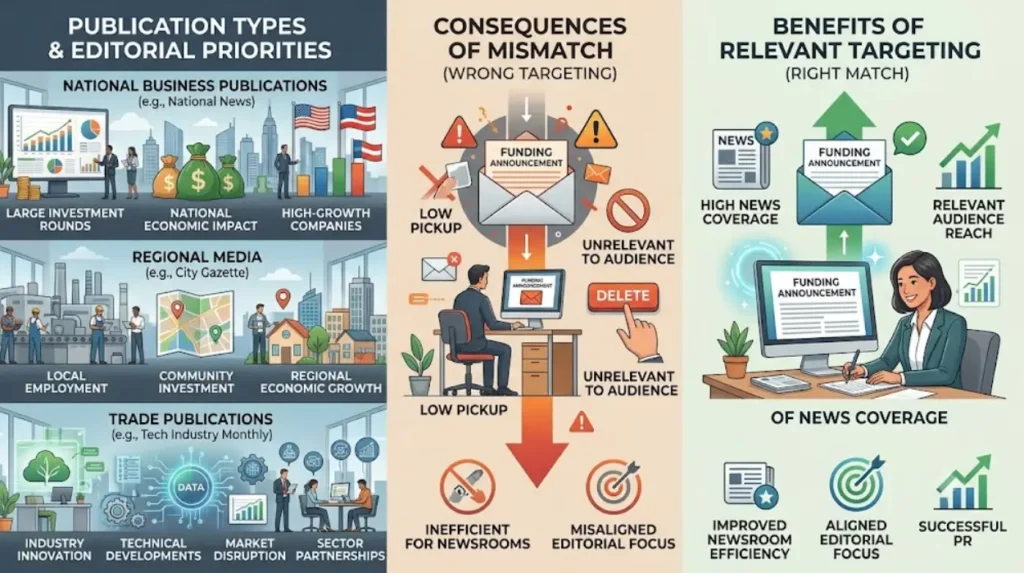
Sending startup funding announcements to unrelated publications lowers pickup because editorial priorities differ between national newspapers, regional media, trade publications, and specialist business journalists. Relevant targeting improves newsroom efficiency and editorial relevance.
Every publication serves a defined audience.
Technology journalists cover different subjects from regional business reporters.
Trade publications focus on industry developments rather than general business news.
Different publication types prioritise different stories
National business publications often prioritise:
- Large investment rounds.
- National economic impact.
- High-growth companies.
Regional publications focus on:
- Local employment.
- Community investment.
- Regional economic growth.
Trade publications prefer:
- Industry innovation.
- Technical developments.
- Market disruption.
- Sector partnerships.
Matching the announcement to publication focus improves relevance.
How does credibility influence media interest?
Credibility increases media interest because journalists require accurate, verifiable, and transparent information before publication. Strong evidence reduces reporting risk and improves editorial confidence in business announcements.
Editors verify information before publishing.
Incomplete information delays publication.
Unsupported claims reduce trust.
What strengthens credibility?
Credibility improves when announcements include:
- Named investors.
- Exact funding amount.
- Official company data.
- Executive quotations.
- Independent statistics.
- Customer metrics.
- Product launch dates.
Journalists prefer factual statements over promotional claims.
Clear sourcing also simplifies editorial fact-checking.
What types of startup funding announcements receive stronger coverage?
Funding announcements receive stronger coverage when investment supports major business developments such as expansion, innovation, employment growth, acquisitions, exports, or significant customer adoption. Business outcomes create stronger editorial value than investment figures alone.
Examples include:
- Expansion into European markets.
- Opening new UK offices.
- Hiring 150 employees.
- Launching regulated financial products.
- Commercialising university research.
- Building manufacturing facilities.
- Scaling climate technology solutions.
Investment becomes supporting evidence for wider economic or industry change.
Journalists report the broader impact.
Explore More Expert Insights:
What a Slow News Day Means for Your UK Press Release Timing
How UK Fintech Companies Get Press Coverage Without a Big Budget
How can startups improve future funding announcement success?
Startups improve funding announcement success by presenting measurable business outcomes, supporting evidence, strong timing, publication relevance, and complete contextual information. Editorial quality improves when announcements answer journalists’ core reporting questions before publication.
Preparation begins before writing the announcement.
Businesses collect operational data, customer metrics, investment details, and future milestones in advance.
Practical improvements
Useful practices include:
- Define the business impact.
- Quantify growth using verified data.
- Explain funding allocation.
- Include market context.
- Match announcements to relevant publication categories.
- Use factual executive quotations.
- Verify every statistic.
- Maintain clear structure.
Organisations planning broader media strategies often compare publication categories through:
UK Fintechs Coverage on a Startup Budget
Most UK startup funding announcements receive no media pickup because funding alone rarely meets editorial standards for newsworthiness. Journalists evaluate announcements based on measurable business impact, relevance, credibility, supporting evidence, timing, and audience value.
A funding announcement becomes stronger when it explains what changes because of the investment. Customer growth, market expansion, product launches, employment creation, regulatory progress, and verified business results provide the context that editors seek.
Understanding how newsrooms assess funding announcements enables startups to produce clearer, more informative communications that align with established editorial practices rather than relying solely on the size of an investment round.