
News cycles shape how journalists prioritise stories. In the United Kingdom, the amount of breaking news on a given day directly affects newsroom workloads, editorial choices, and the visibility of press releases. Understanding what defines a slow news day helps organisations plan announcements when editors have greater capacity to review external stories.
Effective timing depends on understanding the news agenda, publication schedules, audience interests, and editorial priorities rather than simply choosing a specific weekday.
What is a slow news day?
A slow news day is a period when major national, political, business, or international events generate fewer breaking stories. UK newsrooms receive fewer urgent assignments, allowing journalists and editors to dedicate more attention to planned content, industry developments, and external press releases.
A slow news day refers to a period with limited high-priority news coverage competing for editorial attention. News organisations still publish continuously, but fewer unexpected events require immediate reporting.
A newsroom normally prioritises content in this order:
- Breaking national news
- Government announcements
- Major business developments
- Public safety updates
- International events
- Planned editorial features
- External press releases
When breaking news occupies the first categories, lower-priority announcements receive less attention.
What causes a slow news day?
Several factors contribute to quieter news periods in the UK.
Examples include:
- Parliamentary recesses
- Weekends without major sporting events
- Periods between election campaigns
- Days without major economic announcements
- Holiday periods with fewer government activities
These situations reduce competition for newsroom resources.
Why does a slow news day affect UK press release timing?
A slower news cycle increases editorial capacity. Journalists spend less time covering urgent developments and more time reviewing announcements, expert commentary, industry reports, research findings, and business news submitted through standard editorial channels.
Every newsroom has finite editorial resources.
Editors assign reporters according to news priority. When significant breaking stories dominate coverage, external submissions remain in inboxes for longer or receive no review.
When fewer urgent stories exist, editors evaluate a larger proportion of incoming releases.
How editors prioritise stories
Editors generally assess several factors:
- Public interest
- News value
- Relevance to readers
- Timeliness
- Geographic importance
- Industry significance
- Supporting evidence
A slower news environment does not change these criteria. It simply allows editors additional time to evaluate submissions thoroughly.
Example
A regional manufacturing investment announcement submitted during a major UK general election receives limited attention because election coverage dominates.
The same announcement distributed during a quieter week faces substantially less editorial competition.
How can you identify a slow news day?
A slow news day becomes visible through reduced breaking-news volume, fewer urgent homepage updates, stable headline rotation, lighter political activity, and increased publication of feature articles, analysis, interviews, and lifestyle content across UK news outlets.
News cycles follow observable patterns.
Monitoring several indicators provides a clearer understanding of editorial activity.
Editorial indicators
Common signs include:
- Fewer breaking-news banners
- Longer homepage headline stability
- More feature articles
- Greater publication of opinion pieces
- Increased business analysis
- More industry-specific reporting
These changes indicate that immediate news pressure has decreased.
Calendar indicators
Certain scheduled events frequently increase newsroom activity.
Examples include:
- Budget announcements
- Interest rate decisions
- General elections
- Party conferences
- Royal events
- National emergencies
Avoiding these periods reduces competition with major stories.
When are UK press releases most likely to compete with major news?
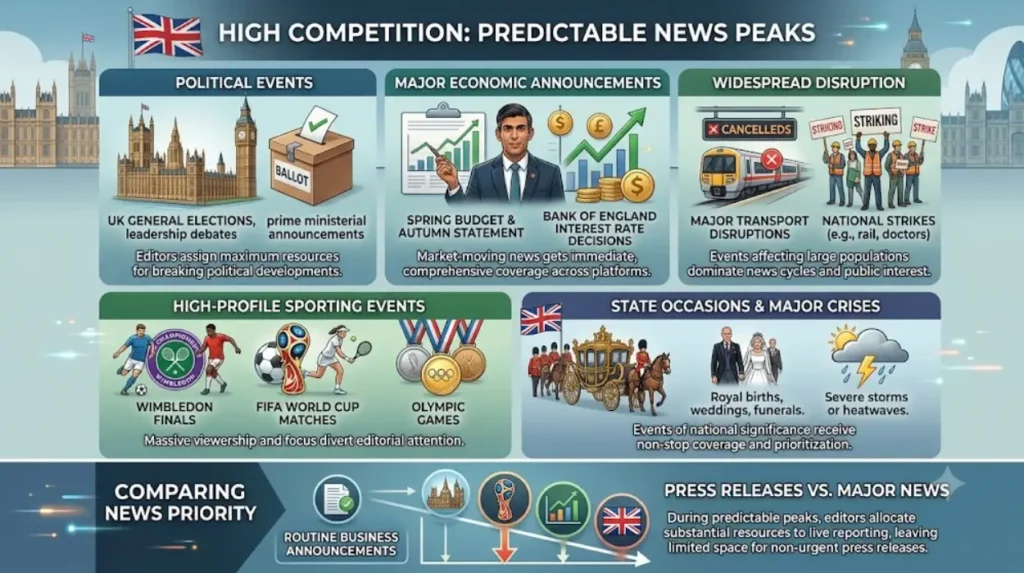
Press releases face the strongest competition during national political events, major economic announcements, severe weather incidents, international crises, and high-profile sporting competitions because these stories receive immediate editorial priority across multiple news organisations.
Timing involves understanding predictable news peaks.
Many annual events consistently dominate UK coverage.
High-competition periods
Examples include:
- Spring Budget announcements
- Autumn Statement
- Bank of England interest rate decisions
- UK General Elections
- Major transport disruptions
- National strikes
- Wimbledon finals
- FIFA World Cup matches
- Olympic Games
- State occasions
During these periods, editors allocate substantial resources to live reporting.
Routine business announcements receive lower priority.
What factors influence press release timing besides the news cycle?
News volume represents one timing factor. Audience behaviour, publication deadlines, journalist working patterns, embargo schedules, publication type, and regional relevance also determine whether a press release reaches editors at an appropriate time.
Effective timing combines several operational considerations.
Publication schedules
Different publications work on different production cycles.
For example:
- National newspapers update continuously.
- Regional newspapers combine scheduled publishing with digital updates.
- Trade publications often follow planned editorial calendars.
- Industry magazines publish monthly or quarterly editions.
Matching these schedules improves relevance.
Audience activity
Editors publish stories when audiences actively consume news.
Morning publication windows frequently receive higher readership for business news.
Lifestyle content often appears later in the day.
Industry relevance
Sector-specific announcements perform best when aligned with industry reporting cycles rather than national breaking news.
For example:
- Financial reporting follows earnings calendars.
- Technology launches often coincide with product events.
- Healthcare announcements frequently align with research publication schedules.
Readers seeking additional guidance on industry-specific distribution strategies can explore:
How to Choose a PR Distribution Service That Understands UK Fintech.
How do different UK media outlets respond to slow news days?
Different media organisations maintain different editorial priorities. National newspapers, regional publications, broadcasters, digital publishers, and trade magazines all evaluate press releases according to their audiences, publication schedules, and editorial objectives.
Not every newsroom responds identically.
Publication type influences editorial decision-making.
National media
National publications prioritise:
- Politics
- Business
- National economy
- Public policy
- Consumer issues
Large national stories continue receiving priority regardless of overall news volume.
Regional publications
Regional newsrooms focus on:
- Local businesses
- Community developments
- Infrastructure projects
- Employment
- Education
- Local government
Local relevance remains the primary editorial factor.
Trade publications
Industry publications often publish:
- Research reports
- Product developments
- Regulatory updates
- Executive appointments
- Market analysis
These publications rely less on national news cycles than general-interest media.
What types of press releases benefit most from quieter news periods?
Announcements that compete for editorial attention rather than responding to immediate events often receive greater visibility during quieter news periods because editors actively seek planned stories to maintain publication schedules.
Some announcement categories naturally fit slower news environments.
Examples include:
- Industry research
- Market reports
- Business expansion
- Executive interviews
- Product launches
- Community initiatives
- Sustainability programmes
- Recruitment announcements
These stories remain relevant without depending on breaking events.
Evergreen announcements
Evergreen news retains value beyond a single day.
Examples include:
- Annual research
- Consumer surveys
- Industry forecasts
- Educational campaigns
- Business milestones
Editors often publish these stories when immediate news pressure declines.
Does a slow news day guarantee media coverage?

A slower news cycle increases editorial availability but does not guarantee publication. Editors continue selecting stories based on relevance, accuracy, audience interest, originality, evidence, and overall news value rather than available newsroom capacity alone.
Editorial standards remain consistent.
Every submission competes with:
- Staff-written articles
- Freelance content
- Wire services
- Government announcements
- Industry updates
- Previously scheduled features
Quality remains essential.
Core editorial requirements
Editors continue expecting:
- Accurate information
- Verifiable facts
- Clear headlines
- Relevant quotations
- Supporting data
- Concise structure
Timing enhances opportunity but never replaces newsworthiness.
Explore More Expert Insights:
How UK Fintech Companies Get Press Coverage Without a Big Budget
How Regional UK Publications Choose Which Stories to Run
How can organisations monitor UK news cycles effectively?
Monitoring the UK news agenda involves following editorial calendars, government schedules, economic announcements, parliamentary activity, industry events, and national headlines to understand periods of higher and lower newsroom demand.
Regular monitoring creates better timing decisions.
Useful sources include:
- National newspaper homepages
- Public government calendars
- Economic release schedules
- Parliamentary calendars
- Industry association events
- Major sporting calendars
Combining these sources provides a broader picture of likely newsroom activity.
Build a timing calendar
A practical monitoring calendar includes:
| Activity | Frequency |
|---|---|
| Review national headlines | Daily |
| Check economic calendar | Weekly |
| Monitor parliamentary schedule | Weekly |
| Review industry events | Monthly |
| Track seasonal trends | Quarterly |
Historical patterns also reveal recurring busy periods.
Readers interested in understanding specialist media distribution can continue with:
Time Intelligence Media Group’s UK Trade Media Distribution Explained.
A slow news day refers to a period with reduced competition from major breaking stories. During these periods, UK journalists and editors often have greater capacity to review planned announcements and external press releases. However, publication decisions continue to depend on editorial standards, audience relevance, factual accuracy, and news value.
Successful press release timing combines awareness of the national news agenda, publication schedules, seasonal events, industry calendars, and editorial priorities. Understanding these factors enables organisations to make informed decisions about when to distribute announcements within the UK media landscape.