
Guaranteed placements deliver paid, pre-arranged media placements; earned coverage results from editorial interest without payment. Guaranteed placements buy placement space or sponsored content. Earned coverage relies on journalists choosing to cover a story based on news value. Each route uses different workflows, measurement methods, and legal disclosure requirements.
Guaranteed placements are transactional agreements with publishers or distribution channels. Buyers pay a fixed fee for specific visibility: publisher homepage slots, sponsored articles, or guaranteed inclusion in email newsletters. Earned coverage depends on press release quality, timeliness, and relationship-building with journalists. Earned coverage offers editorial independence for the publisher and typically carries higher trust signals for readers.
How do buying processes differ for guaranteed placements and earned coverage?
Buying guaranteed placements follows contract negotiation, placement scheduling, and paid invoicing; earned coverage follows outreach, pitching, and editorial decision timelines. For guaranteed placements, buyers request media kits, confirm audience metrics (page views, unique users), set run dates, and supply creative assets. Contracts state insertion dates, formats, and reporting metrics. For earned coverage, PR teams draft targeted pitches, distribute press releases, and follow journalist responses; publication timing depends on editorial calendars.
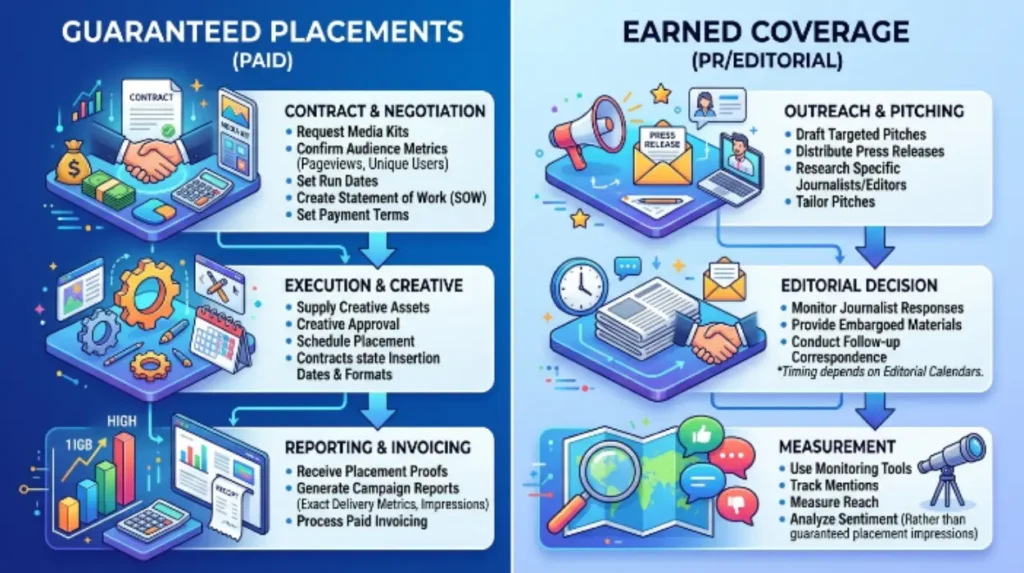
Guaranteed placements require procurement steps: SOW creation, payment terms, and creative approval. Buyers receive placement proofs and campaign reports with exact delivery metrics. Earned coverage requires tailored pitches to specific journalists or editors, follow-up correspondence, and provision of embargoed materials if requested. Measurement for earned coverage uses monitoring tools for mentions, reach, and sentiment rather than guaranteed placement impressions.
What components define a guaranteed placement package?
A guaranteed package lists exact placement positions, dates, formats, audience metrics, price, and disclosure terms. Components include placement type (sponsored article, banner, newsletter slot), exact run dates and times, expected impressions or open rates, creative specifications, and the legal requirement for sponsorship disclosure.
Packages include audience demographics and proof-of-performance clauses. Publishers supply ad specs for image sizes, character counts for copy, and click-tracking details. Contracts often include remediation terms if delivery metrics fall below agreed thresholds. Buyers should request historic performance data and sample placements to verify alignment with campaign goals.
What components define earned coverage efforts?
Earned coverage relies on a clear news angle, factual press material, targeted media lists, and responsive spokespeople available for interviews. Key components include a compelling lead, precise data points, verified sources, multimedia assets, and timely follow-up.
Press materials must present the six basic facts: who, what, when, where, why, and how. Media lists should target relevant beats and specific journalists; for example, national business journalists, regional editors in Manchester, and trade reporters in healthcare. Spokespeople must be available within specified time windows for same-day interviews or clarifications. Earned coverage often benefits from embargoed briefings to give journalists time to prepare.
What legal and disclosure rules apply to both formats in the UK?
UK rules require clear disclosure of paid content and accuracy in public statements; ASA rules, CAP Code, and publisher policies apply to sponsored placements and press releases. Sponsored content must include clear labelling as paid or sponsored. Advertorial language must not mislead readers about editorial independence. Press releases used in financial announcements must also comply with FCA disclosure rules where applicable.
For guaranteed placements, publishers enforce disclosure labels and may require pre-approval of copy. For earned coverage, accuracy and sourcing prevent misleading claims that could breach advertising or consumer protection rules. Public bodies and regulated sectors must follow sector-specific disclosure or filing requirements when issuing announcements.
How do measurement and reporting differ between the two approaches?
Guaranteed placements report exact delivery metrics such as impressions, clicks, open rates, and placement screenshots; earned coverage reports reach, pick-up count, and engagement estimates. Guaranteed metrics come from publisher analytics or ad servers and include viewable impressions and click-through rates. Earned coverage measurement uses media monitoring services to count mentions, estimate audience reach, and track backlinks.
Guaranteed placements allow calculation of cost-per-thousand impressions (CPM) and cost-per-click (CPC). Earned coverage metrics include number of articles, outlet authority, social shares, and referral traffic. Attribution models for earned coverage require time-based correlation between outreach and coverage dates. Buyers use both types of data to assess return on investment.
What are the typical costs and timelines for each option in the UK?
Guaranteed placements cost fixed fees ranging from £250 for local newsletter slots to £25,000+ for national homepage features; timelines span 3–30 days for booking and production. Costs vary by publisher reach and placement prominence. Local publishers and niche trade sites charge lower fees. National newspapers and high-traffic portals command premium rates.
Earned coverage costs focus on labour: PR staff time, media relations, and content creation. Typical earned outreach campaigns run 7–21 days from initial pitch to publication for newsworthy items. Breaking news or embargoed briefings can compress timelines to same-day or 48-hour coverage if journalists accept the story. Measurement services and follow-up analysis add additional budget lines for earned campaigns.
What benefits does guaranteed placement offer to buyers?
Guaranteed placements deliver predictable visibility, exact placement control, and contractual performance guarantees. Buyers obtain guaranteed impressions on specific pages or in defined newsletters. Creative control over messaging and visual assets remains with the buyer within the publisher’s ad specs. Reporting provides concrete delivery numbers for campaign accounting.
Guaranteed placements support precise audience targeting and scheduling for product launches or timed campaigns. They allow buyers to secure premium real estate on publisher sites during peak windows. Paid placements reduce dependency on editorial calendars and provide predictable campaign timelines.
What benefits does earned coverage offer to buyers?
Earned coverage offers editorial credibility, potential for wider organic reach, and third-party validation by independent journalists. Coverage in editorial sections provides perceived impartiality and enhances trust. Earned pieces can generate backlinks, social amplification, and long-term discoverability in search results.
Earned coverage can outperform paid placements in trust metrics when outlets publish substantive reporting. Editorial features often include more detailed context and external references, increasing content longevity. Earned media supports reputation building and authority in a sector when coverage appears in relevant trade or national outlets.
Explore More Expert Insights:
How to Vet a UK PR Distribution Partner Before You Sign
Which UK Media Databases Are Worth the Subscription in 2026
When should buyers combine both approaches?
Buyers combine approaches when they require immediate visibility plus long-term editorial credibility; use guaranteed placements for timing and earned outreach for credibility and backlinks. A combined approach aligns launch schedules with editorial interest. Paid placements secure initial audience exposure; simultaneous earned outreach targets news desks and specialist journalists.
For a product launch, buyers use guaranteed homepage features on launch day and run earned outreach to secure follow-up editorial reviews. For policy announcements, buyers place a sponsored explainer and issue press materials to relevant journalists for independent coverage. Coordinated scheduling ensures consistent messaging across paid and editorial channels.
What are practical use cases for each method in the UK market?
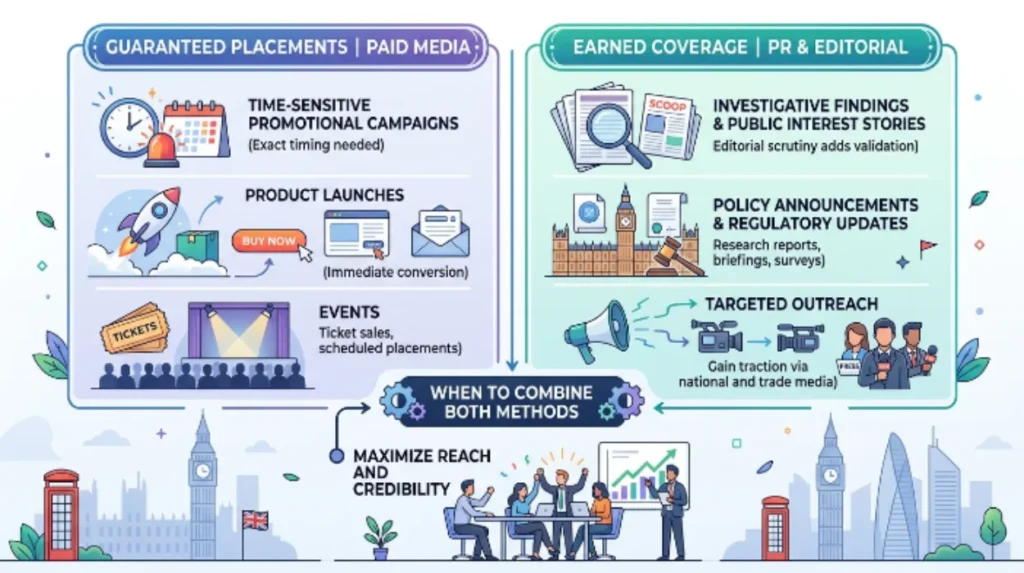
Use guaranteed placements for time-sensitive promotional campaigns, product launches, and events; use earned coverage for investigative findings, policy announcements, or independent validation. Promotional campaigns that require exact timing use paid placements. Product launches aiming for immediate conversion benefit from homepage visibility and newsletter slots. Events needing ticket sales rely on scheduled placements.
Earned coverage suits research reports, public interest stories, or regulatory updates where editorial scrutiny adds value. Policy briefings and survey results often gain traction through targeted outreach to national and trade journalists. Combine both methods when campaigns require both reach and credibility.
Must-Read Detailed Guide:
How Long Should a UK Press Release Be in 2026?
Guaranteed placements provide contractual visibility, exact delivery metrics, and creative control. Earned coverage provides editorial trust, potential backlinks, and organic reach. UK buyers choose based on campaign timing, budget, and desired credibility. For time-sensitive launches use paid placements to secure placement and schedule; for reputation-building and long-term authority pursue earned coverage through targeted media outreach. For balanced outcomes combine both approaches to achieve immediate impact and sustained editorial validation.
Learn Everything About It Here:
How Time Intelligence Media Group Handles Same-Day PR Distribution in the UK