
A media database is a structured directory of journalists, outlets, and contact details used to target media outreach efficiently across the United Kingdom. It reduces time locating contacts, supports segmentation, and enables measurable outreach.
A media database stores journalist profiles, outlet beats, circulation and audience metrics, and contact channels. Teams use databases to find relevant reporters by beat, geography, or platform. Databases capture email addresses, phone numbers, social profiles, preferred pitch formats, and recent coverage history. Quality databases update contacts on a regular cadence and annotate relationship history with outreach timestamps and outcomes. Using a database speeds campaign setup and reduces the number of irrelevant pitches sent to national and trade desks.
How do media databases differ by data coverage and update frequency?
Databases differ by number of records, depth of profile fields, and update cadence measured in days or weeks; some update contacts weekly while others update quarterly.
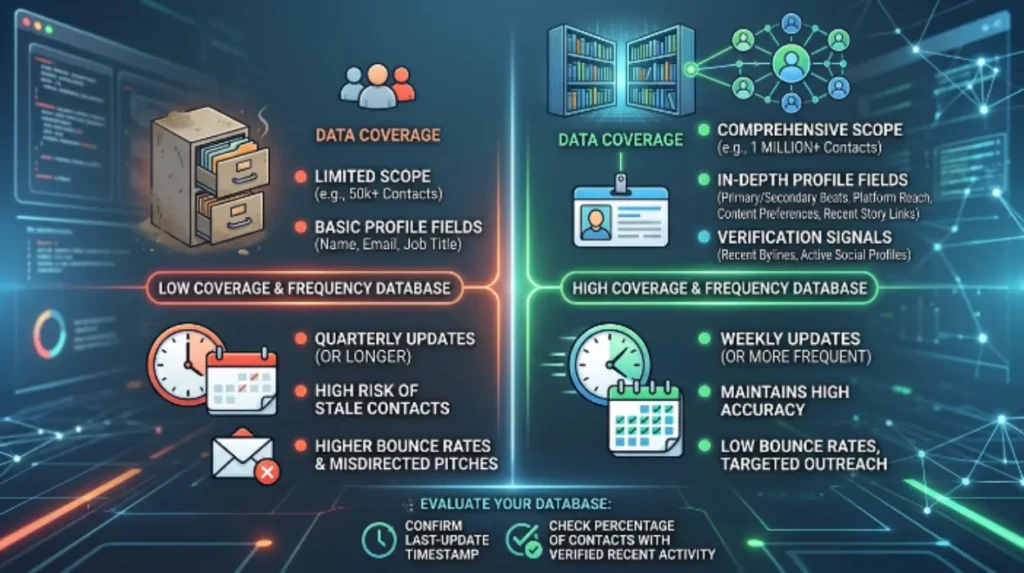
Databases list between 50,000 and 1,000,000 contacts depending on scope. Depth varies from basic name and email to advanced fields such as primary beat, secondary beats, platform reach, content preferences, and recent story links. Update cadence matters for accuracy: weekly updates reduce bounce rates and wrong-desk pitches; quarterly updates increase stale-contact risk. High-refresh datasets include verification signals such as recent bylines and active social profiles. When evaluating a database, confirm the last-update timestamp and the percentage of contacts with verified recent activity.
What search and segmentation features determine database usefulness?
Effective databases provide multi-criteria search, saved segments, Boolean queries, and export options to structure targeted media lists quickly.
Search must support filters for outlet type, beat, geographic focus, audience size, and language. Saved segments accelerate recurring campaigns and maintain list consistency. Boolean support enables precise queries such as “technology AND fintech NOT consumer.” Export options must include CSV, Excel, and integration-friendly formats for CRM or PR platforms. API access allows programmatic list creation and syncing with campaign tools. Advanced tagging enables teams to flag contacts for embargoes, exclusives, or outreach history.
How important are journalist profiles and content traces in a media database?
Journalist profiles and content traces provide evidence of topical relevance and improve pitch targeting by showing recent coverage and content tone.
Profiles that include recent article links, author bios, and social activity demonstrate active engagement in a beat. Content traces show story frequency, headline samples, and common themes. Databases that store byline history allow PR teams to match pitch angles to demonstrated reporter interests. Profiles with content timestamps show recency and reduce the risk of pitching inactive journalists. In practice, interviews and product briefings succeed when PR teams reference recent relevant articles from a journalist’s profile.
Which measurement and analytics features add value for mid-funnel teams?
Analytics that track open rates, placement counts, outreach-to-coverage ratios, and contact responsiveness provide actionable signals for improving campaigns.
Databases with built-in analytics report metrics such as outreach volume per contact, email open rates, reply rates, and placements attributed to specific lists. Some systems calculate coverage lift and share of voice across selected outlets. Responsiveness metrics identify high-engagement contacts for follow-up. Time-to-placement metrics measure the number of days from first outreach to published coverage. These analytics inform list refinement and message iteration for higher conversion in subsequent campaigns.
What integrations and workflow tools support PR operations in 2026?
Integrations with CRM, email platforms, content management, and monitoring tools streamline workflows and ensure consistent data across systems.
Databases that export to popular CRM formats reduce manual data entry. Native email integration enables sequence-based pitching and tracking within the database environment. Integration with media monitoring tools aligns outreach with coverage outcomes. Calendar sync and booking tools assist with interview scheduling. API endpoints enable two-way syncing so contact updates flow to campaign tools and reporting dashboards. Workflow features such as task assignment, notes, and reminders maintain team accountability.
What privacy and data compliance details should buyers check?
Buyers must verify data sourcing methods, consent provenance, and compliance with UK data protection laws, including retained processing records and opt-out management.
Databases must document how contact data is collected and refreshed. Confirm whether contacts consented to receive press materials or whether data comes from public bylines and corporate bios. Check automated suppression lists for journalists who opted out. Verify data processing agreements, record-keeping practices, and retention policies that align with UK GDPR requirements. Ask the vendor for a summary of privacy impact assessments and evidence of secure storage and role-based access controls.
What pricing models exist and which suit mid-funnel budgets?
Pricing models include per-seat subscriptions, tiered feature bundles, and pay-per-export credits; choose models that match team size, outreach volume, and integration needs.
Per-seat models charge per named user and suit small teams that need full access. Tiered bundles group features such as advanced analytics, API access, and higher export limits. Credit-based models suit occasional users who prefer a lower base fee and pay per export. Annual contracts typically reduce per-month costs by 10–30% compared with month-to-month billing. When estimating total cost, include onboarding, training, and integration expenses. Mid-funnel teams often prioritise a single-seat plus API access or a small team license with higher export allowances.
What trial, onboarding, and support expectations should teams require?
Require a time-limited trial with full feature access, structured onboarding, and responsive support channels including phone, email, and dedicated onboarding specialists.
Trials should last 14 to 30 days and include sample datasets relevant to the UK market. Onboarding must cover search training, segment creation, export workflows, and API keys. Request documentation of typical onboarding timelines and success metrics used during the pilot. Support SLAs should specify response times: under 24 hours for email and under 2 hours for critical issues. Access to a knowledge base and training webinars speeds team adoption.
Explore More Expert Insights:
Owned Newsroom vs Paid Distribution: What Works Better for UK Brands
How to Compare UK PR Distribution Packages Without Overpaying
When is a subscription justified for a UK communications team?
A subscription is justified when teams conduct more than 12 targeted campaigns per year, require integration with workflow tools, and need verified UK-specific contacts for B2B or sector outreach.
Teams running frequent launches or those that require precise beat-level targeting gain time savings that exceed subscription costs. Verified UK contacts reduce misdirected pitches and improve placement rates. Subscriptions benefit teams that need audit trails for outreach and those that require analytics to optimise mid-funnel conversion. For in-house teams, a subscription replaces time spent building and maintaining manual contact lists.
What are practical next steps for evaluating media databases in 2026?
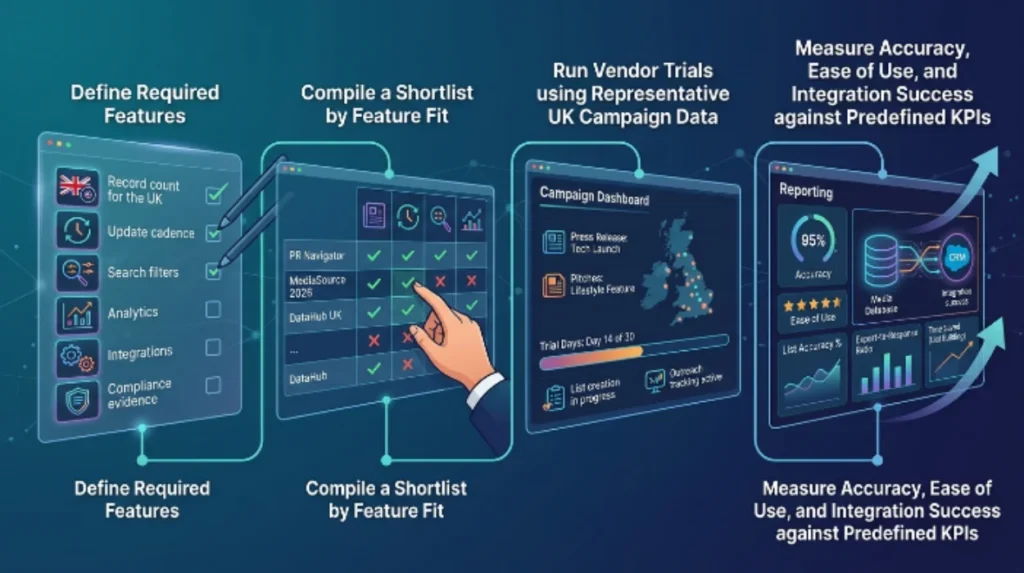
Define clear use cases, compile a shortlist by feature fit, run vendor trials using representative UK campaign data, and measure accuracy, ease of use, and integration success against predefined KPIs.
Start by listing required features: record count for the UK, update cadence, search filters, analytics, integrations, and compliance evidence. Shortlist vendors that meet core requirements. Run a 14–30 day trial using one or two real campaigns to test list creation, export fidelity, and outreach tracking. Measure outcomes against KPIs such as list accuracy percentage, export-to-response ratio, and time saved in list building. Use pilot data to inform contract length and feature tier selection.
For further reading on channel selection and PR measurement, see:
How UK Trade Press Differs From National Media for Product Launches
Media databases in the UK vary by coverage depth, update cadence, search sophistication, analytics, integrations, and compliance practices. Mid-funnel teams should prioritise verified UK contact coverage, weekly update cadence where possible, multi-criteria search, API and CRM integrations, and measurable analytics. Evaluate vendors through structured trials and predefined KPIs to ensure data quality and workflow fit.
Read More to Understand Better:
How Time Intelligence Media Group Measures PR Distribution Results for UK Clients