
Same-day PR distribution delivers press releases to targeted UK media lists and platforms within the same 24-hour period after final sign-off. Time Intelligence Media Group defines same-day distribution as delivery to specified journalist and publisher contacts, newsroom feeds, and syndication partners within the same calendar day of client approval. The service includes routing plain-text and HTML versions, attaching multimedia, and providing live delivery confirmation.
Same-day distribution requires pre-validated media lists and automated workflows. It requires clear client approval windows and ready-to-send assets: final headline, 30–40-word lead, dateline, contact details, one quote, and a one-sentence boilerplate. The process uses distribution channels with fast ingestion APIs and direct publisher connections to ensure immediate pickup. Same-day delivery excludes editorial booking guarantees; it focuses on rapid dissemination to editorial inboxes, wire feeds, and monitored portals.
How does the same-day distribution process work step by step?
The process follows asset validation, embargo and timing confirmation, targeted routing, live delivery, and reporting within the same day. First, client provides final copy and multimedia assets and confirms embargo instructions and target time in UK local time. Second, the team validates assets for formatting, link integrity, and legal compliance. Third, the system routes the release to pre-segmented UK media lists, national wire partners, trade outlets, and sector-specific contacts. Fourth, the system records delivery receipts and captures screenshots or proof-of-delivery for publishers that supply them. Fifth, the service issues a consolidated report with delivery timestamps and initial pickup indicators.
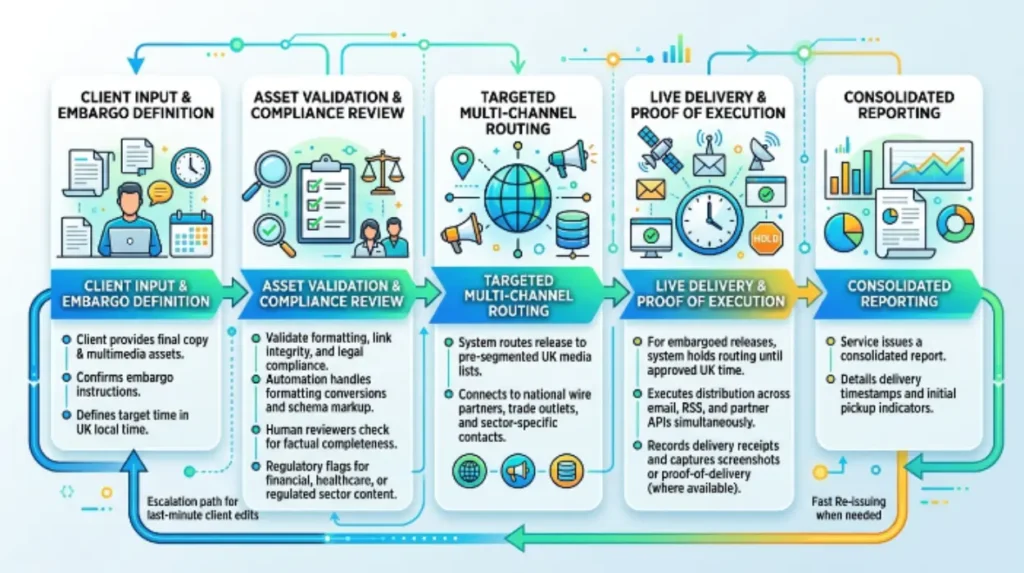
Automation handles formatting conversions and schema markup insertion. Human reviewers check for factual completeness and regulatory flags for financial, healthcare, or regulated sector content. For embargoed releases, the system holds routing until the approved UK time and executes distribution across email, RSS, and partner APIs simultaneously. The workflow includes escalation paths for last-minute client edits and fast re-issuing when needed.
What components and inputs are required from clients for same-day delivery?
Clients must provide final text, headline, dateline, contact details, multimedia, target media list or audience segments, embargo rules, and delivery time. Final text must include the six basic facts: who, what, when, where, why, and how, and a 30–40-word lead paragraph. Multimedia assets require web-optimised images and captions, and optional video files with hosted streaming links. Contact details must list one media contact with phone and email.
Clients must specify target sectors and geography within the UK: national, London, Scotland, Wales, Northern Ireland, or specific regions such as Manchester or Glasgow. For trade outreach, clients list beats such as finance, health, technology, or education. Clients provide any regulatory statements for financial disclosures or embargo instructions using day-month-year UK format. Missing elements delay same-day execution and may push distribution to the next available slot.
How does the service ensure legal and regulatory compliance in the UK?
The workflow enforces content checks for advertising standards, FCA disclosures, and sector-specific rules, plus clear labelling for paid or sponsored content. Automated validation flags promotional language and unsupported claims. Human reviewers confirm financial announcements include required regulatory statements and filing references. For health or medical claims, reviewers request clinical source citations and trial identifiers when present.
The system enforces the Advertising Standards Authority (ASA) and Committee of Advertising Practice (CAP) rules on misleading claims and sponsorship labelling. For regulated securities announcements, the process requires client confirmation of any necessary FCA notifications and includes advice to consult legal counsel when statutory filings are required. The distribution includes disclosure labels for sponsored or advertorial placements when delivery to partner publisher paid channels occurs.
How does targeting work for UK media and journalist lists?
Targeting uses segmented UK lists by geography, sector, outlet type, and journalist beat; lists update weekly and include contact verification scores. Segments include national newspapers, regional newsrooms, trade publications, broadcast producers, and digital-only outlets. Each contact record includes outlet name, journalist name, beat, email, phone, and last-contact timestamp.
The system supports custom lists supplied by clients and cross-references them with verified internal lists. Targeting rules allow inclusion or exclusion of outlets and weight distribution to priority contacts. For high-priority stories, the workflow schedules follow-up alerts to selected journalists and offers embargoed attachments under controlled access. Lists include performance history showing previous pickup rates for specific beats and outlets.
How are multimedia and links handled for fast distribution?
Multimedia assets receive web optimisation, correct file naming, alt text, and hosted links; the system attaches or embeds assets according to publisher requirements. Images are converted to common web formats with maximum file sizes and appropriate aspect ratios. Videos are hosted on secure streaming endpoints and referenced with embed codes or direct links. Alt text and captions accompany each asset for accessibility and captioning requirements.
Links receive validation for redirects and tracking parameters. The system replaces unsafe or blocked tracking tokens with accepted parameters for major publishers. When publishers require host-served images, the workflow supplies direct image URLs; when they prefer attachments, the release includes files in email-compatible formats. These preparations reduce publisher rejections and speed editorial processing.
What reporting and analytics come after same-day distribution?
Reporting includes delivery receipts with timestamps, pickup counts, outlet screenshots, click metrics for included links, and a distribution summary within 24 hours. The report lists total emails sent, delivery success rate, bounce rate, and open rate for partner newsletter distributions. It also highlights initial media pickups with links to live coverage and social shares obtained within the first 24 hours.
Analytics include referral traffic estimates from monitored pickups and backlinks found by automated crawlers. For paid partner placements used alongside distribution, the report includes verified impressions and click-through rates. The consolidated report supplies raw delivery logs suitable for client auditing and campaign accounting.
What outcomes can clients expect from same-day PR distribution?
Clients receive fast visibility across chosen UK media segments, documented delivery proofs, and initial coverage indicators that support immediate monitoring and follow-up. Same-day distribution drives rapid awareness among journalists and stakeholders. Documented proofs assist regulatory compliance and internal reporting. Early pickup indicators let clients deploy follow-up communications, interviews, or paid amplification within hours.
Same-day distribution does not guarantee editorial coverage. Editorial decisions remain with publishers. Clients can use initial reports to prioritise outreach to outlets that opened the release or requested interviews. For time-sensitive crises or product launches, same-day distribution ensures timely news delivery to critical contacts.
Explore More Expert Insights:
What UK Clients Get With Time Intelligence Media Group’s Distribution Service
How Time Intelligence Media Group Measures PR Distribution Results for UK Clients
How does integration with paid placements or earned outreach support goals?
Integration links same-day distribution with targeted paid placements and coordinated journalist outreach to convert awareness into measurable outcomes. Paid placements secure immediate visibility in high-traffic locations on target dates. Earned outreach follows with tailored journalist pitches and spokespeople availability. Coordinated workflows align timing so paid exposure appears alongside potential editorial coverage.
For product launches, clients schedule paid homepage features for launch day while executing same-day press routing. For regulatory filings, clients issue the release and pursue trade editor briefings to encourage informed coverage. Integrated reporting consolidates paid delivery metrics and earned pickups for ROI analysis and next-step decisions.
What use cases in the UK require same-day PR distribution?

Use cases include earnings releases, product launches, crisis statements, regulatory filings, and timely campaign announcements that require immediate media notification. Earnings and regulatory filings need precise timing for market transparency. Product launches scheduled for specific dates need coordinated media notice. Crisis communications require immediate distribution to manage public messaging. Political statements and policy updates timed with government releases benefit from same-day routing.
Each use case defines asset requirements and target lists. For example, earnings releases need audited figures and legal disclaimers. Product launches require product images and demo videos. Crisis statements require a single verified spokesperson and rapid contact availability for media queries.
Learn Everything About It Here:
How Long Should a UK Press Release Be in 2026?
Same-day PR distribution in the UK delivers rapid routing to targeted media segments, enforces regulatory checks, optimises multimedia, and provides proof-based reporting within 24 hours. Integration with paid placements and earned outreach supports conversion-focused campaigns that require immediate visibility and documented outcomes. For regulated announcements, include statutory disclosures. For product launches, prepare multimedia and spokespeople for immediate interviews.
Dive Deeper Into This Topic:
Guaranteed Placements vs Earned Coverage: What UK Buyers Should Expect