
The FCA regulates financial services and the ASA enforces advertising rules; both set standards that change what can appear in UK press releases about regulated products.
The Financial Conduct Authority (FCA) is the statutory regulator for financial services in the United Kingdom. The Advertising Standards Authority (ASA) is the independent advertising regulator that enforces the UK Code of Non-broadcast Advertising and Direct & Promotional Marketing (CAP Code). Press releases that discuss financial products, investment opportunities, pensions, insurance, or other regulated services fall under FCA rules and the ASA’s interpretation of advertising standards. Compliance prevents enforcement actions, corrections, and reputational harm.
The FCA defines regulated activities and requires communications to be fair, clear, and not misleading. The ASA applies the CAP Code to promotional claims and can investigate paid or unpaid publicity when it is commercial in nature. Both bodies assess factual accuracy, risk information, balance, and presentation style. When press releases include pricing, performance data, or comparisons, the regulatory standards become stricter.
What specific standards do the FCA require for communications about regulated products?
FCA rules require communications to be clear, fair, and not misleading, to disclose material risks, and to provide evidence for factual claims.
The FCA’s rules on communications originate in the Principles for Businesses and specific sourcebooks such as the Conduct of Business Sourcebook (COBS) for investment-related material and the Financial Promotion Order for promotions. Key requirements include factual accuracy, avoidance of biased presentation, and clear disclosure of risks and costs. When historical performance is stated, firms must present appropriate context such as timeframes, whether figures are net of fees, and the use of comparable benchmarks. Any forward-looking statements require substantiation and must not create unrealistic expectations.
The FCA requires firms to ensure that third-party communications, including press releases, meet the same standards if the content promotes regulated products. This means firms must review, approve, and maintain records of press releases that qualify as financial promotions. When communications target retail consumers, additional protections apply, including simplified language and prominent risk warnings.
What advertising rules does the ASA apply to press releases?
The ASA applies the CAP Code which demands honesty, evidence for claims, and clear identification of commercial intent in promotional content.
The ASA enforces the CAP Code across paid, owned, and earned media where content serves a marketing or promotional purpose. The Code requires claims to be substantiated with evidence that is available to the ASA on request. The Code prohibits misleading omissions and requires that benefits and limitations are presented with equal clarity. Comparative claims must be accurate, and superlatives require verifiable proof. The ASA also examines the overall impression a communication creates in the minds of the target audience.
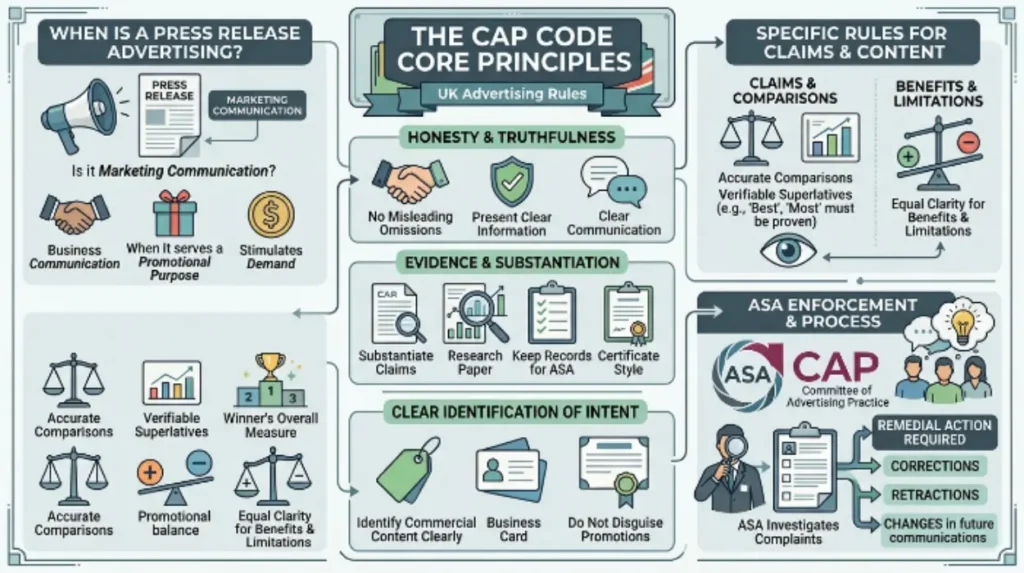
When a press release contains promotional claims about products or services, the ASA treats it like any advertisement. Even factual announcements can fall under the CAP Code if they are designed to stimulate demand. The ASA can investigate complaints and require remedial action such as corrections, retractions, or changes in future communications.
How do FCA and ASA rules interact for financial press releases?
Both regimes overlap on accuracy and fairness; the FCA focuses on investor protection and authorised firm responsibilities while the ASA focuses on advertising standards and public impressions.
The FCA and ASA share common ground in demanding truthful, evidenced communications. The FCA deals with whether a communication is a regulated financial promotion and whether it meets conduct of business obligations. The ASA assesses whether the public would find the communication misleading or unfair under advertising rules. In practice, a press release about a financial offering must satisfy FCA requirements for financial promotions and the ASA’s CAP Code for advertising claims.
Firms should adopt processes that address both sets of rules. This includes legal and compliance review for FCA obligations, and claims substantiation and consumer perspective review to meet ASA standards. A single press release can attract scrutiny from both bodies if it contains both regulatory content and promotional messaging. Regulatory enforcement can arise from either an FCA finding of an unlawful financial promotion or an ASA ruling following a complaint.
What elements must appear in a compliant regulated press release?
Compliant press releases contain accurate statements, verifiable evidence, clear risk disclosures, target audience identification, and approval records.
Accuracy requires checking figures, dates, and descriptions against source documents. Evidence means retaining research, data sources, and benchmark comparisons. Risk disclosures should be prominent, specific, and contextualised; for example, stating the nature of potential losses, liquidity constraints, and relevant time horizons. Identifying the intended audience ensures the communication uses appropriate language and includes protections required for retail recipients. Approval records demonstrate that authorised personnel reviewed and approved the release under internal governance procedures.
When presenting performance metrics, include time periods and fees. When making forward-looking statements, include assumptions and limit certainty. When comparing to competitors, use objective, recent data and cite sources. For third-party endorsements, confirm permissions and provide context for relevance. Firms must keep records of all approvals and supporting evidence for at least the period required by regulatory recordkeeping rules.
What process should organisations follow to prepare a regulated press release?
A robust process includes legal classification, claims substantiation, compliance review, senior approval, and recordkeeping.
First, classify the communication: determine whether the content constitutes a financial promotion under FCA rules or a commercial communication under the CAP Code. Next, gather and document evidence for all factual claims and performance statements. Then run a compliance review that checks FCA sourcebook requirements and CAP Code principles and ensures language is clear and risk information is prominent. Obtain sign-off from an authorised senior individual where required by internal governance or FCA rules. Finally, archive the final text, approvals, and supporting evidence for regulatory inspection.
Organisations must train staff involved in drafting press releases to recognise regulated content. Legal counsel or compliance teams should provide templates and checklists that address key disclosure points. Where third-party distributors or journalists republish content, include instructions or embargoed language to reduce the likelihood of misleading edits.
What are the consequences of non-compliant press releases?
Consequences include regulatory investigations, required corrections or retractions, fines, and reputational damage.
The ASA can require removal or amendment of online content, publish rulings against the advertiser, and refer serious cases to statutory bodies. The FCA can investigate breaches of financial promotion rules, require firms to stop disseminating unlawful promotions, impose fines, and escalate enforcement where consumer harm occurs. Civil liability claims can arise if investors suffer loss after relying on misleading information. Reputational consequences include media coverage of regulatory action and loss of stakeholder trust.
Regulators consider both the content and the firm’s governance when deciding penalties. Demonstrable proactive procedures, prompt corrective action, and full cooperation reduce the risk of severe sanctions. Conversely, repeated or deliberate misstatements attract greater penalties.
What are practical examples of compliant and non-compliant statements?
Compliant statements state facts with sources and risk context; non-compliant statements omit risks, use unsubstantiated superlatives, or present selective performance.
A compliant example: “Net return was 4.2% annualised from 2019 to 2023, net of fees, based on audited statements.” This statement gives a figure, period, fee treatment, and source type. A non-compliant example: “This investment delivers top returns” without data or timeframe. Another non-compliant example: “Past returns guarantee future performance” which violates both FCA and ASA rules on misleading assertions. When comparing products, compliant wording cites dates and objective metrics, while non-compliant wording uses vague terms like “best” with no evidence.
Explore More Expert Insights:
How UK Trade Press Differs From National Media for Product Launches
The Real Cost of PR Distribution in the UK: What Your Budget Buys
How should journalists and PR teams handle third-party claims and data?
When using third-party research or ratings, obtain explicit permission to reproduce data. Check the methodology and date of the source, and confirm whether the original issuer imposes limitations on redistribution. For analyst quotes, obtain written consent and confirm the context. When summarising external reports, avoid selective citation that misrepresents the overall findings. Maintain a record of communications with third parties to support future regulatory queries.
If a journalist independently republishes a quoted figure, clarify the original source within the press release. Where embargoes apply, ensure all parties understand publication timing and legal obligations. Failure to verify third-party claims increases the risk of factual inaccuracies that trigger ASA complaints or FCA scrutiny.
How can organisations reduce regulatory risk over time?

Adopt written policies, train staff annually, use standard templates, and perform periodic audits of communications.
Written policies should define approval authorities, documentation requirements, and templates for common disclosure items such as risk statements and performance metrics. Annual training ensures writers, communications teams, and senior approvers understand evolving FCA and ASA expectations. Standard templates reduce omission errors by including required fields for evidence, audience classification, and sign-off. Regular audits identify gaps and provide corrective action plans. Maintain a central repository for approved messaging and past releases to ensure consistent public statements.
Regulators value a demonstrable culture of compliance. Transparent processes and rapid corrective responses reduce enforcement risk and preserve public trust.
Explore the Advanced Guide:
How to Vet a UK PR Distribution Partner Before You Sign
The FCA and ASA shape what can appear in UK press releases about regulated products by requiring accuracy, evidence, and clear risk disclosure. Compliance requires classification of the communication, documented evidence for claims, prominent risk statements, appropriate approval, and recordkeeping. Non-compliance triggers investigations, corrections, fines, and reputational harm. Organisations that formalise policies, train staff, and use audit controls reduce regulatory exposure and improve the clarity of public communications.
Complete Details Available Here:
What UK Clients Get With Time Intelligence Media Group’s Distribution Service