
An owned newsroom is a brand-controlled digital hub for news and content; paid distribution is a service that delivers press releases to external media channels and databases. Each entity serves different communication objectives and measurement models.
An owned newsroom is a website section or microsite where a company publishes press releases, multimedia assets, executive bios, downloadable files, and contact details. It delivers permanent, searchable records under the brand domain. Owned newsrooms support SEO through on-site content, structured metadata, and internal linking. They record direct traffic, time on page, and conversions using analytics platforms. Paid distribution is a service or platform that sends press releases to media outlets, journalist databases, newswires, and syndication partners. It delivers timed pushes to aggregated audiences outside the brand domain. Paid distribution reports include impressions, pickup counts, pickup URLs, and basic engagement metrics.
How does the process of using an owned newsroom differ from paid distribution?
Owned newsroom workflows center on content creation, CMS publishing, and SEO; paid distribution workflows center on targeting, scheduling, sending, and monitoring pick-ups. Each workflow requires distinct resources and timelines.
Owned newsroom processes require content drafting, editorial approval, multimedia production, metadata tagging, and CMS publishing. Typical timelines run from 2 to 14 days depending on approval cycles and multimedia needs. Maintenance tasks include archiving, page updates, and ongoing SEO optimization. Paid distribution processes require crafting a distribution-ready release, selecting target lists or tiered packages, scheduling the send, and monitoring incoming pickups. Distribution sends can execute within 24 hours after final approval when using standard wire services. Follow-up outreach and journalist pitches often occur in the 48–72 hours after distribution to secure interviews or feature coverage.
What components make up the costs for each approach?
Owned newsroom costs include development, hosting, content production, and SEO; paid distribution costs include placement fees, list access, multimedia add-ons, and reporting. Quantified cost elements determine total investment.
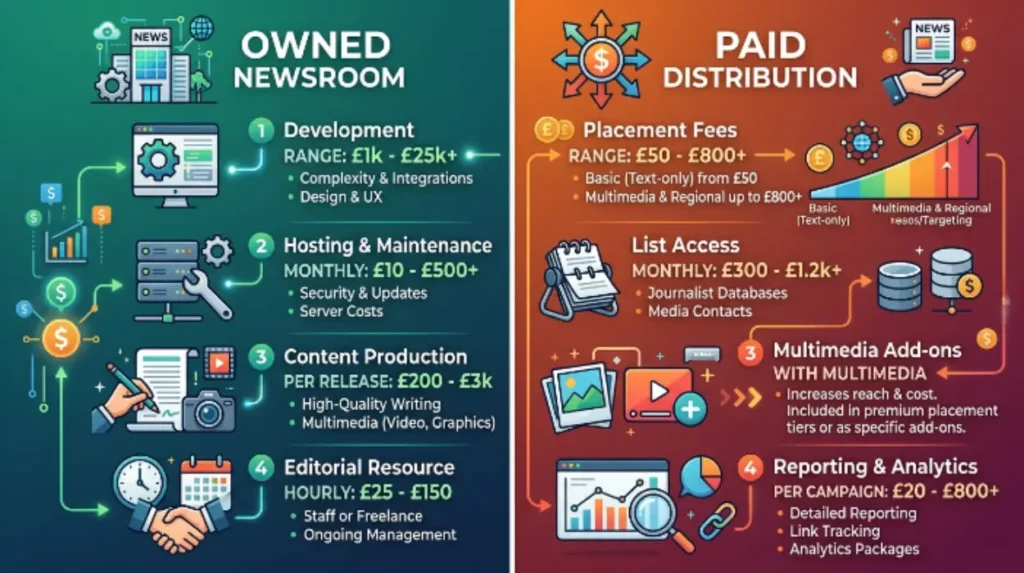
Owned newsroom development costs range from £1,000 to £25,000 depending on complexity, integrations, and design. Hosting and maintenance add £10 to £500 per month. Content production budgets vary: a single high-quality press release with multimedia costs £200 to £3,000. Ongoing editorial resource costs depend on staff or freelance rates, typically £25 to £150 per hour. Paid distribution fees for a single release vary from £50 for basic text-only national runs to £800 for multimedia-enhanced national plus regional targeting. Journalist database access subscriptions range from £300 to £1,200 per month. Detailed reporting or link-tracking packages add £20 to £800 per campaign.
What benefits does an owned newsroom provide for UK brands?
Owned newsrooms deliver permanent content control, SEO benefits, direct visitor metrics, and centralised digital asset management. These benefits support long-term content strategies and domain authority.
Control over messaging prevents third-party alterations and preserves brand tone. Content remains indexed under the brand domain, contributing to organic search visibility and cumulative SEO value. Direct visitor metrics provide precise data on user journeys, conversions, and on-site engagement. Centralised asset storage simplifies journalist access and internal reuse of images, logos, and fact sheets. Owned newsrooms also support gated assets for lead capture and house historical archives for regulatory or compliance reference.
What benefits does paid distribution provide for UK brands?
Paid distribution offers broad third-party reach, immediate exposure, journalist access, and measurable pickup reports. These benefits support short-term visibility and PR amplification.
Distribution reaches external audiences across national and regional outlets and trade verticals within hours. Access to curated journalist lists improves chances of coverage in specific sectors, such as finance or healthcare. Pickup reports identify which outlets republished content and provide URLs for backlink tracking. Paid distribution accelerates news visibility during time-sensitive events, product launches, or announcements that require coordinated external exposure.
How do outcomes compare between owned newsroom and paid distribution?
Owned newsroom outcomes focus on organic search value, sustained traffic, and asset control; paid distribution outcomes focus on short-term reach, media pickups, and referral traffic. Outcomes map to different KPIs and time horizons.
Owned newsroom measurements include organic search rankings, direct visits, on-site engagement metrics, and conversions traceable to newsroom content. These metrics accumulate over months and years. Paid distribution measurements include immediate impressions, pickup counts, referral sessions from republished items, and initial backlink acquisition. Paid distribution delivers spikes in awareness within 24–72 hours; sustained impact depends on pickup quality and subsequent follow-on coverage.
When does an owned newsroom outperform paid distribution?
An owned newsroom outperforms paid distribution for long-term brand visibility, SEO-driven content strategies, and complex assets requiring controlled presentation. It suits organisations with ongoing content needs and resources for maintenance.
Brands with regular newsflow—monthly or more frequent announcements—gain SEO cumulative benefits from an owned newsroom. Stories that rely on rich media, detailed backgrounders, or downloadable research perform better in a controlled environment. Regulatory filings, detailed technical documentation, or governance updates require permanent, unaltered records that an owned newsroom provides. Owned newsrooms lower per-release cost over time for organisations that publish dozens of items per year.
When does paid distribution outperform an owned newsroom?
Paid distribution outperforms for rapid external reach, targeted sector exposure, and events that need immediate media attention. It suits time-sensitive announcements and one-off campaigns.
Announcements that require national or regional media attention within days perform better with paid distribution. Product launches with a short lead window, crisis statements requiring immediate broadcast, and events seeking rapid ticket sales benefit from distribution services. Campaigns that lack in-house audience or domain authority gain initial visibility through external syndication and journalist exposure.
Explore More Expert Insights:
How to Compare UK PR Distribution Packages Without Overpaying
What to Look for in a UK PR Distribution Report (and the Metrics That Mislead)
How should UK brands choose between the two approaches?

Brands should align channel choice with campaign goals, frequency, timeline, and available resources; a hybrid model often balances reach and long-term value. Decision criteria map to measurable KPIs.
If the primary goal is domain growth, lead capture, and controlled archives, prioritise investment in an owned newsroom and allocate content production budgets accordingly. If the primary goal is immediate media pickup and broad external reach, prioritise paid distribution for selected releases and use personalised pitches for key journalists. For most organisations with mixed objectives, combine owned newsroom publishing with selective paid distribution for major announcements to secure both immediate exposure and long-term SEO value.
What operational steps improve results when using both methods together?
Synchronise publishing schedules, use consistent metadata, prepare multimedia assets in advance, and set unified tracking to measure cross-channel impact. These steps create coherent measurement and improve media pickup efficiency.
Publish the release on the owned newsroom before or simultaneously with paid distribution to ensure that republished items link back to the brand domain. Use structured metadata and canonical tags to prevent duplicate-content penalties and to direct SEO value to the brand site. Prepare high-resolution images, video clips, and downloadable data sheets before the send to reduce turnaround times for journalists. Apply consistent UTM parameters and link-tracking across newsroom assets and distribution items to attribute referral traffic accurately.
For cost-focused context and budgeting guidance, see:
The Real Cost of PR Distribution in the UK: What Your Budget Buys
This article defined owned newsrooms and paid distribution, explained processes and cost components, contrasted benefits and outcomes, and offered selection and operational guidance for UK brands.
For a deeper, implementation-focused comparison, see:
Time Intelligence Media Group vs Traditional UK Newswires: What’s Different