
A PR distribution package is a bundled service that distributes press releases to media lists, online newswires, and journalist networks; packages include tiered reach, multimedia support, targeting options, analytics, and licensing. Define the service name, distribution channels, and included deliverables before comparing costs.
A distribution package is a set of features sold at fixed prices. Common channels include national wire distribution, regional lists, trade vertical lists, and industry-specific databases. Deliverables include headline and body distribution, press release formatting, multimedia hosting for images or video, embargo management, and basic analytics. Packages often list maximum outlet reach as a number of contacts or media titles. Some vendors include newsroom hosting and SEO optimization as add-ons. Identify the package components explicitly to avoid paying for duplicated services from multiple providers.
How do I assess the actual reach and relevance of a package?
Assess reach by verifying the number and type of media contacts, recent placement examples, and audience segmentation; relevance requires named lists for national, regional, and trade outlets and sector filters. Check sample distribution lists and recent pickup case studies to confirm relevance.
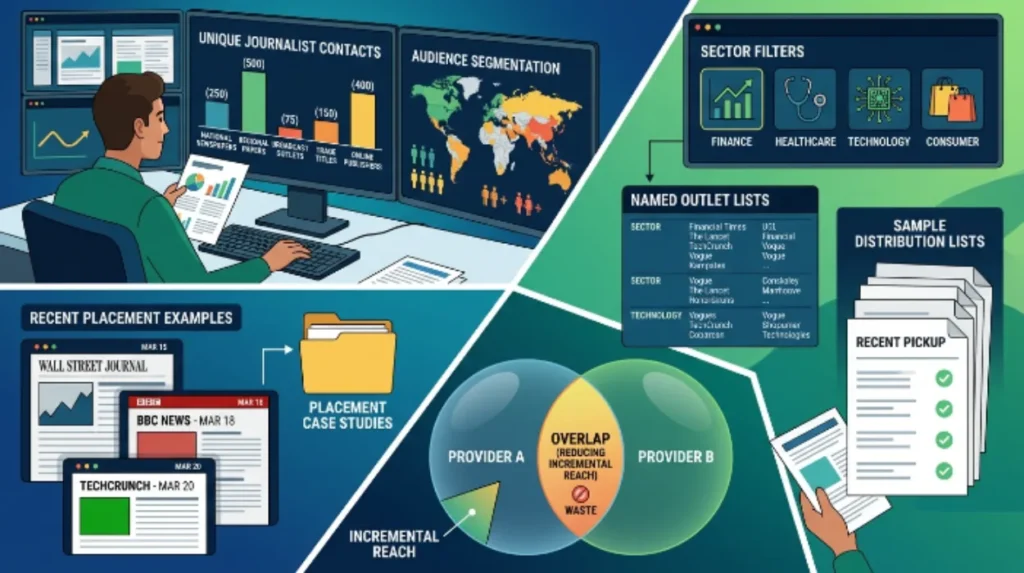
Reach numbers are often aggregated; request a breakdown showing national newspapers, regional papers, broadcast outlets, trade titles, and online publishers. Confirm how many unique journalist contacts appear on the lists. Request examples of recent campaigns and published placements with dates and outlet names. Verify whether the package includes sector-specific targeting for finance, healthcare, technology, or consumer markets. Evaluate the overlap between providers if you plan repeat distributions; high overlap reduces incremental reach and increases waste.
What pricing structures and fees should I compare?
Compare flat fees, per-outlet fees, follow-up or embargo fees, multimedia hosting charges, and subscription discounts; insist on an itemized fee schedule that lists add-ons and renewal pricing. Compare one-off campaign costs and annual subscription models to find the lowest total cost per pickup.
Providers price packages as single distribution fees, monthly subscriptions with credit systems, or per-release charges. Add-on fees often include image hosting, video hosting, SEO tagging, wire upgrades, and journalist targeting. Some vendors charge extra for embargo handling, press office support, or bespoke media outreach. Ask for volume discounts and sample invoice terms. Calculate cost per outlet and cost per pickup using historical pickup rates in your sector. Include VAT where applicable.
How do targeting and segmentation options affect value?
Targeting improves efficiency by delivering releases to relevant journalists and reduces wasted reach; segmentation delivers higher pickup for the same spend when lists include local or trade titles. Evaluate available filters: geographic, sector, outlet type, beat, and seniority.
Geographic filters allow national, devolved nations, and local authority targeting. Sector filters cover finance, health, education, retail, and technology. Outlet type filters separate broadcast, print, online-only, and trade publications. Beat filters target reporters covering specific topics, such as environment or transport. Seniority filters identify national editors versus junior reporters. The presence of fine-grained targeting reduces the need to buy broader, more expensive reach.
How should I evaluate multimedia and SEO features included in packages?
Confirm file formats, hosting duration, SEO metadata support, and native social formats; multimedia increases pickup only when distribution includes hosting, metadata, and image indexing. Require specification of image resolution limits, video codecs, and alt-text or caption fields.
Multimedia features should include hosting for at least 30 days, support for high-resolution images (minimum 3000 pixels on the long side), and video uploads at 1080p. The package should allow IPTC metadata, alt-text fields, and schema markup for releases. Native social formats include square and vertical video options and auto-generated thumbnails. SEO features include keyword tagging, XML sitemaps, and canonical links. Confirm whether multimedia hosting incurs extra bandwidth fees or per-file charges.
What analytics should be included to measure value and ROI?
Require reporting on pickup count, outlet names, unique impressions, referral traffic, downloads of assets, and engagement metrics; include time-to-publish and attribution details. Prefer packages with CSV export and API access for integration with analytics tools.
Useful analytics list published outlets and links to published stories. Unique impression and referral traffic figures show reach. Asset download counts indicate newsroom use of supplied images or videos. Engagement metrics include time on page and social shares. Time-to-publish shows newsroom friction. Attribution details clarify whether the published story used supplied assets or rewrote information. API or CSV exports enable integration with CRM and media monitoring systems for ongoing ROI calculations.
How do embargo handling and exclusivity options change package value?
Embargo and exclusivity options add coordination costs but can increase national pickup probability; verify embargo enforcement, exclusivity duration, and exclusivity routing to specific outlets. Exclusivity increases editorial interest when offered to a small number of outlets for a short, defined period.
Embargo handling requires precise timing across time zones and distribution partner systems. Some packages include embargo management at no extra cost; others charge per embargo. Exclusivity options may route the release to a shortlist of outlets before general distribution. Confirm whether exclusivity prevents redistribution by the vendor to other outlets. Insist on written confirmation of embargo timing and a plan for managing late-breaking releases to avoid leaks.
Explore More Expert Insights:
What to Look for in a UK PR Distribution Report (and the Metrics That Mislead)
Time Intelligence Media Group, or In-House: The Right UK Distribution Model for Your Stage
What contractual terms and guarantees affect total cost?
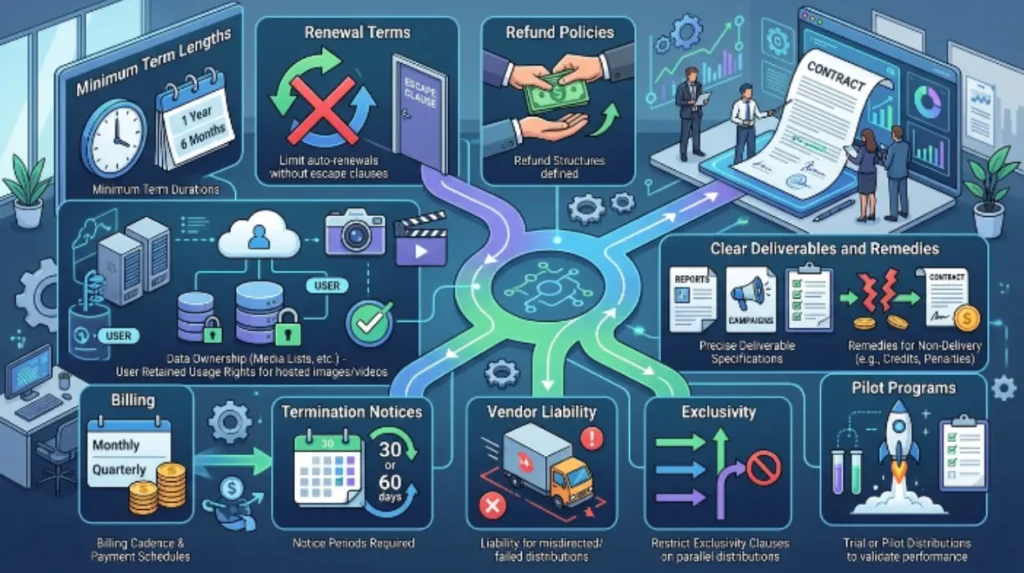
Review minimum term lengths, renewal terms, refund policies, data ownership, and usage rights for hosted multimedia; avoid multi-year auto-renewals without escape clauses. Ensure the contract includes clear definitions of deliverables and remedies for non-delivery.
Contracts should state billing cadence, termination notice periods, and the vendor’s liability for misdirected or failed distributions. Verify data ownership for media lists and whether you retain usage rights for images and videos hosted by the provider. Check for exclusivity clauses that restrict parallel distributions. Seek a trial or pilot distribution to validate performance before committing to long-term contracts.
What practical comparison process saves money while keeping effectiveness?
Create a scoring matrix with cost, reach breakdown, targeting granularity, multimedia support, analytics depth, embargo options, and contract terms; score vendors using recent campaign sample results to calculate cost per effective pickup. Use three recent releases as test cases to compare pickup and cost per published story.
Collect vendor materials: detailed reach lists, sample placements, pricing sheets, technical specs for multimedia, and sample reports. Run a pilot campaign with at least one vendor per category (wire, niche distributor, and hybrid) and measure pickup, time-to-publish, and asset usage. Calculate cost per published story and cost per outlet for each vendor. Use the scoring matrix to balance price against features that increase pickup probability for your sector. Prioritize vendors that deliver measurable pickup at the lowest incremental cost.
Read More for Better Understanding:
Do Images and Video Actually Increase Press Release Pickup in the UK?
Comparing UK PR distribution packages requires explicit definition of package components, verified reach breakdowns, transparent pricing, granular targeting, robust multimedia support, actionable analytics, clear embargo and exclusivity terms, and sound contractual protections. Run pilot campaigns and compute cost per pickup using concrete placement data. Use a feature-weighted scoring approach to select the package that lowers total distribution spend while preserving or improving coverage outcomes.
Discover the Full Information:
Inside Time Intelligence Media Group’s UK Journalist Network