
Time Intelligence Media Group’s UK journalist network is a curated database of UK-based journalists, editors, and content producers used to place stories, arrange exclusives, and source commentary across print, broadcast, and online outlets. The network lists 9,500+ UK contacts, role, outlet, beat, and preferred contact method.
The network defines each contact by name, job title, outlet type, beat, region, and contact preference. Outlet types include national newspapers, regional newspapers, trade publications, broadcast outlets, and specialist online publishers. Beats cover politics, health, finance, technology, consumer, environment, and local government. The database updates contact records monthly and records the last-contact date and engagement history. The network also stores editorial calendars when available and flags journalists who accept contributed content or embargoed exclusives.
How is the journalist network assembled and verified?
The network assembles contacts from public mastheads, verified outreach, editorial calendars, and subscription-based media monitoring; verification uses direct email confirmation, response tracking, and third-party data cross-checks. The process filters out inactive emails and duplicates, and it assigns confidence scores to each record.
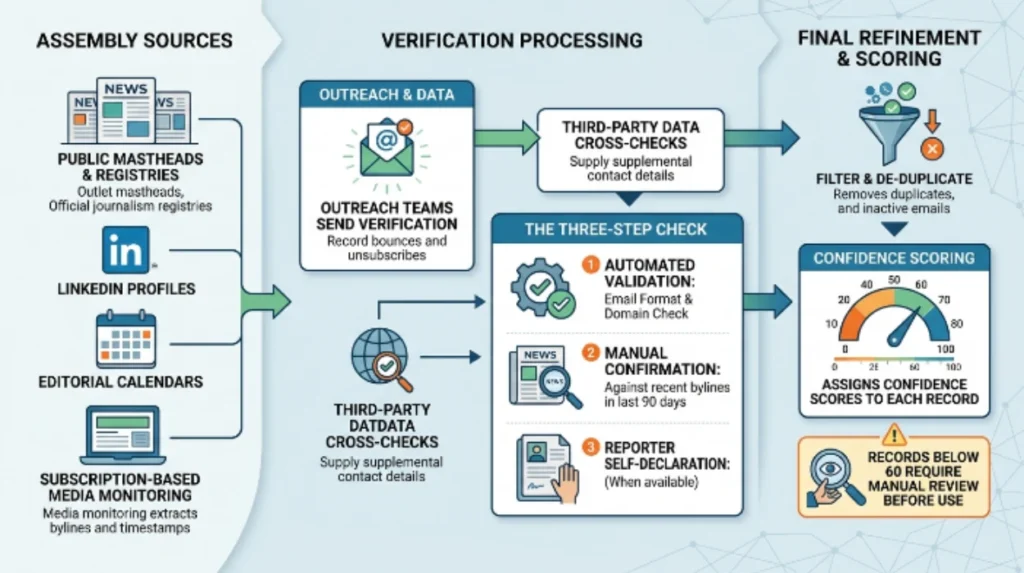
Assembly starts with public sources: outlet mastheads, LinkedIn profiles, and official journalism registries. Outreach teams send verification emails and record bounces and unsubscribes. Media monitoring extracts bylines and timestamps to confirm active publishing. Third-party data providers supply supplemental contact details. Verification includes a three-step check: automated validation of email format and domain; manual confirmation against recent bylines in the last 90 days; and reporter self-declaration when available. Each contact carries a confidence score from 0 to 100. Records below 60 require manual review before use.
What components comprise the network’s contact profiles?
Each contact profile contains full name, job title, outlet, beat tags, location, contact methods, confidence score, last-published date, and editorial calendar notes. Profiles include social handles, phone numbers when public, and a history of previous PR interactions.
Profiles include structured fields for fast querying. Beat tags use a controlled vocabulary of 120 terms to ensure consistent targeting. Location fields support country, devolved nation, region, and city granularity. Contact methods prioritize direct email, desk email, and social DM. Editorial calendar notes list planned themes and special issues for the next 12 months when available. Interaction history logs pitch dates, open rates, responses, and published placements tied to specific campaigns.
How do users access and search the network?
Users access the network via a web portal with advanced search filters, saved queries, list export, and campaign routing tools; the portal supports Boolean queries and natural-language search for convenience. Access includes role-based permissions and activity logs for compliance.
Search filters allow combination by outlet type, beat, region, seniority, and confidence score. Boolean queries support AND, OR, NOT, and proximity operators. Natural-language search accepts phrases like “health reporters London national” and returns ranked results. Saved queries store frequent target lists. List export options deliver CSV files with selected fields or direct routing to distribution workflows. Role-based permissions restrict contact exports and editing to authorised users. Activity logs record who accessed which records and when.
How does the network integrate with distribution and pitching workflows?
The network integrates with email distribution systems, newsroom wire services, and CRM platforms through API endpoints and CSV import/export, enabling targeted pitching and performance tracking. Integration includes campaign scheduling, embargo controls, and automated follow-up sequences.
APIs allow programmatic retrieval of lists and automatic injection into distribution queues. Campaign scheduling enforces embargo timestamps and sequences contacts by preferred contact method. Automated follow-up sequences send reminder pitches at defined intervals and log responses to the contact history. Integration with CRM platforms links media interactions to broader stakeholder records. The system supports webhook notifications for published placements, updating campaign metrics in real time.
What quality controls and compliance measures exist?
Quality controls include monthly record audits, bounce-rate thresholds, duplicate detection, and manual spot checks; compliance measures cover GDPR, data retention limits, and opt-out handling. The network maintains audit trails for all changes and retains consent records where applicable.
Monthly audits remove contacts with sustained bounce rates above 10% over 90 days. Duplicate detection consolidates records using name, outlet, and domain matching. Manual spot checks validate a random 5% sample each month. GDPR compliance requires lawful basis documentation for each contact where email outreach occurs; opt-out and unsubscribe records store timestamps and source. Data retention policies purge retired records after 24 months of inactivity unless refreshed. Audit trails record user edits, import sources, and verification steps for each profile.
What performance metrics tie the network to campaign results?
Performance metrics include pickup rate, outlet quality score, time-to-publish, asset usage rate, and engagement per contact; metrics link published placements back to the originating contact and campaign. Analytics attribute outcomes to specific contacts and sequences for accurate ROI.
Pickup rate measures the percentage of targeted contacts that produced published stories. Outlet quality score ranks publications by estimated monthly audience and editorial prominence. Time-to-publish records days between distribution and story publication. Asset usage rate counts how often supplied images or videos are used by outlets. Engagement per contact logs opens, replies, and conversions to placements. Attribution maps link published URLs, timestamps, and bylines back to the contact and campaign that generated the lead.
Explore More Expert Insights:
How Time Intelligence Media Group Guarantees UK National Media Reach
Why UK Brands Choose Time Intelligence Media Group for Press Release Distribution
What are the benefits of using this network for UK-focused PR campaigns?
Using the network increases targeting precision, reduces wasted outreach, and accelerates placement timelines by supplying updated contacts and editorial intelligence specific to the UK market. The network improves efficiency for national, regional, and trade campaigns by providing role, beat, and calendar data.
Precise targeting reduces the volume of irrelevant pitches. Regional granularity supports localised campaigns for devolved nations and city-level PR. Editorial calendar intelligence allows timing around known themes, increasing editorial receptivity. Confidence scores inform prioritisation of high-probability contacts. API-driven routing and automated follow-ups shorten campaign cycles and reduce manual administration. The network’s audit and compliance features lower legal risk for email outreach in the UK.
What use cases show clear outcomes from the network in the UK?
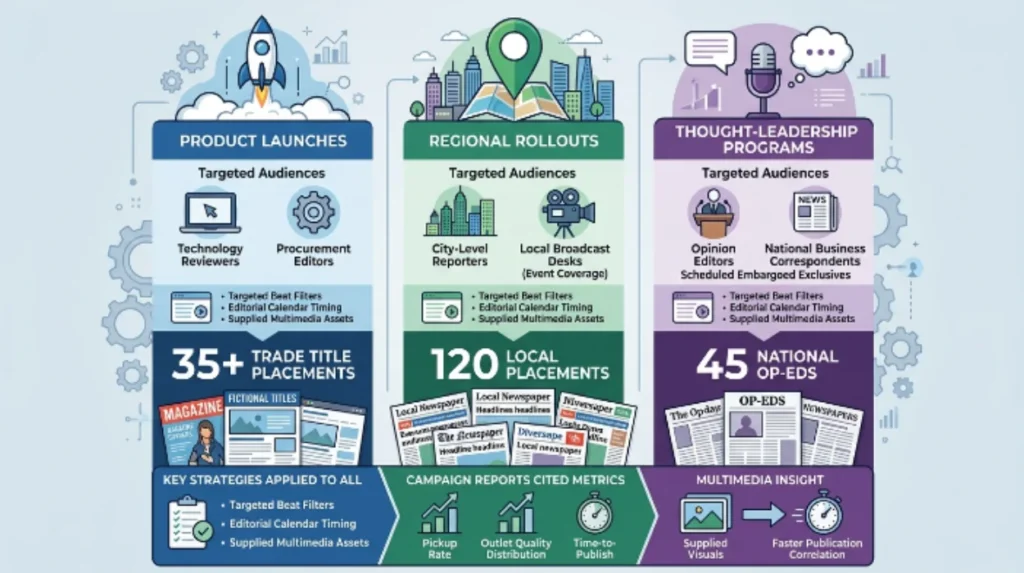
Successful use cases include product launches that placed in 35+ trade titles, regional campaign rollouts that secured 120 local placements, and thought-leadership programs that generated 45 national op-eds. Each case used targeted beat filters, editorial calendar timing, and supplied multimedia assets.
Product launches used technology and trade filters to reach product reviewers and procurement editors. Regional rollouts targeted city-level reporters and local broadcast desks for event coverage. Thought-leadership programs identified opinion editors and national business correspondents and scheduled embargoed exclusives. In each case, campaign reports cited pickup rate, outlet quality distribution, and time-to-publish as key success metrics. Asset usage data showed direct correlation between supplied visuals and faster publication.
Dive Deeper Into This Topic:
Do Images and Video Actually Increase Press Release Pickup in the UK?
The network provides a structured, verified, and integrated contact database for UK media outreach. It defines contacts by role, outlet, beat, and location, verifies records through multi-step checks, and integrates with distribution and analytics systems. Quality controls enforce data hygiene and GDPR compliance. Performance metrics attribute placements to contacts and campaigns, enabling cost-per-pickup calculations. Use cases show measurable improvements in targeting, pickup rates, and time-to-publish across national, regional, and trade campaigns.
Click Here to Explore More:
How to Compare UK PR Distribution Packages Without Overpaying