

Industry reports are structured documents that present market data, analysis, and insights about a specific sector; they include methodology, data sources, key findings, and actionable conclusions in a formal format.
Industry reports define a market, measure size, and describe trends. They list data sources such as surveys, panel data, transactional datasets, and official statistics. They state methodology including sample size, sampling frame, collection methods, and analysis techniques. They present findings as charts, tables, and narrative summaries. They conclude with implications for stakeholders such as buyers, vendors, and policymakers. An industry report for the UK B2B market commonly covers annual revenue, growth rates, customer segments, procurement processes, and regulatory impacts.
How are industry reports produced?
Report production follows stages: scoping, data collection, analysis, drafting, review, and publication with clearly documented timelines and responsibilities.
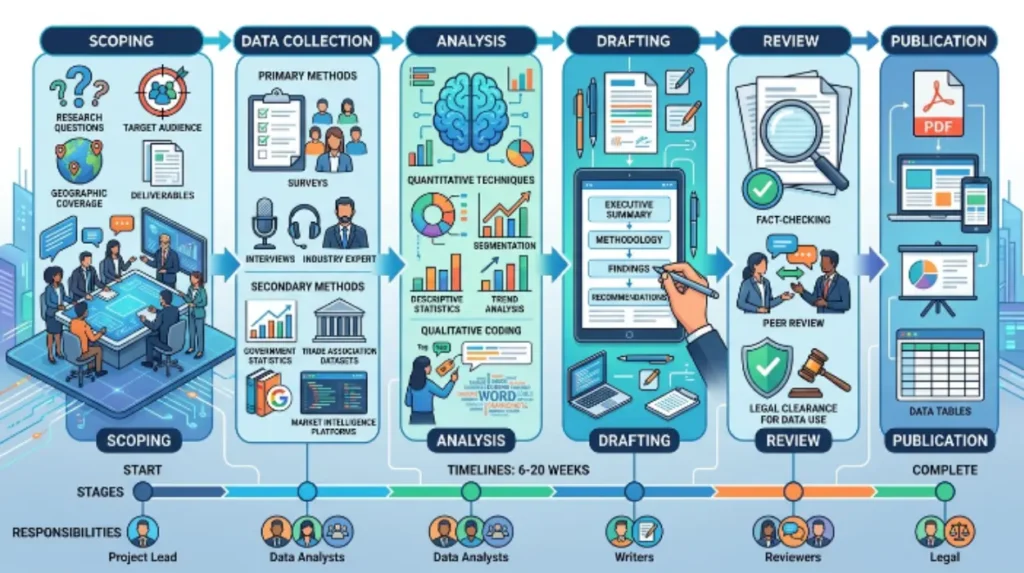
Scoping defines research questions, target audience, geographic coverage, and deliverables. Data collection uses primary methods (surveys of buyers or procurement teams, interviews with industry experts) and secondary methods (government statistics, trade association datasets, market intelligence platforms). Analysis applies quantitative techniques such as descriptive statistics, segmentation, and trend analysis, and qualitative coding for interviews. Drafting assembles executive summary, methodology, findings, and recommendations. Review includes fact-checking, peer review, and legal clearance for data use. Publication formats include PDF, web pages, slides, and data tables. Timelines for complete reports range from 6 weeks for focused studies to 20 weeks for national, multi-sector studies.
What components must an industry report include?
Core components are an executive summary, methodology, data sources, key findings, market metrics, and a limitations section; appendices include raw data and survey instruments.
The executive summary highlights top-line metrics: market size in currency, growth percentages, and three priority insights. The methodology section details sample size, margin of error, field dates, and data-cleaning methods. Data sources identify named datasets such as Office for National Statistics releases, industry panels, and proprietary survey results. Key findings present numeric metrics: market value in GBP, compound annual growth rate (CAGR), and buyer preference shares. A limitations section lists coverage gaps and known biases. Appendices contain survey questionnaires, codebooks, and raw tables with variable definitions. This structure ensures reproducibility and citation clarity.
Why are industry reports trusted by UK B2B buyers?
Trust arises from transparent methodology, documented data sources, and replicable analysis that allow buyers to verify claims and compare with other datasets.
Transparency requires explicit sample sizes and source citations. Replicable analysis includes clear statistical methods and accessible data tables. Reports that include named official sources such as ONS statistics and published procurement records increase credibility. Peer review and expert validation add verification for technical readers. In B2B procurement, stakeholders require evidence that purchasing decisions rest on quantified demand, supplier capacity, and regulatory constraints. Industry reports present these elements in a single referenced document, enabling due diligence and board-level briefing.
Which formats of industry reports perform best in the UK B2B context?
Formats that perform best combine a concise executive summary, downloadable data tables, and web-native pages with searchable sections and clear citation metadata.
Concise executive summaries allow time-pressed procurement leads to extract implications within two minutes. Downloadable data tables facilitate integration into procurement models and financial forecasts. Web-native pages improve discoverability and metadata indexing for search engines. PDFs remain important for formal sharing within procurement and legal teams. Visualizations with labeled axes and source notes enable clear interpretation. Each format must include citation metadata such as publication date, authorship, and dataset references to be citation-friendly and legally auditable.
How do buyers use industry reports during the procurement process?
Buyers use industry reports to define requirements, benchmark suppliers, validate pricing, and inform risk assessments during supplier selection and contracting stages.
In requirement definition, buyers extract documented demand patterns and feature priorities to shape tender specifications. For benchmarking, buyers compare supplier claims with market average prices and service levels presented in the report. Pricing validation uses reported unit costs, margin ranges, and historical price trends. Risk assessment relies on documented supply-chain constraints and regulatory signals in the report. Procurement committees use report citations in tender evaluation documents and board papers to justify sourcing decisions.
What are the measurable benefits of using industry reports in B2B buying?
Measurable benefits include reduced procurement cycle time, improved bid-to-win ratios, more accurate budget forecasts, and lower sourcing risk exposure when decision-makers use validated market data.
Procurement cycle time shortens when specification drafting uses established market metrics instead of time-consuming primary discovery. Bid-to-win ratios improve when buyers set realistic evaluation criteria aligned with market capabilities. Budget forecasts become more accurate when based on reported historical price trends and quantified growth rates. Sourcing risk falls when reports identify concentration risks and alternative supplier pools with named regions and capacity figures. Each benefit is traceable to specific report sections such as market sizing and supplier landscape.
When should organisations commission new industry reports?
Organisations should commission reports when entering a new market, launching a new procurement category, or when existing public data is older than 18 months.
Entering a new market requires first-party intelligence on buyer behaviour and competitor capacity. Launching a new procurement category needs supplier capability mapping and lead-time data. Public data older than 18 months risks missing structural shifts such as regulatory changes or supply shocks. Event-driven triggers for fresh reports include new legislation, major supplier exits, or technological disruption documented in industry announcements. Commissioning a tailored report focuses resources on relevant questions and yields actionable timelines and cost estimates.
Explore More Expert Insights:
Why 96% of UK Marketers Now Use AI Tools and Why Research Still Beats Them
How Original Data Became the Most Competitive Content Asset in UK Media in 2026
How are industry reports cited in professional documents?
Citations include author, publication year, title, publisher, and dataset DOI or URL alongside a clear page or table reference for the specific fact being used.
Professional citation lists authoring organisation or named analysts, year of publication, full title, and publisher. If a DOI exists, include it to ensure persistent access. For web publications, include the access date and stable URL. Inline references specify the page, table, or figure number for the cited metric. This citation format supports audit trails and allows legal teams to verify data provenance during contract negotiations.
What limitations should readers consider when using industry reports?
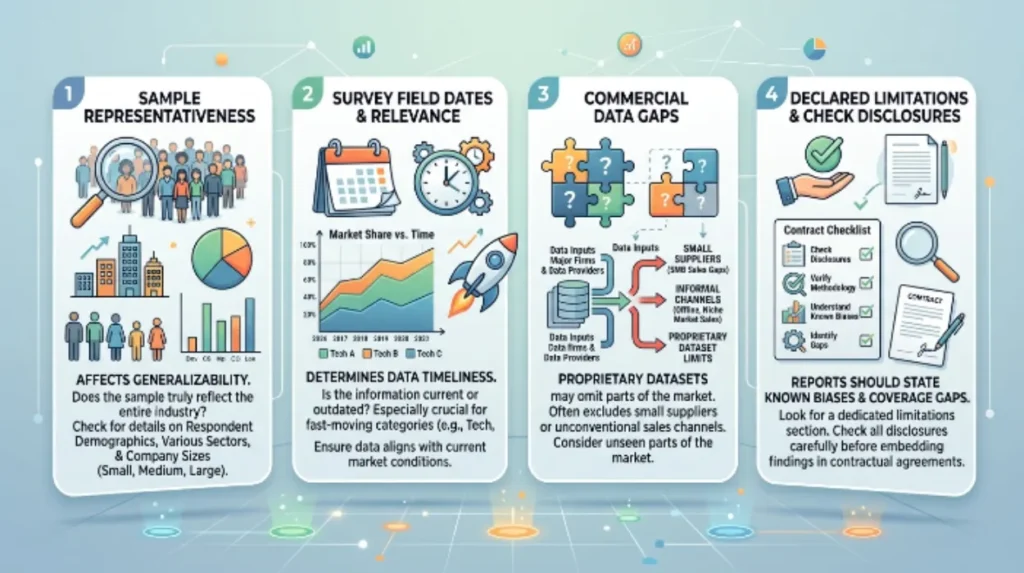
Readers must consider sample representativeness, survey field dates, potential commercial data gaps, and declared limitations listed in the report.
Sample representativeness affects generalisability; reports should state respondent demographics, sectors, and company sizes. Field dates determine relevance, especially for fast-moving categories. Commercial data gaps occur when proprietary datasets omit small suppliers or informal channels. Reports should include a limitations section stating known biases and coverage gaps. Users must check these disclosures before embedding findings in contractual documents.
Discover More Insights:
How Media-Published Reports Outperform Gated PDFs for UK Lead Generation
Industry reports provide structured, transparent, and citation-ready market intelligence for UK B2B buying. They define markets with clear methodology, quantify metrics with named data sources, and support procurement actions such as specification, benchmarking, pricing validation, and risk assessment. Readers require attention to methodology, field dates, and declared limitations to use reports responsibly and to cite them accurately in professional contexts.
Check Out the Full Article:
Research Report Packages for UK Brands: Timelines, Inclusions and Investment Ranges



