
Times Intelligence is a measurement and verification capability that tracks ad exposures within a UK news network and reports impressions that meet industry viewability and fraud-detection standards.
Times Intelligence defines verified impressions as served ad impressions that pass viewability thresholds, human verification, and inventory-quality checks. Viewability criteria follow standard thresholds: at least 50% of pixels in view for one continuous second for display, and two continuous seconds for video. Human verification filters remove non-human traffic using device and behavioral signals. Inventory-quality checks confirm domain, page template, and placement validity. The combination produces a count of impressions that advertisers can rely on for billing, reporting, and campaign optimisation.
How does Times Intelligence measure and verify impressions?
Times Intelligence measures impressions using client-side and server-side instrumentation, reconciles logs with independent verification vendors, and applies fraud detection and viewability algorithms to produce verified impression counts.
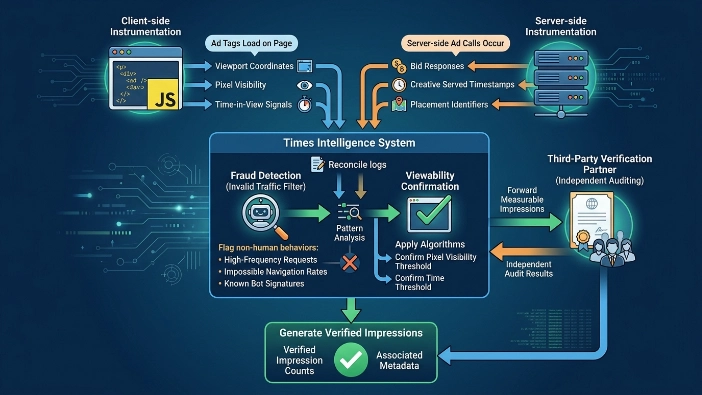
Measurement begins when ad tags load on page or when server-side ad calls occur. Client-side scripts capture viewport coordinates, pixel visibility, and time-in-view signals. Server-side logs record bid responses, creative served timestamps, and placement identifiers. Times Intelligence reconciles these data sources and forwards measurable impressions to third-party verification partners for independent auditing. Fraud detection employs pattern analysis to flag non-human behaviors such as high-frequency requests, impossible navigation rates, and known bot signatures. After filtering invalid traffic and confirming viewability thresholds, the system issues verified impression counts and associated metadata for each ad event.
What components ensure accuracy in verified impressions?
Accuracy depends on synchronised timestamps, unique impression identifiers, device-level viewability signals, third-party verification, and consistent threshold definitions.
Synchronised timestamps enable cross-system reconciliation between ad servers, page logs, and verification vendors. Unique impression identifiers persist across the ad call lifecycle to link bid, serve, and view events. Device-level signals capture viewport size, pixel visibility, and continuous time-in-view metrics. Third-party verification provides independent confirmation using the same impression identifiers and thresholds. Consistent threshold definitions ensure that display and video measurements remain comparable across campaigns. Data retention and audit logs store raw events for at least 90 days to support dispute resolution and post-campaign audits.
How does Times Intelligence detect and filter invalid or fraudulent traffic?
Detection uses multi-signal behavioral analysis, known-bot lists, velocity checks, and anomaly detection to flag and remove invalid traffic before counting impressions as verified.
Behavioral analysis evaluates session dynamics such as navigation speed, mouse movement, and interaction patterns. Known-bot lists and device fingerprinting block traffic from identified non-human sources. Velocity checks detect artificially rapid impression rates from single IP ranges or device clusters. Anomaly detection algorithms compare real-time metrics against baseline patterns and flag sudden deviations. When a suspect event appears, the system quarantines related impressions and subjects them to manual review or deeper automated checks. Confirmed invalid impressions are excluded from verified counts and reported in inventory-quality summaries.
How are viewability and attention metrics reported and validated?
Viewability and attention metrics are reported as viewable impressions, viewability rate, average time in view, and attention score; validation uses independent verification logs and sample audits.
Viewable impressions count impressions meeting pixel-and-duration thresholds. Viewability rate equals viewable impressions divided by measurable impressions. Average time in view captures the mean continuous seconds an ad remained visible. Attention score is a composite metric that weights time in view and engagement signals such as hover or user interactions. Validation occurs through log reconciliation between the network, advertisers’ ad servers, and verification vendors. Periodic sample audits analyse raw viewport and event traces to confirm algorithmic results. Reports include sample sizes, device splits, and confidence intervals for transparency.
How does Times Intelligence link verified impressions to campaign billing and guarantees?
Verified impressions feed billing records and delivery guarantees by matching verified counts to contractual thresholds and issuing reconciled invoices or credit adjustments when discrepancies arise.
Campaign contracts specify delivery metrics, such as guaranteed numbers of viewable impressions or minimum viewability rates. Times Intelligence maps verified impressions to those contractual units using unique impression identifiers and timestamps. When verified delivery meets contractual thresholds, billing proceeds on the reconciled counts. When verified delivery falls below guarantees, the system triggers remediation: either credits, makegoods, or rebudgeting according to contract terms. Detailed reconciliation reports show the path from served impression to verified impression and document exclusions for invalid traffic or technical failures.
What privacy and compliance measures govern impression verification?
Privacy and compliance rely on anonymised identifiers, minimal data retention, consent management, and adherence to UK and EU data protection laws.
Impression verification uses hashed or pseudonymous identifiers rather than persistent personal identifiers. The system minimises the data fields stored and keeps retention windows to operational needs—commonly 90 days for audit purposes. Consent management platforms record user consent and gate measurement scripts where required by law. Data processing agreements and standard contractual clauses govern third-party transfers. Regular compliance reviews ensure alignment with the UK GDPR and relevant regulatory guidance. Auditable logs document access and processing activities for regulatory or advertiser inquiries.
What operational processes support real-time monitoring and post-campaign audits?
Operational processes include real-time dashboards for delivery and quality, automated alerts for anomalies, daily reconciliation tasks, and scheduled post-campaign audits with raw-event export capabilities.
Real-time dashboards display measurable impressions, viewability rates, and fraud flags by placement and creative. Automated alerts notify operators of sudden drops in viewability or spikes in invalid traffic. Daily reconciliations compare ad server logs to verification feeds and resolve discrepancies. Post-campaign audits export raw event streams, including viewport traces and bid logs, to support independent review. Audit reports present verified delivery, exclusions, and remediation actions. These processes enforce accountability and provide advertisers with evidence for delivery claims.
Explore More Expert Insights:
Brand Awareness vs Direct Response: Choosing the Right UK Banner Campaign Objective
Why Running Banners Alongside Sponsored Content Lifts UK Conversion Rates by 34%
What benefits do advertisers and publishers gain from verified impressions?
Advertisers gain transparent exposure accounting, reduced wasted spend, and reliable delivery guarantees; publishers gain higher yield for verified inventory and strengthened advertiser trust.
Advertisers receive accurate counts of impressions that had a genuine chance of being seen. Verified impressions reduce spend on non-viewable or fraudulent inventory and improve return on ad spend when campaigns optimize against verified metrics. Publishers that demonstrate high verified viewability command higher CPMs and attract long-term buyers seeking quality inventory. Both sides benefit from clearer dispute resolution paths because reconciliation reports provide a common data model and shared identifiers. Verified impressions form the foundation for outcome-based pricing and advanced attribution models.
What use cases benefit most from verified-impression delivery?
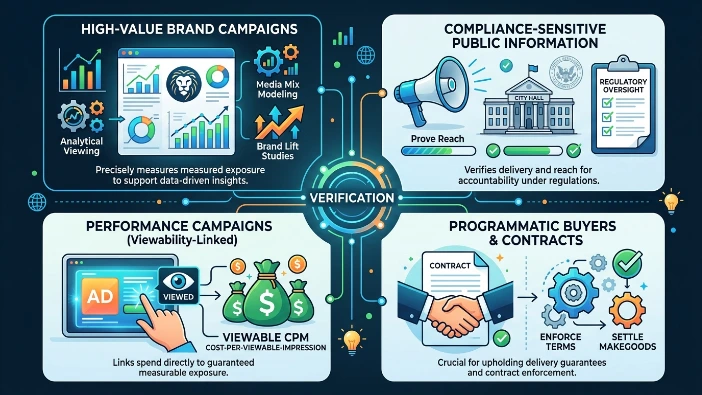
High-value brand campaigns, compliance-sensitive public information campaigns, and performance campaigns that rely on viewability-linked guarantees benefit most from verified-impression delivery.
Brand campaigns that require measured exposure use verified counts to support media mix modeling and brand-lift studies. Public information campaigns that operate under regulatory oversight need verified delivery to prove reach. Performance campaigns that price on viewable CPM or cost-per-viewable-impression use verified impressions to link spend to measurable exposure. Programmatic buyers that include delivery guarantees in contracts rely on verified impressions to enforce terms and settle makegoods.
Click Here to Explore More:
The Attention Economy: How UK Banner Ads on Trusted Sites Get 4× More Viewability
Times Intelligence delivers verified impressions by combining synchronised measurement, multi-signal fraud detection, independent verification, and transparent reconciliation processes. The system produces viewable impression counts that feed billing, guarantees, and performance optimisation. Advertisers receive accountable exposure metrics; publishers monetise quality inventory.
For tactical guidance on seasonal timing and audience receptivity, review the following:
Banner Ad Seasonal Strategy: When UK News Audiences Are Most Receptive by Quarter