

The shift replaces one-off, placement-driven transactions with multi-year, data-driven partnerships focused on audience growth, content alignment, and measurable business outcomes.
Historically, brand-publisher relationships in the UK relied on discrete tactical buys. A brand paid for a single placement, sponsorship, or display campaign. Those deals measured immediate delivery: impressions, clicks, or short-term conversions. Strategic deals reorganize that model. Brands and publishers form longer-term agreements that align editorial calendars, audience development plans, and shared measurement frameworks. The partnership allocates resources to content series, audience research, and cross-platform distribution rather than only to an isolated insertion. Strategic deals use pooled first-party data, agreed KPIs, and joint governance structures to ensure accountability. This approach changes procurement, contracting, and performance expectations across marketing and media functions.
How did this evolution start in the UK market?
The evolution began as third-party cookie deprecation, rising content costs, and advertiser demand for attention efficiency forced buyers and sellers to seek predictable audience quality and privacy-compliant data sharing.
Regulatory changes and major browser moves reduced reliance on cookie-based targeting. Brands required resilient audience access. Publishers responded by increasing investment in direct audience relationships: newsletters, logged-in experiences, and subscription products.
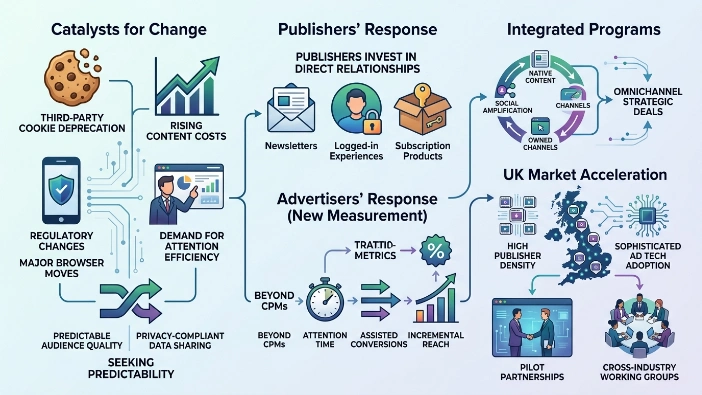
Concurrently, measurement expectations expanded beyond CPMs to include attention time, assisted conversions, and incremental reach. Commercial teams on both sides recognised short-term buys delivered uncertain value. The complexity of omnichannel consumption created opportunities for integrated programmes that combined native content, social amplification, and owned-channel distribution. These programmes became the foundation of strategic deals. The UK market, with its high publisher density and sophisticated ad tech adoption, accelerated this transition through pilot partnerships and cross-industry working groups.
What components define a strategic brand-publisher deal?
A strategic deal includes multi-period contracts, shared audience data governance, agreed KPIs, collaborative editorial planning, measurement frameworks, and revenue or value-sharing mechanisms.
Contract duration typically spans 12 to 36 months. Data governance defines what first-party signals transfer, how anonymization occurs, and which measurement partners validate outcomes. KPIs extend beyond impressions to include unique reach, attention minutes, conversion lift, and subscription sign-ups when relevant. Editorial planning aligns brand messaging with publisher content verticals to preserve editorial integrity and relevance. Measurement frameworks use deterministic or probabilistic matching, pre/post studies, and incrementality testing. Commercial terms may include fixed retainers, guaranteed deliverables, revenue shares on subscription referrals, or performance-based bonuses tied to defined outcomes. Legal clauses address brand safety, IP ownership for co-produced content, and exit conditions tied to KPI performance.
How do publishers and brands set measurable goals in these deals?
Parties agree on three to five quantifiable KPIs, define baseline metrics, and set reporting cadence with independent validation for at least one KPI.
The process begins with baseline measurement: current audience size, typical engagement metrics, and historical conversion rates. From baseline, partners select KPIs that reflect both reach and value: unique reach per month, average engaged time per article, incremental conversions attributable to the partnership, and cost per increment. They choose one validation method: independent third-party measurement, agreed analytics tags, or privacy-preserving cohort analysis. Reporting cadence typically runs monthly for operational metrics and quarterly for strategic outcomes. Contracts include data provision schedules and a dispute-resolution mechanism for metric discrepancies.
Which technical and legal systems support strategic deals?
Systems include identity and consent platforms, secure data clean rooms, common analytics schemas, and contract clauses for data use, IP, and audit rights.
Identity systems provide logged-in experiences and hashed identifier exchanges that comply with UK privacy law and GDPR. Consent management platforms capture lawful bases for processing and share consents through interoperable signals. Secure data clean rooms enable matched analysis without exporting raw PII; these environments run agreed queries and return aggregated results. Common analytics schemas standardize event definitions—page view, engaged time, video complete—so both parties measure the same events. Legal frameworks stipulate permitted data uses, retention periods, IP rights for co-created content, and audit access to measurement processes. Contracts also specify remedies and performance thresholds tied to payment schedules.
What benefits do brands gain from strategic publisher deals?
Brands gain predictable audience access, improved measurement of long-term outcomes, lower effective cost per engaged user, and reduced reliance on fragile third-party IDs.
Predictable access emerges from guaranteed reach and prioritized distribution in publisher channels, including newsletters and social amplification. Measurement improvements occur because partners share first-party signals and establish joint attribution models. Effective cost per engaged user falls when campaigns focus on attention and conversion rather than raw impressions. Brands obtain more resilient audience pathways when publishers supply logged-in inventory and consent-backed identifiers, reducing exposure to cookie-related volatility. Strategic deals also enable experimentation with subscription referrals, lead generation, and product launches using publisher trust and editorial context.
What benefits do publishers gain from strategic brand partnerships?
Publishers gain stable revenue streams, deeper audience insights, investment in content, and higher lifetime value per user through co-developed products.
Stable revenue arises from retainers, multi-year guarantees, and performance incentives that smooth commercial variability. Brands often fund journalistic projects, video series, or data journalism that publishers could not finance through ad CPMs alone. Shared analytics reveal audience segments with higher conversion propensity, enabling better editorial and product decisions. Revenue-sharing models with brands create new monetisation routes—for example, affiliate-linked membership offers or branded subscription bundles. Strategic deals also improve retention when branded content integrates with core editorial experiences and drives logged-in registrations.
When should brands prefer strategic deals over transactional buys?
Brands prefer strategic deals when the campaign horizon is 6 months or longer, when audience quality is essential, or when the objective includes long-term metrics such as retention or lifetime value.
If objectives center on a single short-term promotion with minimal need for audience data, transactional buys remain efficient. However, for category-rebuilding campaigns, product launches that require repeated exposure, or objectives tied to audience development and retention, strategic deals deliver measurable advantages. Strategic arrangements suit situations where brands need prioritized distribution, access to niche publisher audiences, or integrated measurement that links content exposure to downstream outcomes.
How do strategic deals change procurement and agency roles?
Procurement shifts from lowest-cost buys to value-based contracting; agencies evolve from media buyers to partnership managers and measurement integrators.
Procurement teams adopt outcome-based specifications and evaluate proposals on forecasted long-term value. Contracts include clauses for joint governance, KPI recalibration, and co-investment. Agencies that traditionally focused on short-term media trading add capabilities in audience strategy, data engineering, and campaign co-creation. Measurement integrators consolidate signals from publisher clean rooms, brand analytics, and ad servers to produce unified reports. Legal and compliance teams engage earlier in the process to align data sharing with privacy frameworks.
What use cases demonstrate the strategic approach in practice?
Use cases include subscription growth programs, product launch campaigns using content series, lead generation through co-created tools, and longitudinal brand health studies across publisher channels.
A subscription growth programme uses publisher newsletters and paid placements tied to referral codes and shared attribution, with revenue shares for successful sign-ups. A product launch uses a multipart editorial series, supported by native video and social amplification, and follows cohorts to measure purchase lift over 90 days. Lead generation projects build interactive tools hosted on publisher sites, with anonymised leads passing through a clean room for conversion matching. Brand health studies run pre/post surveys within publisher environments and link exposure to brand consideration and preference changes.
Explore More Expert Insights:
The Credibility Gap: Why UK Audiences Trust Editorial Partners Over Paid Ads
How News Media Partnerships Are Replacing Expensive Programmatic Buys in the UK
What are the limitations and risks of strategic brand-publisher deals?
Limitations include higher upfront complexity, dependency on shared data infrastructure, and potential brand-audience misalignment if editorial integration is weak.
Setting up clean rooms and identity systems requires technical investment and legal negotiation. Not all publishers have equivalent audience scale or product capabilities, which limits comparability. Poorly aligned editorial integrations can harm performance: content that breaks audience expectations reduces engagement and undermines outcomes. Measurement disputes can occur when parties use different analytics baselines or when external market shifts change conversion behaviour. Contracts must include governance to manage these risks and a joint roadmap for technical and editorial work.
How should stakeholders begin implementing strategic deals?
Begin with a six- to twelve-month pilot that defines three KPIs, establishes a clean room or shared measurement, and outlines editorial scope and reporting cadence.
A pilot tests the technical stack and governance without committing multi-year budgets. Start by agreeing on audience segments and baseline metrics. Implement a privacy-compliant data match in a secure environment and run a pre/post incrementality analysis. Define content scope: number of articles, newsletter placements, and social amplification. Establish monthly operational reviews and quarterly strategic checkpoints. Use pilot results to scale contract terms, refine KPIs, and codify shared processes.
Click Here to Explore More:
Audience Overlap Analysis: How to Choose Between 3 Competing UK Media Partners
This evolution from transactional to strategic brand-publisher deals reorients commercial relationships toward durable audience value, rigorous measurement, and operational collaboration. The model requires investment in data infrastructure and governance but yields clearer accountability, better-aligned content, and measurable long-term outcomes for both parties
Read the Detailed Explanation:
Why Content Syndication Across 10 UK Sites Outperforms Any Single Placement



