
A media partner is an organisation that distributes and amplifies content to target audiences. Selecting the right media partner ensures accurate audience reach, measurable performance, regulatory compliance, and efficient use of budget.
Define media partner as a publisher, platform, broadcaster, or network that hosts content or campaigns and reports performance. Define ‘industry’ as the market sector a brand occupies, for example retail, finance, healthcare, or technology. In the UK context, media partners must operate within Advertising Standards Authority rules and data-protection law. Key roles of a media partner include audience provision, creative placement, measurement reporting, and fraud mitigation. Effective partnerships reduce wasted reach and deliver traceable outcomes against business KPIs.
What four-step process identifies the right media partner?
Follow a four-step process: define objectives and audience, map partner capability, validate performance and compliance, and negotiate measurement and reporting terms.
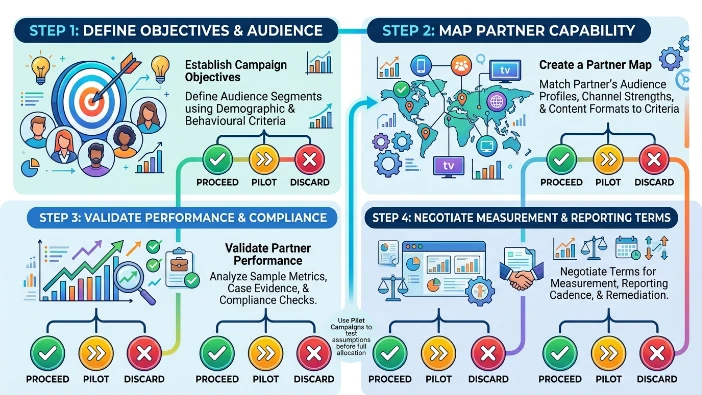
Step one establishes campaign objectives and audience segments with demographic and behavioural criteria. Step two creates a partner map that matches partners’ audience profiles, channel strengths, and content formats to those criteria. Step three validates partner performance through sample metrics, case evidence, and compliance checks. Step four negotiates terms for measurement, reporting cadence, and remediation. Each step produces a decision gate proceed, pilot, or discard. Use pilot campaigns to test assumptions before full allocation.
How do you define objectives and audience for partner selection?
Define objectives with specific KPIs and define audiences with explicit demographic and behavioural attributes, using primary research and analytics for precision.
Objectives must list target metrics and numbers, for example increase qualified leads by 30% or raise trial sign-ups by 15% within 90 days. Audience definition requires age range, location granularity (for example UK nation or city), purchasing behaviour, and platform habits. Use first-party analytics, CRM segmentation, and primary surveys to create evidence-based personas. Document baseline metrics to measure lift. Example for a finance product, define the target as adults aged 25–44 in Greater London with credit-card-owner status and monthly online banking activity above a defined threshold.
How do you map partner capability to industry needs?
Map capability by comparing partner audience composition, channel format strengths, content expertise, and cost structures against industry requirements.
Start with audience composition: request audience demographics, verified traffic sources, and audience overlap percentages. Assess channel format strengths: display, native, video, podcast, email, or social amplification. Evaluate content expertise relevant to the industry, for example financial journalism or health editorial. Review cost structures including CPMs, fixed placements, and performance fees. For regulated industries, check editorial policies and legal clearance capabilities. Use sample reports and case examples to confirm prior success in the same sector, for instance a publisher’s documented case of increasing trial sign-ups for a retail client.
How do you validate partner performance and compliance?
Validate performance using independent measurement, past campaign evidence, fraud and viewability checks, and documented compliance with UK regulations.
Request audited audience metrics and third-party verification where available. Verify viewability rates, invalid traffic percentages, and brand-safety controls. Review sample campaign reports that show baseline, test, and lift metrics. For example, examine a past campaign that reported conversion lift and retention changes. Confirm compliance with the Advertising Standards Authority, Information Commissioner’s Office requirements, and sector-specific rules such as FCA guidance for financial promotions or MHRA rules for healthcare messaging. Ask for contractual clauses that allow independent measurement audits and share technical tags for server-to-server verification.
What measurement and reporting terms must be negotiated?
Negotiate clear metrics, reporting cadence, data ownership, attribution model, and remediation clauses with fixed thresholds and timelines.
Specify primary metrics and numeric targets, for example viewability ≥ 70% and post-click conversion rate increase of 12% over baseline. Set reporting cadence: weekly operational reports and monthly strategic reviews. Define data ownership and access to raw logs or aggregated exports for in-house analysis. Agree an attribution model: last-click, multi-touch, or incrementality testing with control groups. Include remediation clauses that define penalties or make-goods if performance thresholds fail by predefined margins. Require agreed SLAs for tag deployment and reporting latency. Ensure contractual language permits independent audits and access to measurement partners.
What components of a media partnership influence outcomes?
Components include audience fidelity, creative alignment, measurement rigour, technical integration, and commercial model.
Audience fidelity is the extent to which partner audiences match the target profile; quantify this using overlap percentages. Creative alignment covers format fit and editorial tone relevant to industry messaging. Measurement rigour covers availability of third-party verification and the partner’s analytics capabilities. Technical integration includes tag support, APIs, and consent management compatibility. Commercial model covers whether pricing is CPM, CPC, fixed-fee, or performance-based and the implied risk distribution. Each component impacts outcomes such as conversion rates, cost per acquisition, and retention metrics.
What benefits follow from selecting the right partner?
The right partner produces higher conversion efficiency, reduced wasted spend, faster insight cycles, and compliant campaign delivery measurable in percentage improvements.
Selecting a well-matched partner improves conversion efficiency, for example lowering cost per acquisition by measurable percentages. It reduces wasted spend through precise audience targeting and independent fraud controls. Faster insight cycles arise from reliable reporting that reduces analysis time and enables quicker optimisation. Compliant delivery reduces legal risk and preserves brand trust. These benefits translate into operational metrics: shortened campaign ramp-up times, improved lift in A/B tests, and clearer attribution of outcomes to media investment.
What use cases demonstrate partner selection differences across UK industries?
Use cases include retail customer acquisition, financial services product launches, healthcare awareness campaigns, and B2B lead generation, each requiring distinct partner criteria and measurement approaches.
In retail customer acquisition, prioritise partners with high transaction-intent audiences and transactional tracking. For financial services product launches, prioritise partners with strong regulatory clearance processes and high-trust editorial environments. For healthcare awareness campaigns, prioritise partners with editorial medical expertise and compliance controls for sensitive content. For B2B lead generation, prioritise partners with niche professional audiences and account-based targeting capabilities. Each use case requires tailored performance baselines and pilot structures to confirm partner fit.
Explore More Expert Insights:
5 Media Partnership Models That Generate Leads Without a Single Paid Ad
Co-branded Content vs Licensing Deals: UK ROI Data Compared
How should teams pilot and scale media partnerships?
Pilot with limited budgets, control groups, and predefined success gates; scale only after pilots meet numeric goals and reporting integrity checks.
Design pilots with 10–20% of planned budget allocated to test delivery, measurement, and creative resonance. Use control groups or geo-based holdouts to measure incremental lift. Define success gates with explicit numeric criteria, such as conversion lift ≥ 10% versus control and viewability ≥ 70%. Validate reporting integrity with independent verification before scaling. After gates clear, increase allocation in phases: 25%, 50%, then full scale while maintaining continuous monitoring and optimisation.
What next-step resources support partner selection and planning?
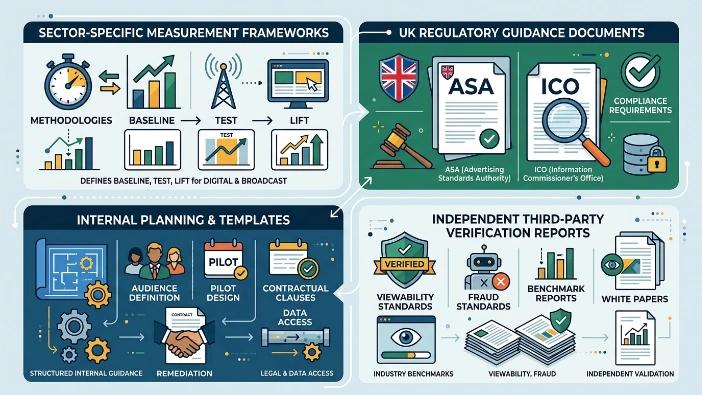
Use sector-specific measurement frameworks, UK regulatory guidance documents, and independent third-party verification reports to inform selection and planning.
Consult measurement frameworks that define baseline, test, and lift methodologies for digital and broadcast channels. Reference UK regulatory guidance from the Advertising Standards Authority and the Information Commissioner’s Office for compliance requirements. Use independent verification providers’ white papers and industry benchmark reports for viewability and fraud standards. For deeper planning, consult structured internal templates for audience definition, pilot design, and contractual clauses that cover data access and remediation.
Check the Complete Explanation:
69% of UK Marketers Think Their Strategy Works — Their Audiences Disagree
Concluding factual summary: Identifying the right UK media partner requires a structured four-step approach define objectives and audience, map partner capability, validate performance and compliance, and negotiate measurement and reporting. Use pilots with numeric success gates and independent verification to make scaling decisions. For guidance on partner evaluation processes and investment planning, consult intermediate and advanced resources such as sector-specific measurement frameworks and regulatory guidance.
Explore More Useful Information:
Media Partnership Solutions for UK Brands: Scope, Timeline and Investment Guide