

A media partnership model is a defined collaboration between organisations and media outlets that structures content creation, distribution, and lead capture without using paid advertising.
A model specifies partner roles, content formats, audience segments, publication cadence, and performance metrics. Entities include publishers, trade titles, podcast producers, newsletter editors, event organisers, and corporate communications teams. Each model sets revenue and lead-generation expectations, for example, target lead volumes, content frequency, and conversion pathways. Partners sign content agreements that define ownership, distribution rights, and data-sharing rules. This definition separates partnerships from one-off placements by requiring a documented workflow and measurable objectives.
Which five partnership models generate leads organically?
Five effective models are co-produced editorial series, sponsored editorial partnerships, newsletter content swaps, podcast co-creation, and event‑to-content pipelines.
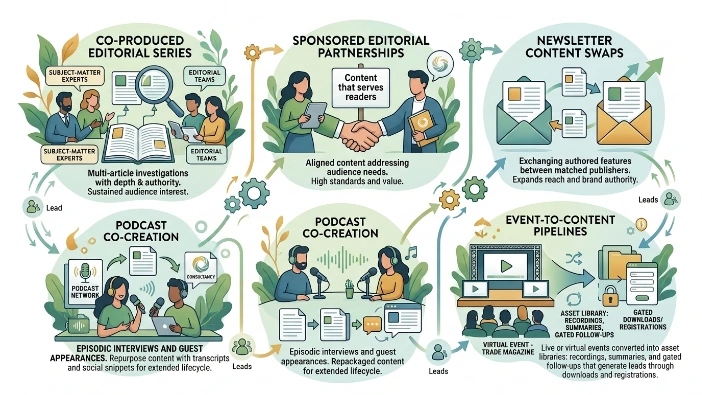
Each model suits different lead objectives and audience types. Co-produced editorial series pairs subject-matter experts with editorial teams to produce multi-article investigations that drive sustained interest. Sponsored editorial partnerships design content aligned to audience needs while preserving editorial standards. Newsletter content swaps exchange authored features between publishers with matched audiences to expand reach.
Podcast co-creation produces episodic interviews and repackages transcripts into articles and social snippets for extended lifecycle. Event‑to‑content pipelines convert live or virtual events into asset libraries: recordings, summaries, and gated follow-ups that generate leads through downloads and registrations. Real examples include a trade magazine and an industry association co-publishing a three-part investigation; a regional newsletter and a software vendor exchanging authored briefings; a podcast network and a consultancy producing an interview series.
How does a co-produced editorial series create leads?
A co-produced editorial series captures leads by delivering repeatable value, gated downloads, and newsletter sign-ups tied to each instalment.
The process starts with a joint editorial brief that defines theme, target metrics, and source lists. Publishers assign reporters, and experts supply data or interviews. Each instalment ends with a downloadable asset such as a dataset, whitepaper, or source dossier that requires an email to access. Publishers place email capture forms on article pages and promote instalments via newsletters and social channels. Content quality and author credibility drive organic sharing and search visibility. Measured outcomes include page visits, email captures per installment, and downstream conversion rates for leads that engage further. A manufacturing trade journal produced a four-part series with three gated datasets and recorded 1,200 email captures across two months.
What does a sponsored editorial partnership involve?
A sponsored editorial partnership formally funds content production while maintaining editorial oversight and integrating lead mechanisms like bespoke landing pages and co-branded downloads.
Sponsors commission content aligned to audience interests and provide subject-matter input. Editorial teams maintain control over factual presentation and sourcing. Lead mechanisms include co-branded downloadable guides, webinar registrations linked to articles, and landing pages that collect contact details. Contracts specify disclosure language, approval windows, and performance KPIs such as organic traffic and lead counts. Outcomes track email captures, webinar attendance, and resource downloads attributed to the partnership. For example, a sector report sponsored by a professional body included three gated toolkits and generated 800 qualified registrations in 90 days.
How do newsletter content swaps expand lead pools?
Newsletter content swaps exchange authored content between publishers to reach new subscribers and drive direct sign-ups without paid distribution.
Partners align on topical fit and swap a featured article or authored explainer in each partner newsletter. Each article links back to a gated asset or a subscription form on the originating publisher’s site. Swap agreements cover frequency, placement position, and minimum audience match criteria. Metrics include referral sign-ups and click-through rates. This model leverages existing subscriber trust and newsletter open rates to acquire new leads. A regional business newsletter and a professional association swapped monthly features for six months and recorded a 22% referral sign-up uplift for both partners.
How does podcast co-creation convert listeners into leads?
Podcast co-creation converts listeners by packaging episode transcripts, resource pages, and gated follow-ups that require registration for downloads.
The process begins with topic planning and guest selection. Hosts record episodes, produce show notes, and create a resource page per episode with timestamps, transcripts, and downloads. The resource page includes a registration form to access exclusive materials such as toolkits or data files. Episodes drive organic discovery through search, directory listings, and social sharing. Partners cross-promote episodes in newsletters and editorial channels to boost reach. Measured outcomes include resource downloads, email captures from episode pages, and click-throughs to longer-form content. A sector podcast series published weekly and repurposed transcripts into three downloadable guides, producing 950 email captures in three months.
What is an event‑to‑content pipeline and how does it create leads?
An event‑to‑content pipeline converts live or virtual events into gated assets and republished editorial that capture registrations and contact details.
The pipeline records sessions, conducts post-event interviews, and produces summaries and deep-dive articles. Organisers create on-demand pages that host recordings and downloadable proceedings behind a registration wall. Follow-up sequences include segmented email outreach and additional content tailored to attendee interests. Partners track registrations, on-demand views, and resource downloads. This model extends event value and generates leads long after the live date. For example, a virtual conference produced 12 session recordings and a proceedings ebook; the proceedings required registration and generated 2,400 new contacts over six weeks.
Which components are essential for partnership lead capture?
Essential components include gated assets, clear landing pages, shared KPIs, data-sharing agreements, and attribution frameworks.
Gated assets provide tangible value in exchange for contact details. Landing pages present the asset and collect consistent fields such as name, company, role, and email. Partners agree on shared KPIs: lead volume, lead quality, traffic, and engagement duration. Data-sharing agreements define consent, storage, and use rights consistent with UK data protection law. Attribution frameworks assign lead ownership and follow-up responsibilities using UTM parameters, referral codes, and shared dashboards. These components create a repeatable process for identifying and routing leads to the correct partner for nurturing.
How should partners measure lead quality and ROI?
Partners measure lead quality using explicit qualification criteria, engagement thresholds, and conversion tracking tied to business outcomes.
Qualification criteria include job title relevance, company size, and expressed interest indicators such as downloads or webinar attendance. Engagement thresholds track page views, time on resource pages, and repeat visits. Conversion tracking links captured leads to downstream actions like demo requests or purchases through CRM integration and unique referral IDs. Partners report on lead volume, conversion rate, cost per organic lead (zero paid spend), and revenue influenced. Example metrics include a conversion rate from captured lead to sales meeting of 6% and a three-month revenue-influenced figure for a series of £48,000.
Explore More Expert Insights:
Co-branded Content vs Licensing Deals: UK ROI Data Compared
How to Evaluate a UK Media Partner: 9 Non-Negotiable Criteria
When are these models most effective for UK audiences?
These models perform best for B2B audiences, niche professional sectors, regional markets, and topics requiring expertise and trust.
B2B buyers and professionals value authored analysis, data-rich assets, and expert interviews. Niche sectors such as healthcare, finance, legal, and manufacturing reward in-depth content and curated events. Regional markets respond to localised reporting and events tied to local policy issues. Topics that require verification and authority perform better with human-led production and clear sourcing. Examples include a healthcare report for NHS stakeholders, a regional infrastructure briefing for local councils, and a finance-focused podcast for professional advisers.
How should organisations select the right partnership model?
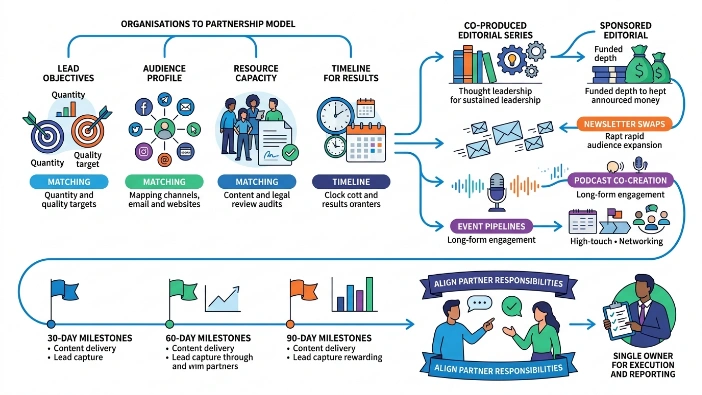
Select a model by matching lead objectives, audience profile, resource capacity, and timeline for results. Define lead quantity and quality targets, map audience channels, and audit internal resources for content and legal review. Choose co-produced editorial series for sustained thought leadership, sponsored editorial for funded depth, newsletter swaps for rapid audience expansion, podcast co-creation for long-form engagement, and event pipelines for high-touch interactions. Set 30-, 60-, and 90-day milestones for content delivery and lead capture. Align partner responsibilities and set a single owner for execution and reporting.
Dive Deeper Into This Topic:
Why Human-Generated Media Partnerships Beat AI Content for UK Audience Trust
Partnership models that prioritise human-led content, gated assets, and clear attribution generate leads without paid ads by leveraging editorial credibility and audience trust. Organisations choose models based on objectives, audience type, and available resources. Documented agreements, shared KPIs, and data controls ensure measurable lead flows and partner accountability.
Explore the Complete Guide:
What a Fully Managed UK Media Partnership Delivers in 90 Days: Real Numbers



