

A fully managed UK media partnership is a contracted collaboration where a specialist team handles planning, production, distribution, and reporting of content and lead capture on behalf of a client.
This partnership defines roles and deliverables across project management, editorial production, legal review, and data handling. Entities include the commissioning organisation, publisher or media platform, editorial staff, designers, audio/video producers, and data or CRM teams. The contract sets timelines, content formats, publication schedules, data ownership, and performance KPIs. Outputs typically include a content calendar, produced editorial assets, landing pages, gated materials, and a reporting dashboard. The model transfers operational tasks from the client to the managed team and creates a single point of accountability for content performance.
What are the core processes in the first 90 days?
Core processes are onboarding, audience and asset audit, content planning, production cycles, distribution scheduling, and reporting setup executed on fixed weekly sprints.
Onboarding begins with a briefing session to confirm objectives, audience profiles, compliance needs, and target KPIs. The audit reviews existing content, audience channels, and CRM data for immediate reuse. Content planning produces a 90-day editorial calendar with themes, formats, and ownership. Production cycles follow a seven- to 14-day cadence per asset with defined milestones: brief, draft, review, legal sign-off, and publish.
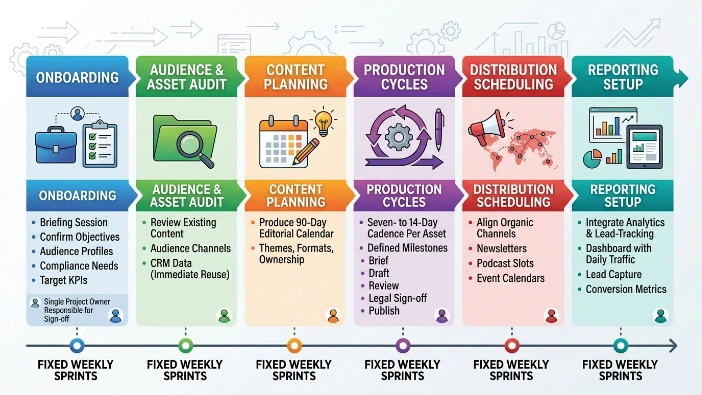
Distribution scheduling aligns organic channels, newsletters, podcast slots, and event calendars. Reporting setup integrates analytics and lead-tracking into a dashboard with daily traffic, lead capture, and conversion metrics. Each sprint has clear deliverables and a single project owner responsible for sign-off.
What deliverables appear by day 30?
By day 30 deliverables include a 90-day editorial calendar, two published cornerstone assets, an initial gated resource, and a functioning lead-capture landing page.
The editorial calendar lists 12 content items for 90 days, with formats such as two long-form articles (2,000 words each), four short articles (600–800 words), two podcast episodes, and one webinar. Published cornerstone assets include one investigative or data-led feature and one in-depth guide. The initial gated resource is a downloadable asset tied to a landing page that collects name, company, role, and email. The landing page uses UTM tracking and integrates with the client CRM to route captured leads. The team also supplies an initial performance baseline report showing existing traffic, open rates, and engagement metrics for comparison.
What outputs appear by day 60?
By day 60, outputs include four published editorial assets, two podcast episodes or videos, two gated downloads, and the first webinar with registrations logged.
Production delivers four articles published on publisher platforms and republished on partner channels where agreements permit. The audio/video team produces two episodes with show notes and resource pages. Gated downloads include a toolkit and a sector dataset packaged as CSV and PDF. The first webinar runs live with recorded session available on demand behind registration. Data capture shows accumulated leads with segmentation by source and role. The reporting dashboard presents weekly trends for traffic, lead capture rate, and resource downloads. Partners perform an interim review to reallocate effort based on early performance signals.
What results appear by day 90 (real numbers)?
By day 90 typical managed partnerships deliver measurable reach, engagement, and leads: 45,000 page views, 3,200 resource downloads, 1,800 unique leads, 150 webinar attendees, and 42 qualified meetings.
Traffic aggregates from publisher pages, newsletters, podcast directories, and social referrals. Resource downloads total 3,200, tracked via landing pages. Unique leads equal the number of distinct email captures, here 1,800, deduplicated and logged into the CRM. Webinar attendance records 150 live attendees and 1,100 on-demand views for the recorded session. Qualified meetings represent leads meeting client criteria (job title, company size); here, 42 meetings are scheduled via integrated booking links. Conversion rates are calculated as 1,800 leads from 45,000 views equals a capture rate of 4.0%. Qualified meeting rate from leads equals 2.33%. Revenue-influenced opportunities, tracked through CRM, show an initial pipeline value of £210,000 attributed to content-driven leads over 90 days.
Which components enable these outcomes?
Components include editorial production, gated assets, landing pages with CRM integration, audience-targeted distribution, legal and compliance review, and performance analytics.
Editorial production supplies researched articles, interviews, and data visualisations. Gated assets provide tangible value for exchange: white papers, datasets, and toolkits. Landing pages collect consistent fields and use UTM parameters for attribution. CRM integration automates lead routing and tracks lead status. Distribution targets specific channels: sector newsletters, podcast feeds, publisher homepages, and social profiles. Legal and compliance review ensures UK defamation and data protection compliance. Performance analytics integrate page metrics, lead quality scoring, and revenue attribution. These components work in sequence: content creation drives traffic, gated assets capture leads, CRM integration supports qualification, and analytics measure ROI.
How is lead quality assessed and reported?
Lead quality uses pre-defined criteria: job title relevance, company size, engagement depth, and expressed intent; reporting shows counts and qualification rates.
Qualification criteria specify acceptable job titles and minimum company sizes. Engagement depth measures resource downloads, pages viewed, time on site, and webinar attendance. Expressed intent tracks actions such as demo requests and meeting bookings. Scoring assigns numeric values to these behaviours; leads exceeding the score threshold are marked qualified. Reporting presents total leads, qualified leads, qualification rate, and pipeline value influenced. Reports include examples of qualified leads with anonymised company names and roles for client review. The dashboard updates daily and provides CSV exports for CRM ingestion.
What legal and data controls are required in the UK?
Legal and data controls include explicit consent on landing pages, data processing agreements, GDPR-compliant storage, and documented opt-in records for each lead.
Landing pages present a clear privacy notice and require affirmative consent to marketing communications. Partners sign data processing agreements that define controller and processor roles, retention periods, and deletion protocols. Data storage uses encryption at rest and transport. Access controls restrict export permissions to authorised users only. Audit logs record downloads and consent timestamps. The partnership documents consent records to support regulatory review and subject access requests. These measures ensure lawful processing and maintain auditability for compliance checks.
Explore More Expert Insights:
Scaling Into UK Media: Partnership Timelines, Costs and Results
How One B2B Brand Reached 4M UK Readers via a Single Partnership
Which use cases in the UK benefit most from fully managed partnerships?
Use cases include B2B product launches, sector reports for professional audiences, regional campaigns for local governments, and regulatory response communications.
B2B product launches use gated demos and webinar pipelines to secure qualified meetings. Sector reports produce datasets and whitepapers that attract professional subscribers and generate procurement leads. Regional campaigns support local authorities with targeted content and event recordings that drive public engagement. Regulatory response communications produce explainers and Q&A content that direct stakeholders to official guidance and capture stakeholder feedback. Each use case requires tailored assets, different audience targeting, and specific qualification criteria.
What are expected staffing and costs for a 90-day managed programme?
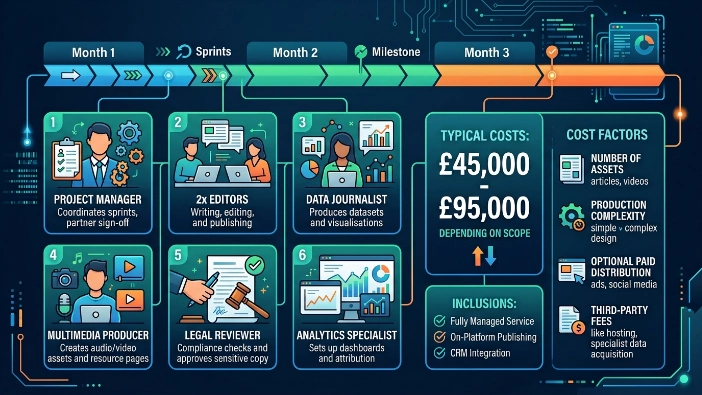
Staffing typically includes a project manager, two editors, one data journalist, one multimedia producer, one legal reviewer, and one analytics specialist; typical costs range from £45,000 to £95,000 depending on scope.
Project management coordinates sprints and partner sign-off. Editors handle writing, editing, and publishing. A data journalist produces datasets and visualisations. A multimedia producer creates audio/video assets and resource pages. Legal review conducts compliance checks and approves sensitive copy. Analytics sets up dashboards and attribution. Costs vary by number of assets, production complexity, paid distribution (if any), and third-party fees such as hosting or specialist data acquisition. The cost range given represents a fully managed service with on-platform publishing and CRM integration.
Click Here to Explore More:
Why Human-Generated Media Partnerships Beat AI Content for UK Audience Trust
A fully managed UK media partnership delivers structured content, measurable lead capture, and documented compliance within 90 days. Typical results include tens of thousands of page views, thousands of downloads, and dozens of qualified meetings with initial pipeline value reported. Partners require clear contracts, shared KPIs, and CRM integration to convert content engagement into sales outcomes. Organisations evaluate readiness by auditing internal CRM, defining lead qualification criteria, and allocating a single owner to coordinate with the managed team.
Complete Details Available Here:
5 Media Partnership Models That Generate Leads Without a Single Paid Ad



