
Event content distribution is the process of converting live event outputs into formatted assets and publishing those assets across multiple digital and media platforms within a set timeframe. It includes capture, editing, formatting, metadata, and publication steps.
Event content distribution defines how raw materials from an event—video, audio, images, quotes, slides, and data—transform into publishable assets. For a UK event, distribution begins at capture points: camera feeds, mobile reporters, official press packs, and attendee-generated content. Capture devices record time-stamped source files. Editors create short-form clips, full-length recordings, transcripts, and still images. Metadata gets attached: timestamps, speaker names, location, and keywords. Formatting adapts assets to platform specifications for aspect ratio, bitrate, length, and file type. Scheduling systems queue posts with local UK timezones and platform-specific posting windows. Monitoring tracks initial reach and technical delivery. Legal checks confirm permissions for recordings and images. The entire chain completes when assets appear live on chosen platforms.
How does content move from capture to publish in 24 hours?
Content follows a linear pipeline of capture, rapid editing, metadata enrichment, platform-specific formatting, and scheduled publication within a 24-hour window. Each stage uses parallel workflows and time-based SLAs to meet the deadline.
Capture starts at time zero when the event begins. Multiple capture sources run concurrently to increase asset options: broadcast cameras capture long-form sessions, mobile devices capture reactions, and official photographer shoots high-resolution images. Editors apply a rapid editing workflow: ingest, trim to key moments, add lower-thirds and captions, and export masters. Transcribers create time-coded transcripts and pull quotable soundbites.
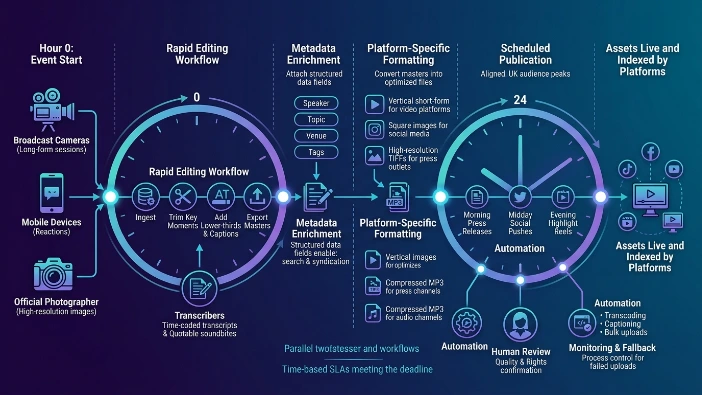
Metadata teams attach structured data fields for speaker, topic, venue, and tags to enable search and syndication. Platform specialists convert masters into platform-optimised files: vertical short-form for video platforms, square images for social, high-resolution TIFFs for press outlets, and compressed MP3 for audio channels. Publishing operates on a schedule aligned with audience peaks in the UK morning press releases, midday social pushes, and evening highlight reels. Automation handles repetitive tasks: transcoding, captioning, and bulk uploads. Human review confirms quality and rights. Monitoring and fallback processes handle failed uploads or errors. The pipeline closes when assets are live and indexed by platforms.
Which ten platforms receive event content within 24 hours?
Ten platforms commonly receive event assets: broadcast TV, national newspapers, local press websites, on-demand video platforms, social short-video platforms, mainstream social networks, audio/podcast platforms, newswire services, industry forums, and internal organisation channels. Each platform requires distinct formats and metadata.
Broadcast TV receives edited clips and b-roll with EDLs and broadcast-standard codecs for newscasts. National newspapers publish photos, quotes, and reporter copy with captions and IPTC metadata. Local press websites host galleries, summary articles, and embedded video players. On-demand video platforms accept long-form session recordings and highlight reels with chapter markers.
Social short-video platforms host vertical clips under 60 seconds with captions embedded. Mainstream social networks host a mix of posts image posts, link posts, native video, and text updates with hashtags and mentions. Audio platforms and podcast hosts publish recorded sessions or episode clips in MP3 format with show notes. Newswire services distribute press releases, images, and embargoed materials with standardised fields. Industry forums and specialist blogs publish technical summaries, slide decks, and speaker abstracts. Internal organisation channels include intranets, mailing lists, and partner portals where full resources and high-resolution files are posted. Each destination requires adapted filenames, delivery protocol, and metadata schema for indexing.
What formats and metadata do platforms require?
Platforms require specific file formats, aspect ratios, bitrate ranges, captioning, and structured metadata including titles, descriptions, speaker IDs, timestamps, and location tags. Deliverables map directly to platform specifications.
Video platforms require H.264 or H.265 MP4 files with specific resolutions: 1920×1080 for landscape long-form, 1080×1920 for vertical short-form, and 1080×1080 for square posts. Audio platforms require MP3 at 128–320 kbps with ID3 tags for title, artist, and episode number. Image deliveries use JPEG or TIFF with IPTC/XMP metadata fields filled for caption, creator, and licensing.
Newswire formats include plain-text press releases and attached image packages with caption and credit lines. Social posts require embedded captions or SRT files for accessibility and engagement; hashtags and mentions included in description fields. Metadata must include exact event time in UTC and UK local time, speaker canonical names, speaker roles, affiliated organisations, session titles, and geo-coordinates. File naming conventions use clear identifiers: eventcode_speakername_assettype_timestamp.format. Rights declarations specify usage windows and territories. Transcripts attach timecodes to quotes for quote verification and indexing.
What roles and teams handle the 24-hour workflow?
Roles include capture technicians, journalists, editors, metadata specialists, platform operators, legal/rights officers, and monitoring analysts operating in coordinated shifts with defined SLAs. Each role owns clear deliverables and time targets.
Capture technicians manage cameras, audio feeds, and photography. Journalists and reporters file copy and pull quotes during or immediately after sessions. Editors assemble clips and apply branding elements. Metadata specialists tag assets with structured fields and prepare distribution lists. Platform operators convert files to required formats, upload assets, and schedule posts. Legal and rights officers confirm release forms, image rights, and embargo conditions. Monitoring analysts track initial uptake, error reports, and content indexing across platforms. Coordinated handoffs use a central asset management system to avoid duplicate work. SLAs set maximum times per task: capture to first edit in 90 minutes, first publish-ready clip within 3 hours, full event package within 12 hours, and full cross-platform publication within 24 hours. Shift overlaps ensure continuous coverage for long events.
What are the technical enablers for rapid multi-platform publishing?
Technical enablers include central asset management, automated transcoding, captioning engines, API-based platform publishing, and real-time monitoring dashboards. These systems reduce manual steps and maintain traceability.
A central digital asset management (DAM) system stores masters, versions, and metadata. Automated transcoding pipelines generate multiple output formats in parallel. Automatic speech recognition creates first-pass captions and searchable transcripts. APIs connect DAM outputs to platform publishing endpoints for bulk upload and scheduling. Content delivery networks and adaptive streaming ensure playback quality across devices. Real-time monitoring dashboards report upload status, ingestion errors, and publishing timestamps. Workflow orchestration tools assign tasks and notify owners when SLAs approach. Audit logs record who changed what for compliance and rights management. These enablers keep the 24-hour pipeline predictable and auditable.
What benefits does 24-hour multi-platform distribution deliver for UK events?
Fast multi-platform distribution increases audience reach, ensures timely reportage, preserves first-mover advantage, and produces searchable archives for future use. Benefits span publicity, accountability, and post-event value.
Publishing within 24 hours captures audience attention while the event is topical. Multi-platform presence reaches diverse audience segments across broadcast, written press, social, and industry channels. Timely publication supports media pick-up and social amplification during peak attention windows in the UK. Structured metadata and transcripts make content discoverable in search engines and archives. Rapid distribution supports transparency by publishing official records, statements, and evidence close to the event timeline. The process creates reusable asset libraries for future promotion, training, and regulatory reporting. Measured against time-stamped delivery metrics, organisers confirm partner performance and enforcement of rights.
Explore More Expert Insights:
UK Events Industry Rebound: Why Media Coverage Is the Most Overlooked Growth Lever
How Live Events Generate 4× More Earned Media When Coverage Is Pre-Planned
What use cases illustrate this 24-hour flow in the UK?
Use cases include political conferences, public health briefings, product launches, academic symposia, and local council meetings; each uses the 24-hour pipeline for distinct objectives. Examples show asset types and platform mixes.
Political conferences require short clips for news broadcasts, quotes for national newspapers, and social clips for rapid reaction. Public health briefings need full recordings for transparency, press releases for outlets, and accessible transcripts for disability compliance. Product launches use highlight reels for tech forums, image galleries for trade press, and short vertical clips for social attention. Academic symposia publish full talks to on-demand platforms, slide decks to specialist forums, and summaries to institutional channels.
Local council meetings publish recordings to council websites, highlight statements to local press, and minutes to internal archives. Each use case adjusts asset priority: briefings prioritise verbatim transcripts, launches prioritise demo clips, and symposia prioritise full-session archives.
How should UK organisers measure the success of the distribution process?
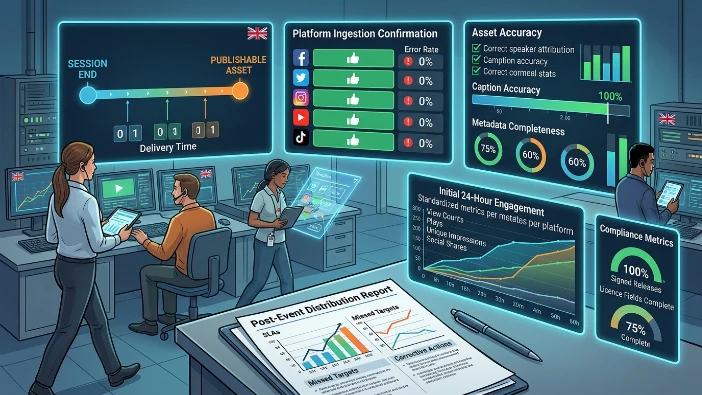
Measure success using delivery time, platform ingestion confirmation, asset accuracy, metadata completeness, and initial engagement within the first 24 hours. Quantify metrics with clear thresholds and reporting.
Track delivery time from session end to first publishable asset. Log ingestion confirmations from each platform and record any error rates. Verify asset accuracy: correct speaker attribution, caption accuracy above a chosen word-error threshold, and metadata completeness percentage. Monitor initial engagement metrics standardised per platform: view counts, plays, unique impressions, and social shares within the first 24 hours. Record compliance metrics: signed releases percentage and licence fields completed. Produce a post-event distribution report summarising these metrics against SLAs and highlighting missed targets and corrective actions.
Check the Complete Explanation:
Event Coverage Proposal Checklist: 12 Deliverables to Demand From Any UK Partner
Event content moves from capture to feed through a structured, time-bound pipeline that converts raw recordings into platform-specific assets, attaches precise metadata, and publishes to ten primary platforms within 24 hours. The workflow requires defined roles, automated tools, and measurable SLAs. UK organisers benefit from timely reach, transparency, and reusable archives.
For deeper measurement methods and partner deliverables, see:
Measuring Event Media Coverage: 7 Metrics Beyond Impressions for UK Organisers



