

Social coverage is real-time audience engagement on owned and earned social channels; news coverage is editorial reporting by professional media that provides third-party legitimacy and distribution beyond social networks.
Social coverage uses brand channels, influencers, and attendees’ posts to create immediate visibility and measurable impressions. News coverage uses reporters, editors, and media outlets to place event narratives in journalism formats: previews, features, interviews, and follow-up analysis. Social coverage typically measures likes, shares, comments, views, and short-term reach. News coverage typically measures article placements, estimated readership, referral traffic, and long-term search visibility.
Both coverage types use different content formats: short-form video, images, and livestreams for social; articles, quotes, and investigative pieces for news. Social coverage drives rapid awareness among existing and adjacent audiences. News coverage secures trust signals that search engines and professional audiences value for months. For UK events, combining both increases total audience reach and sustains discovery over time.
How do social and news coverage work together during the event lifecycle?
Social coverage generates immediate attention at announcement, build-up, and live phases; news coverage provides pre-event credibility and post-event permanence in editorial archives.
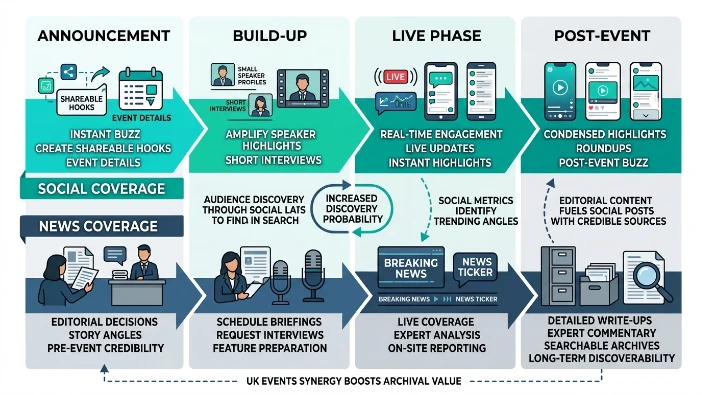
During announcement, social posts create shareable hooks and event details. Journalists use press releases and story angles to decide editorial coverage. During build-up, social amplifies speaker highlights and short interviews. Journalists schedule briefings, request interviews, and prepare features. During the live phase, social drives real-time engagement and amplifies highlights. Journalists publish live updates, interviews, and analysis. Post-event, social condenses highlights into reels and roundups. News coverage produces detailed write-ups, expert commentary, and searchable pages that continue to attract traffic.
This partnership increases the probability that audiences who discover an event through social will subsequently find related editorial content in search results. The two channels feed each other: social metrics help reporters identify trending angles; editorial coverage fuels social posts that cite credible sources. For UK events, this synergy increases long-term discoverability and archival value.
What planning steps ensure both social and news coverage are secured?
Define clear story angles, assemble a press pack, schedule journalist briefings, prepare spokespersons, and plan synchronised social assets and posting timelines.
Start by drafting three concise storylines that fit sector beats: business, culture, and policy. Produce a press pack with event facts, speaker bios, quotes, embargo guidelines, high-resolution images, and short video clips. Identify 10–20 target UK media contacts across national, trade, and regional outlets. Schedule one-to-one briefings two to four weeks before the event. Provide embargoed materials for longer-form features and offer exclusive interview windows to priority outlets.
Train spokespersons for 10–30 second quotable soundbites and 90–120 second interview responses. Create social assets sized for major platforms, with captions that include facts reporters can verify. Set posting timelines that align with journalist deadlines: morning releases for national news cycles and afternoon briefings for trade publications. Measure coverage reach using both social analytics and media monitoring systems that report article placements, estimated readership, and referral traffic.
Which components belong in a media coverage multiplier budget?
Line items include press relations staff or agency fees, press pack production, media distribution, journalist hospitality, on-site press facilities, video editing, and post-event monitoring.
Allocate specific sums: press relations staffing 20% of the media multiplier budget, press pack production 10%, media distribution services 10%, journalist hospitality 15%, on-site press facilities 10%, video editing and captioning 15%, post-event monitoring and clipping 10%, contingency 10%. Define exact deliverables for each line item: number of press contacts outreached, quantity of assets produced, number of journalists hosted, turnaround time for edited clips, and days of monitoring.
Press relations staffing includes research, outreach, briefings, and follow-up. Press pack production includes fact sheets, bios, Q&A, and media-ready images. Media distribution covers wire services or targeted email distribution. Journalist hospitality covers travel reimbursement, dedicated press desks, and interview rooms. On-site press facilities include fast Wi-Fi, camera-friendly lighting, and quiet interview spaces. Video editing produces B-roll and short packages for both reporters and social channels. Monitoring provides clipping reports and attribution data for inclusion in post-event analysis.
What measurable benefits result from investing in both coverage types?
Investing in both increases immediate engagement metrics and multiplies long-term discovery, credibility signals, and referral traffic from editorial sites.
Social-first outputs increase live attendance signals and generate measurable short-term impressions. Editorial placements increase backlink profiles, domain authority signals, and search engine visibility for event-related keywords for 6–18 months. Combined results produce higher referral traffic: editorial articles send direct readers; social posts convert immediate interest to event registrations and post-event content views. Media coverage introduces third-party quotes that search engines and professional readers treat as authority signals. This combination reduces the cost-per-acquisition for future campaigns by improving organic discoverability.
Quantify outcomes with baseline measures: pre-event social reach, number of journalist contacts engaged, number of published articles, estimated editorial readership, referral sessions, and long-term organic traffic uplift. Use these measures to calculate return on investment over a 12-month window.
What content formats work best for social and news coverage respectively?
Social coverage uses short-form video, image carousels, livestreams, and attendee-generated content; news coverage uses feature articles, interviews, Q&A, analysis, and investigative reporting.
Produce 15–60 second highlight videos for social and 60–180 second interview clips for editorial use. Provide journalists with 400–1,200 word briefing notes and 200–400 word speaker bios. Supply high-resolution images (minimum 3000 x 2000 pixels) and B-roll clips (1080p, 30 fps). For social, prepare captions with factual statements and timestamps. For news, provide verifiable facts, data sources, and full quotes suitable for direct attribution.
Ensure content formats align with audience consumption: social drives discovery among younger, networked audiences; news coverage reaches professional and research-focused readers seeking depth and verification. Deliver both concise social packages and expanded editorial materials to fit these consumption patterns.
How does media coverage affect SEO and long-term visibility for UK events?
Editorial coverage creates backlinks, indexed pages, and authoritative references that increase organic search visibility and event-related keyword rankings for 6–18 months.
Search engines index news articles and use external links as ranking signals. Editorial placements create durable pages that appear in search results for speaker names, event names, and topical queries. These pages attract citations, shares, and further coverage. Social posts produce quick spikes in traffic but low long-term indexing value. Therefore, editorial coverage anchors event-related queries with authoritative content that drives continuous referral traffic.
Track SEO impact using metrics: number of referring domains, organic search impressions for targeted keywords, changes in keyword positions, and referral sessions from editorial sources. Compare one-year trends before and after the event to estimate the long-term visibility uplift attributable to news coverage.
Explore More Expert Insights:
Why UK Conference Organisers Are Losing Brand Value Without Multi-Channel Coverage
The 36% Surge in LinkedIn Video Views Is Reshaping UK Professional Event Reach
What use cases show clear value from combining social and news coverage?
Sector launches, policy roundtables, and investor briefings show the highest multiplier effect because they need both rapid reach and authoritative validation.
Product launches require immediate buzz and follow-up trust signals. Policy roundtables need quick social amplification for stakeholder engagement and authoritative editorial to influence decision-makers. Investor briefings need live social visibility for stakeholder updates and detailed editorial coverage for analysts and long-term records. In each case, social drives immediate attendance and perception; news coverage secures professional validation and long-term discoverability.
Measure outcomes in these use cases with event registrations, article placements in targeted outlets, quote attributions, referral traffic, and post-event inquiries from professional audiences.
How should teams allocate effort between social and news coverage during planning?
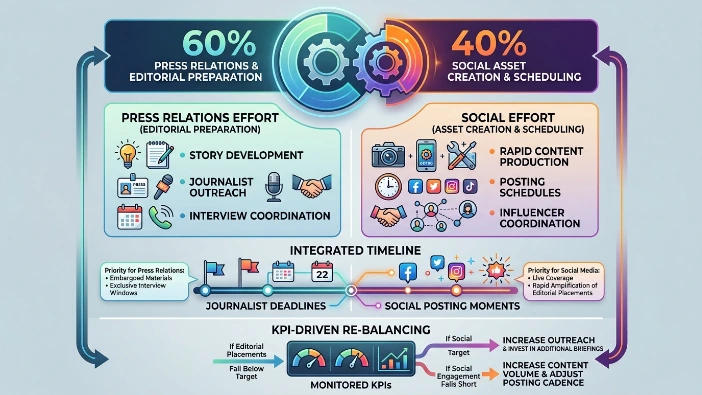
Split planning effort by allocating 60% to press relations and editorial preparation and 40% to social asset creation and scheduling for events that require credibility and long-term discovery.
Dedicate press relations effort to story development, journalist outreach, and interview coordination. Allocate social effort to rapid content production, posting schedules, and influencer coordination. Integrate both plans through a shared timeline that maps journalist deadlines to social posting moments. Ensure press relations receives priority for embargoed materials and exclusive interview windows. Ensure social receives priority for live coverage and rapid amplification of editorial placements when they publish.
Use monitored KPIs to re-balance effort: if editorial placements fall below target, increase outreach and invest in additional briefings; if social engagement falls short, increase content volume and adjust posting cadence.
Read More to Understand Better:
Social Coverage vs News Coverage: Why UK Events Need Both and How to Plan Them
A media coverage multiplier requires clear story angles, a press pack, targeted outreach, dedicated press staffing, journalist hospitality, and synchronised social assets. Social coverage creates immediate reach; news coverage creates long-term authority and search visibility. Allocate budget across specific line items and measure both short-term engagement and long-term organic impact. Proper planning delivers higher total reach, sustained discoverability, and authoritative records for UK events.
Get the Full Insights Here:
How Times Intelligence Deploys Reporters, Editors and Distribution for UK Events



