

An event coverage brief is a concise document that defines event scope, key spokespeople, coverage assets, and deadlines to secure accurate, timely media coverage six weeks prior.
An event coverage brief lists dates, venue details, target audience, core messages, spokespeople, available assets, access arrangements, embargo rules, and contact points. Six weeks is the practical window for media planning in the UK because regional and national outlets schedule features, allocate reporters, and confirm photographer or videographer availability within four to six weeks. A clear brief reduces follow-up queries and limits errors in published content. Example: a national trade reporter used a brief to confirm a scheduled interview two weeks before publication, ensuring the piece included pre-event context and panelist quotes.
What core information must the brief include?
Include event title, date and time, venue address with transport links, organiser contact, and a two-sentence purpose statement for media use.
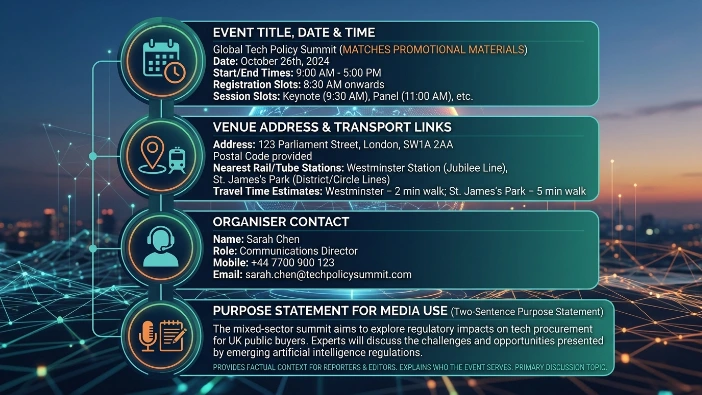
Core fields provide factual context for reporters and editors. Event title must match promotional materials. Date and start/end times must specify registration and session slots. Venue address needs postal code and nearest rail or tube stations with travel time estimates. The organiser contact must list name, role, mobile, and email. The two-sentence purpose statement explains who the event serves and the primary discussion topic. Example: a mixed-sector summit listed “explore regulatory impacts on tech procurement for UK public buyers” to guide editorial framing.
What spokespeople and expert details should you provide?
Provide names, job titles, organisations, one-line bios (30–40 words), availability windows, and briefing notes for each spokesperson.
Each entry includes the person’s professional role, a short bio with credentials, specific topics they will address, and exact times they are available for interview during the event week. Add clear photo and headshot specifications (high-resolution JPEG, 300 dpi). Include any embargo or quotation restrictions. Example: a panel moderator listed as “available 09:00–10:30 and 16:00–17:00; 35-word bio; headshot attached” which allowed a national outlet to schedule a pre-event Q&A.
What visual and multimedia assets must accompany the brief?
Attach venue images, speaker headshots, event logo files, B-roll options, and sample video clips with file specs and download links.
Logos in SVG and PNG, minimum 1200 px width. Headshots in JPEG, 300 dpi. Venue images that show interior and exterior context. B-roll footage segments in MP4, H.264, 1920×1080, labelled with timestamps and captions. Provide a secure, fast download method such as a cloud folder with direct links and expiry dates. State caption text for each asset and licensing terms (editorial use, credit line). Example: a media partner used a labelled B-roll clip of a keynote to publish an online highlight with supplied captions and credit.
How should the brief explain access, accreditation, and on-site logistics?
Outline accreditation process, check-in location and times, press-only access areas, photographer policies, and emergency contact numbers.
Accreditation instructions explain pre-registration URL or email and on-site ID requirements. State exact check-in location and opening times for press, plus a named contact at registration. Clarify press-only areas such as press room, green room, or mixed access. Provide photographer and videographer rules: where tripods are allowed, flash restrictions, and any embargoed recording. Add emergency numbers for venue security and event operations. Example: specifying a press entrance and 08:00 check-in reduced queuing for journalists at a large conference.
What metadata and story angles should the brief recommend?
Offer suggested headlines, three clear story angles, relevant statistics, and suggested interview questions aligned to each angle.
Suggested headlines use plain language and include the core topic and sector. Story angles break the event into newsworthy threads: policy impact, industry reaction, and data-led findings. Provide supporting statistics with sources and dates. Include suggested interview questions for spokespeople to elicit quotable statements and evidence. Example: for a policy panel, provide an angle on “short-term regulatory milestones” plus a 2025 government statistic and two pointed questions for the lead speaker.
How must embargoes, exclusives, and interview rules be handled?
State embargo times, exclusive opportunities, and whether pre-publication review is permitted, with legal or PR constraints specified.
Embargo times require clear local time and timezone notation. Exclusive offers state whether an outlet has first access and the content scope (interview only, interview plus images, or full feature). Pre-publication review rules specify whether quotes may be checked for factual accuracy only, and list deadlines for any review requests. Include legal clearance contacts for sensitive statements. Offering a single national title a 24-hour exclusive on a survey required the outlet to publish within the agreed embargo window.
What distribution and posting instructions should be included?
Provide launch schedule suggestions, social media handles, preferred hashtags, and UTM parameters for tracking referral traffic from media posts.
Suggest a publication timeline for pre-event previews, live coverage windows, and post-event reports. List official social media handles and the event hashtag. Provide UTM-tagged URLs for registration and press pages to trace referral traffic. Specify image aspect ratios for social platforms and any restrictions on third-party tagging. Example: including UTM parameters allowed organisers to attribute 1,200 registrations to three key national media posts.
How should measurement and reporting expectations be set with media partners?
Agree on reporting metrics: article links, estimated print circulation, unique online views, social shares, and a post-event metrics deadline.
Request article URLs, screenshots of print placements, estimated circulation figures for print, unique visitor counts for online pieces, social engagement totals, and a deadline for report delivery (commonly 14 days after publication). Specify the format: spreadsheet or PDF. Include contact for clarifications. Example: a sponsor required a consolidated report within ten days to reconcile exposure against contracted deliverables.
What legal, ethical, and accessibility requirements should the brief specify?
Include consent procedures for photography and recording, copyright ownership terms, accessibility considerations, and GDPR-compliant data handling instructions.
State that attendees photographed are responsible for granting consent and that copyright ownership for supplied assets transfers or remains with the organiser as stated. Provide guidance on alt-text for images, transcript requirements for videos, and language preferences for accessibility. Include data handling rules for journalist-submitted contact lists and any GDPR processing statements. Supplying transcripts for keynotes enabled outlets to produce accessible web pages quickly.
Explore More Expert Insights:
How to Turn a One-Day UK Conference Into 30 Days of Content Across News Sites
Live Event Coverage Formats: Which Gets the Most UK Shares — Video, Live Blog or Recap?
What practical timeline and checklist should be delivered six weeks out?
Issue a timeline with milestones: asset delivery at four weeks, embargo confirmations at two weeks, final media pack at one week, and press liaison on event day.
Six-week brief launch triggers milestones: week 4 deliver high-resolution assets and bios; week 2 confirm embargo and exclusives; week 1 send final schedule and on-site instructions; event day provide a press room and dedicated liaison; post-event send a metrics request within 14 days. Attach a one-page checklist summarising these dates and responsibilities. Example checklist entries: “Week 4: Upload logos and headshots. Week 1: Confirm photographer access.”
How can media partnerships be evaluated and options compared softly?
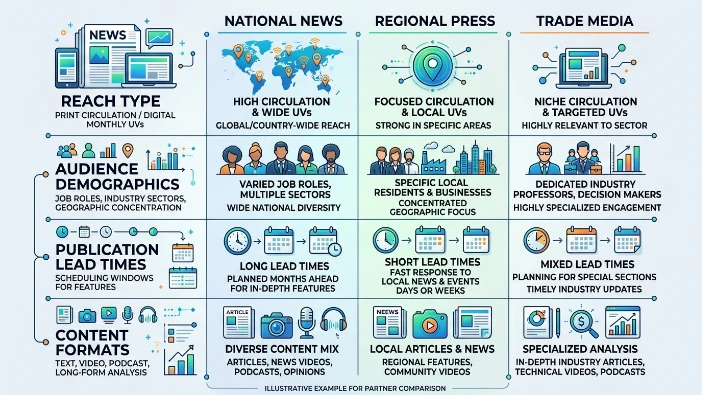
Compare partners by reach type (national, regional, trade), audience demographics; publication lead times, and content formats they produce.
Reach type measures print circulation or digital unique monthly visitors. Audience demographics cover job roles, industry sectors, and geographic concentration. Lead times indicate typical scheduling windows for features. Content formats list text, video, podcast, and long-form analysis. Provide a short example matrix of three partner types national news (broad reach, long lead time), regional press (targeted geographic relevance, short lead time), trade media (sector-specific audiences, high specialist engagement). This comparison informs partner selection without promoting vendors.
Notes for internal linking: include a link to planning resources in related content such as the following:
The 36% Surge in LinkedIn Video Views Is Reshaping UK Professional Event Reach
Deeper coverage analysis such as:
Event Coverage Across 10 UK News Sites: Audience Reach and Engagement Data



