

The 3-phase media coverage framework divides event communications into pre-event planning, during-event capture and distribution, and post-event amplification to maximise reach and measurable outcomes.
The framework organises workflows and budgets around distinct objectives at each phase. Pre-event work defines the news angle, target audiences, and assets. During-event activities capture quotes, images, and recordings while executing live distribution. Post-event tasks repurpose assets, distribute to broader channels, and measure outcomes. The framework reduces duplication, clarifies roles, and supports repeatable processes for trade shows, conferences, roundtables, and webinars across the United Kingdom.
How do you define the pre-event phase and its goals?
The pre-event phase defines the narrative, secures media interest, prepares speakers, and creates assets to drive attendance and early coverage.
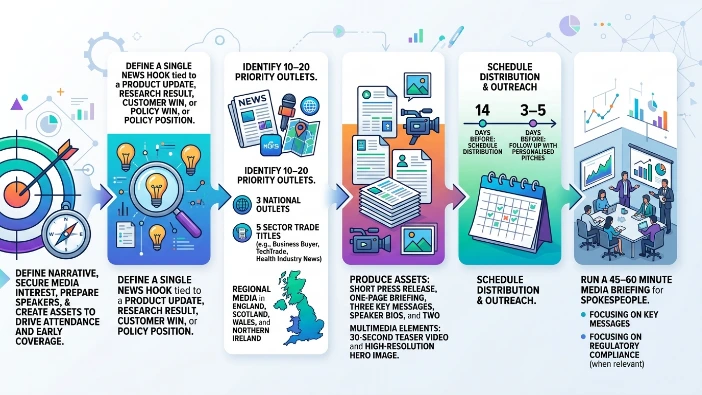
Define a single news hook tied to a product update, research result, customer win, or policy position. Identify 10–20 priority outlets, including three national outlets, five sector trade titles (for example, Business Buyer, TechTrade, and Health Industry News), and regional media in England, Scotland, Wales, and Northern Ireland. Produce a short press release, one-page briefing, three key messages, speaker bios, and two multimedia elements, such as a 30-second teaser video and a high-resolution hero image. Schedule distribution 14 days before the event and follow up with personalised pitches 3–5 days before the event. Run a 45–60 minute media briefing for spokespeople, focusing on key messages and regulatory compliance when relevant.
What specific preparations ensure during-event coverage succeeds?
During-event success requires assigned roles, technical capture plans, a real-time distribution schedule, and contingency processes for technical failure.
Assign a content lead, a live social operator, a photographer/videographer, and a media liaison. Use capture checklists that list session times, speaker names, and desired assets: 20–30 photos, 2–4 short videos per session, and direct quotes from speakers. Set up a live distribution plan with posting cadence for the primary platform and an hourly press update for priority journalists when news breaks. Provide a green room or quiet area for scheduled interviews. Test all equipment and network connections 60–90 minutes before the first session. Keep replacement batteries, backup recorders, and a secondary internet connection available on-site.
What content assets are required across the three phases?
Required assets are a press release, short briefing, speaker bios, hero image, teaser video, session recordings, quote cards, social clips, and an event summary.
Create the press release and briefing in the pre-event phase. Produce a hero image and 30-second teaser video for promotion. Capture full session recordings, 5–10 minute highlight clips, and verbatim quotes during the event. Convert recordings into three quote cards and five short social clips in the post-event phase. Publish a 500–800-word event summary with links to on-demand sessions within 24–48 hours after the event. Store all assets in cloud storage with clear filenames and metadata for reuse.
How should UK teams allocate budget and staff for each phase?
Allocate 30% of coverage spend to pre-event, 40% to during-event, and 30% to post-event; staff one content lead, one editor, one live operator, one photographer, and one media liaison for most mid-size events.
If coverage budget equals £20,000, assign £6,000 to pre-event tasks, £8,000 to on-site capture and staffing, and £6,000 to post-event production and distribution. For staff, hire or assign one event content lead to manage the brief and distribution, one editor to turn raw assets into publishable pieces, one live social operator for real-time posting, one combined photographer/videographer, and one media liaison to handle journalists. Outsource specific tasks—video editing or press distribution—when internal capacity equals less than 50% of required hours.
How do workflows change for hybrid and virtual formats?
Hybrid and virtual formats require stronger streaming infrastructure, digital registration tracking, and extended on-demand asset planning.
For virtual events, deploy a dedicated encoder, a broadcast-quality webcam or camera, and two-way audio for remote speakers. Use registration platforms that capture attendee data and integrate UTMs for tracking content-driven conversions. Record all sessions at 1080p and create on-demand clips within 48 hours. For hybrid events, treat the physical and virtual audiences separately with tailored messaging and two distribution schedules: one for attendees on-site and one for remote participants.
What metrics track coverage performance across the phases?
Measure media mentions, audience reach, social impressions, content views, lead conversions, and earned media value over a 30–60 day window.
Count media mentions in national, trade, and regional outlets and calculate total audience reach using known circulation or follower numbers. Track social impressions, shares, comments, and click-through rates. Measure content views for session recordings and downloads for gated materials. Attribute leads using UTMs and landing pages and report conversions within 30 days for immediate actions and 60 days for slower sales cycles. Calculate earned media value by comparing equivalent advertising costs for comparable placements.
Which tools and systems support efficient execution?
Use a content calendar, cloud asset storage, a basic editorial workflow, social scheduling tools, press distribution services, and an analytics dashboard.
Maintain a shared content calendar with deadlines and ownership. Store assets in cloud storage with naming conventions and metadata tags. Use an editorial workflow that moves assets from raw capture to editing to publishing. Use scheduling tools for timed social posts and a press distribution service for broad reach announcements. Build an analytics dashboard that collects data from social platforms, analytics platforms, and CRM to centralise measurement.
What legal and compliance steps matter for UK events?
Ensure data protection, image rights, regulatory review for claims, and adherence to advertising rules for restricted sectors.
Obtain written consent for photography and video from speakers and attendees where required. Store attendee data in GDPR-compliant systems and restrict access to authorised staff. For regulated sectors such as finance and healthcare, get compliance or legal sign-off on press materials and spokesperson statements before distribution. Label sponsored content according to ASA rules when applicable.
What benefits does the 3-phase framework deliver to UK B2B event programmes?
The framework increases media pickup, extends reach beyond attendees, improves lead attribution, and creates reusable content for future campaigns.
Pre-defined narratives and targeted outreach raise the chance of media coverage. Live capture and timely distribution expand visibility during the event window. Post-event repurposing multiplies content lifespan and supports lead generation. Clear metrics enable cost-per-lead calculations and inform budget decisions for subsequent events.
Explore More Expert Insights:
How News Coverage Helps Charity Events Gain More Support
Seven Benefits of Real-Time Media Coverage for Conferences
When should teams consider outsourcing elements of the framework?
Outsource when internal capacity covers less than 50% of required hours, when specialised broadcast quality is necessary, or when media distribution networks are weak.
Hire external videographers for broadcast-grade streams and editors for fast turnaround. Use PR distribution services when in-house media relationships do not reach desired trade or national outlets. Contract a media relations specialist if internal contacts do not include priority journalists in the UK trade press.
What are practical next steps to implement the framework?
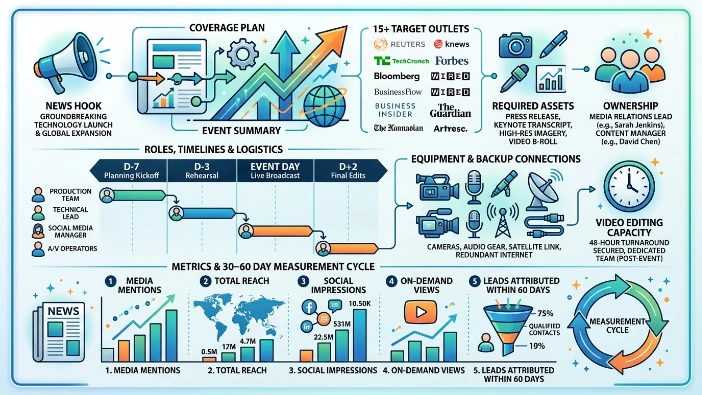
Draft a coverage brief per event, map roles and timelines, secure technical suppliers, and set metrics for a 30–60 day measurement cycle.
Create a one-page brief that lists the news hook, 15 target outlets, required assets, and ownership. Assign staff roles and confirm equipment and backup connections. Book video editing capacity for 48-hour turnaround. Define KPIs: media mentions, total reach, social impressions, on-demand views, and leads attributed within 60 days.
Explore the Advanced Guide:
78% of UK B2B Marketers Now Budget for Events: The Coverage Problem
This 3-phase media coverage framework aligns communications tasks with measurable outcomes. It supports UK B2B teams that seek consistent media exposure and efficient use of event budgets. Use the framework to compare in-house capacity with external options and to plan repeatable processes for upcoming conferences, webinars, trade shows, and roundtables.
Check the Complete Explanation:
Managed Event Coverage vs In-House PR: UK Cost and Reach Analysis 2026



