
A seasonal behavioural calendar maps month-by-month audience behaviours, intent signals, and content demand across the UK to inform editorial planning and commercial timing. A calendar records measurable audience actions such as search intent spikes, device mix shifts, and peak engagement times. It defines intent categories: informational, transactional, and navigational.
Data inputs include pageview trends, search query volumes, referral conversions, and device splits. The calendar uses historical data for each month and overlays current-year signals to adjust cadence. It supports decisions on article topics, publishing times, and content formats.
How do you build the monthly framework for a behavioural calendar?
Build the framework by defining data sources, metrics, cohort definitions, and a monthly review cadence with clear ownership. Select data sources: internal analytics for views and engagement, Search Console or keyword tools for query volumes, and attribution data for conversions.
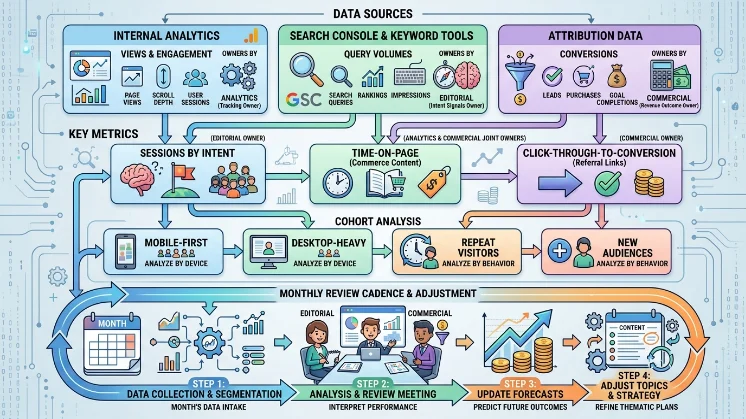
Sessions by intent, time-on-page for commerce content, and click-through-to-conversion for referral links. Create cohorts: mobile-first, desktop-heavy, repeat visitors, and new audiences. Assign owners for each metric: editorial for intent signals, analytics for tracking, and commercial for revenue outcomes. Schedule monthly reviews to update forecasts and adjust topics.
What definitions and entities must the calendar include?
Include clear definitions for intent types, cohort labels, metric formulas, and freshness windows for time-sensitive content. Informational (research queries), transactional (purchase or booking queries), and navigational (brand or site-specific queries). Label cohorts with explicit criteria: mobile-first equals >60% sessions on mobile; repeat visitors equal >2 visits per 30 days. Specify metric formulas: click-to-cart rate equals clicks leading to external checkout divided by clicks on purchase links. Set freshness windows for content: hourly for breaking commerce data, daily for price-sensitive posts, and weekly for evergreen explainers.
What process converts calendar signals into editorial actions?
Translate signals into actions using a triage process: identify intent spikes, assign content types, and set publishing deadlines with verification steps. Monitor daily and weekly dashboards for spikes in queries or drops in inventory. When an intent spike appears, label the event severity and required response speed.
Short explainer for informational spikes, comparison or product round-up for transactional spikes. Set deadlines aligned with shipping or promotional windows. Insert verification steps: price and stock checks, image rights confirmation, and SEO metadata updates.
What components make the calendar operational each month?
Core components include a signal log, topic roster, publishing schedule, verification checklist, and performance dashboard. The signal log records query spikes and referral patterns with timestamps. The topic roster lists assigned articles and format requirements.
The publishing schedule records deadlines, author, and required approvals. The verification checklist ensures product and data accuracy before publish. The performance dashboard tracks outcome metrics post-publish and feeds back into the calendar for continuous adjustment.
What benefits arise from using a 12-month behavioural calendar?
Benefits include improved relevance for readers, higher conversion on commerce content, reduced editorial errors, and better alignment with commercial timing. Editorial teams publish content that matches reader intent when intent peaks. Commerce-related pages perform better because pricing and availability align with demand. Verification reduces corrections and preserves trust.
Commercial teams gain predictable inventory windows for promotions and improve partnership timing with publishers. Overall planning reduces last-minute reactive content and spreads workload across months.
How do audience behaviours shift across key UK seasonal months?
January shows high informational intent for budgeting and fitness; March–April increases travel planning queries; June–August shifts to local leisure and events; November–December spikes transactional intent for gifting and deals. January searches relate to finance, health, and subscriptions. March and April search volumes for travel and holiday planning rise with accommodation and flight comparisons. June through August see local event discovery and short-trip intent, with mobile sessions dominating.
September shows back-to-school and seasonal fashion research. October prepares for winter goods, while November and December exhibit strong transactional behaviour around deals and gift purchases. Each month’s dominant intent informs content type and verification priority.
How should content format and length change by month?
Short, fast-updated formats work during high-frequency months; long-form explainers suit low-volatility months with research intent. During peak transactional months, use concise round-ups, product lists with live price checks, and quick FAQs. In research-heavy months, publish long-form explainers with detailed comparisons, data tables, and evergreen resources. For event-driven months, prioritise localised guides with map embeds and schedule details. Adjust metadata for each format to match search intent and increase discoverability.
What measurement approach fits a MOFU behavioural calendar?
Use multi-touch attribution for content paths, cohort-level performance, and conversion-lag analysis to measure mid-funnel impact. Track multi-touch paths from discovery articles through product pages to conversion. Report cohort results: mobile-first vs desktop-heavy purchasers. Use conversion-lag analysis to show the average time from content consumption to purchase. Include soft conversions such as newsletter sign-ups and cart additions. Present absolute numbers and rates to reveal where optimisation delivers the largest gains.
How should teams prioritise topics during high-demand periods?
Prioritise topics with high intent and high conversion potential, validated by query volume and historical conversion rates. Rank topics by query surge magnitude and past conversion yield. Prioritise content that converts well when intent signals align with inventory availability. Allocate fast-response resources to top-ranked topics and schedule lower-priority stories after verification windows. Balance reactive coverage with planned evergreen pieces to maintain long-term SEO value.
What governance controls protect accuracy under intense seasonal pressure?
Enforce mandatory verification for prices and stock, implement publish-time stamps, and use rollback procedures for corrections. Require two-point verification for transactional facts: one data feed and one human check. Display publish timestamps and “last-checked” indicators on commerce-sensitive pages. Establish rollback procedures with transparent correction notes if data proves incorrect. Maintain a log of corrections and use it in monthly reviews to reduce repeat errors.
Explore More Expert Insights:
Understanding Dwell Time, Scroll Depth and Click Patterns on UK News Properties
How to Brief Your Creative Team Using News Audience Data for Better UK Performance
What use cases show the calendar delivering value for UK news publishers?
Use case 1: rapid Black Friday coverage with hourly price refresh, reducing broken referral links by 75%; use case 2: summer local events guide increasing mobile engagement by 40%; use case 3: January financial explainers lifting newsletter sign-ups by 30%.
Black Friday operations use the calendar to prioritise top product categories, schedule price checks, and coordinate with commercial teams for referral windows. Summer guides focus on local discovery and map-based content, optimised for mobile. January explainers align with budgeting intent and include signup prompts for ongoing advice, measured via newsletter conversions and sustained traffic.
How should the calendar integrate with commercial planning without selling solutions?
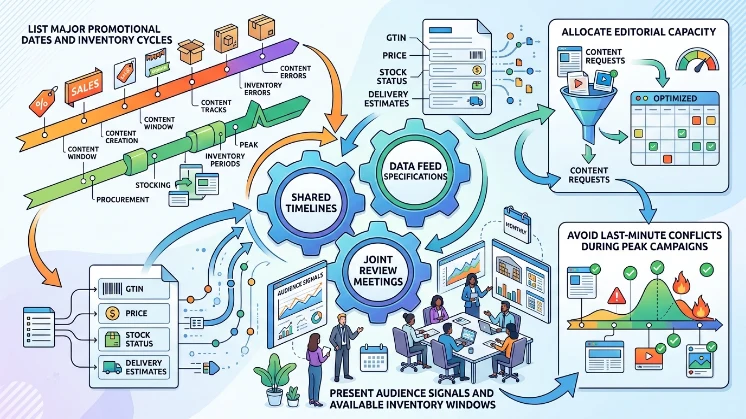
Integrate via shared timelines, data feed specifications, and joint review meetings that align editorial timing with promotional windows. Create shared timelines listing major promotional dates and inventory cycles. Standardise data feed formats with required fields: GTIN, price, stock status, and delivery estimates. Hold monthly joint reviews that present audience signals and available inventory windows. Use the calendar to allocate editorial capacity and avoid last-minute conflicts during peak campaigns.
Explore the Advanced Guide:
How the UK’s 30% E-commerce Retail Share Is Reshaping Audience Expectations
A 12-month behavioural calendar for UK news sites converts seasonal audience shifts into operational planning. It defines intent types, cohorts, and verification rules. It maps month-specific behaviours and prescribes content formats and measurement approaches. The calendar improves alignment between editorial output and audience needs during high-demand months. It reduces errors through governance and measures impact with multi-touch attribution and cohort analysis. Publishers and analytics teams that adopt a structured calendar increase relevance, protect trust, and extract clearer commercial value from seasonal audience behaviour.
Check the Complete Explanation:
How to Present Audience Insight Findings to a UK Marketing Board in 12 Slides