Media remains the primary source of trend discovery because it delivers information at scale, introduces new ideas daily, and shapes public awareness across news platforms, websites, social channels, podcasts, television, and digital publications throughout the United Kingdom.
Trend discovery refers to the process through which people become aware of emerging products, behaviours, cultural topics, technologies, and purchasing patterns. In the UK, media channels play a central role in this process because they reach large audiences and distribute information continuously.
Consumers encounter trends while reading news articles, watching videos, listening to podcasts, browsing websites, or engaging with social content. Media exposure often occurs before active product research begins.
When a trend receives widespread media coverage, awareness increases rapidly. This creates a common understanding among consumers regarding new developments and changing preferences.
What qualifies as media-driven trend discovery?
Media-driven trend discovery occurs when a consumer first learns about a topic through a communication channel rather than through personal experience.
Examples include:
- Reading about electric vehicles in a news publication
- Discovering sustainable fashion through digital articles
- Learning about AI tools through technology reporting
- Seeing health and wellness trends discussed in media coverage
How does media influence consumer behaviour in the UK?
Media influences consumer behaviour by increasing awareness, providing information, establishing relevance, and keeping audiences informed about topics that affect purchasing decisions, lifestyle choices, entertainment preferences, and long-term consumer interests across multiple sectors.
Consumer decisions rarely occur without information. Media provides the context that helps people understand products, industries, and emerging developments.
When audiences repeatedly encounter a topic, familiarity increases. This familiarity often precedes further research and eventual decision-making.
Media also helps consumers compare options. News stories, expert interviews, industry reports, and educational content contribute to a broader understanding of available choices.
Why does repeated exposure matter?
Repeated exposure strengthens recognition.
A consumer who encounters the same trend multiple times across different media channels develops greater awareness than someone who sees it once.
This explains why topics frequently covered in the media often experience faster adoption rates.
How does trust affect trend adoption?
Consumers place greater value on information when it appears within trusted media environments.
Trust influences:
- Information retention
- Perceived credibility
- Research behaviour
- Decision confidence
Higher trust often results in greater engagement with trend-related content.
What types of media drive trend discovery most effectively?
Digital news platforms, social media, video content, podcasts, television, and specialist publications all contribute to trend discovery, but each channel serves a different function within the consumer awareness and information-gathering process.

Different media formats influence audiences in different ways.
How do news platforms contribute?
News platforms provide:
- Industry developments
- Economic updates
- Technology announcements
- Consumer market insights
These sources often introduce trends before they become mainstream.
How does social media accelerate awareness?
Social platforms increase visibility through rapid distribution.
Users encounter trends through:
- Shared articles
- Influencer discussions
- Community conversations
- Short-form video content
Social amplification increases trend exposure across demographic groups.
Why are specialist publications important?
Specialist publications focus on specific sectors.
Examples include:
- Technology publications
- Healthcare publications
- Finance publications
- Automotive publications
These sources often identify trends earlier than general-interest media outlets.
What are brands missing when consumers discover trends through media?
Many organisations focus heavily on campaign delivery while paying insufficient attention to the audience signals, content engagement patterns, and behavioural insights generated through media consumption and trend discovery activities.
Trend discovery creates valuable audience intelligence.
When consumers engage with media content, they reveal interests, priorities, concerns, and emerging needs.
Understanding these signals provides insight into changing market behaviour.
Why is audience context important?
Audience context explains why consumers pay attention to specific topics.
For example:
- Economic news reflects financial concerns.
- Sustainability content reflects environmental interests.
- Technology reporting reflects innovation awareness.
Context helps explain consumer motivations.
Why do trend signals matter?
Trend signals appear before large-scale behavioural changes occur.
These signals include:
- Increased content engagement
- Rising search activity
- Growing topic discussions
- Expanding media coverage
Early identification improves understanding of audience interests.
How does news consumption reveal audience interests?
News consumption data highlights the topics consumers actively follow, helping identify changing priorities, emerging concerns, industry interests, and behavioural patterns that influence future engagement and purchasing decisions across multiple market sectors.
Audience interests become visible through content consumption.
The topics people read, watch, and discuss often indicate future areas of demand.
What information can content engagement reveal?
Content engagement reveals:
- Subject interest
- Topic relevance
- Information needs
- Consumer priorities
For example, increased engagement with renewable energy coverage indicates growing public interest in sustainability-related issues.
Why is behavioural data valuable?
Behavioural data reflects actual actions rather than assumptions.
Examples include:
- Articles viewed
- Videos watched
- Topics followed
- Time spent consuming content
These activities provide measurable indicators of audience interests.
For readers seeking a deeper understanding of how audience intelligence supports creative planning, see:
How to Brief Your Creative Team Using News Audience Data for Better UK Performance.
How do media trends evolve into consumer trends?
Media trends evolve into consumer trends through repeated exposure, public discussion, increased awareness, wider adoption, and continued visibility across multiple communication channels over an extended period.
Not every media topic becomes a consumer trend.
However, successful trends often follow a predictable progression.
Stage 1: Awareness
Media introduces a topic.
Consumers become aware of a new idea, product category, or development.
Stage 2: Discussion
The topic gains visibility.
Audiences discuss it across social platforms, communities, and professional networks.
Stage 3: Research
Consumers seek additional information.
Search activity and content consumption increase.
Stage 4: Adoption
Individuals begin changing behaviours or making decisions based on the trend.
Stage 5: Mainstream Acceptance
The trend becomes widely recognised and integrated into everyday consumer activity.
Why is understanding trend discovery important for market analysis?
Trend discovery provides early insight into consumer interests, enabling more accurate analysis of market direction, audience priorities, emerging sectors, and long-term behavioural changes affecting future demand across the UK economy.
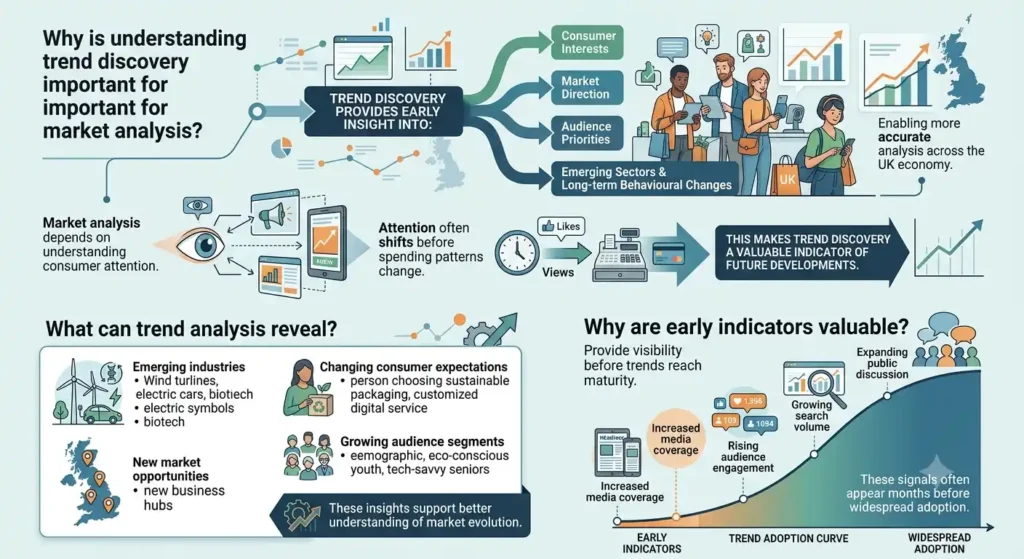
Market analysis depends on understanding consumer attention.
Attention often shifts before spending patterns change.
This makes trend discovery a valuable indicator of future developments.
What can trend analysis reveal?
Trend analysis helps identify:
- Emerging industries
- Changing consumer expectations
- New market opportunities
- Growing audience segments
These insights support better understanding of market evolution.
Why are early indicators valuable?
Early indicators provide visibility before trends reach maturity.
Examples include:
- Increased media coverage
- Rising audience engagement
- Growing search volume
- Expanding public discussion
These signals often appear months before widespread adoption.
How are audience insights connected to long-term planning?
Audience insights help organisations understand behavioural changes over time, allowing more informed planning based on evolving consumer interests, content engagement patterns, and emerging trends identified through media consumption data.
Long-term planning requires a clear understanding of audience behaviour.
Consumer interests evolve continuously.
Media consumption provides an ongoing record of these changes.
What role does audience data play?
Audience data helps identify:
- Interest shifts
- Emerging priorities
- Topic relevance
- Behavioural patterns
These insights support strategic decision-making.
Why is continuous monitoring important?
Consumer behaviour changes rapidly.
Continuous monitoring helps track:
- New trends
- Audience sentiment
- Content engagement
- Information demand
This creates a clearer picture of market direction over time.
Readers interested in how audience insights are applied within annual planning frameworks can explore:
From Data to Decision: How UK Brands Use Audience Insights to Plan Full-Year Buys.
What does the future of media-driven trend discovery look like?
Media-driven trend discovery continues to expand as consumers access information across more channels, consume content in multiple formats, and engage with increasingly personalised information environments throughout their daily routines.
The volume of available information continues to increase.
Consumers now discover trends through interconnected ecosystems that combine news, video, audio, social interaction, and digital publishing.
This creates more opportunities for trend exposure and audience engagement.
What factors are shaping future trend discovery?
Key factors include:
- Digital content growth
- Multi-platform consumption
- Increased audience segmentation
- Real-time information access
- Personalised content experiences
Why will media remain central to trend discovery?
Media serves as the primary mechanism for distributing information at scale.
Dive Deeper With Our Expert Guides:
The Death of the Average UK Reader: Why Broad Targeting Is Failing Brands
Platform Fatigue Is Real: How UK Audience Attention Is Fragmenting Across 10 Channels
Consumers rely on media channels to stay informed about:
- Economic developments
- Technological innovation
- Consumer products
- Social changes
- Industry developments
As information consumption expands, media remains a foundational driver of trend awareness and consumer discovery throughout the United Kingdom.