
Businesses in the United Kingdom increasingly depend on audience intelligence to improve advertising performance, reduce wasted spend, and increase campaign relevance. Two common sources of audience insight are news site audience data and Data Management Platforms (DMPs). Understanding how these approaches differ helps marketers select the most effective data source for campaign planning, targeting, and measurement.
What is the difference between news site audience data and DMP platforms?
News site audience data comes directly from publisher audiences and content interactions. DMP platforms aggregate audience information from multiple sources and organise it into targetable segments. The key difference is data origin, transparency, freshness, and contextual relevance for advertising decisions.
News site audience data is first-party information collected by digital publishers. It reflects actual reader behaviour, content consumption patterns, engagement levels, and interests observed within a specific publication environment.
A DMP platform is a technology system that gathers audience data from various sources. These sources often include websites, third-party providers, advertising networks, and customer databases. The platform then categorises users into audience segments for targeting.
For UK advertisers, the distinction is important because privacy regulations and browser restrictions have significantly reduced the reliability of many traditional third-party data sources.
What defines news site audience data?
News site audience data includes:
- Article readership patterns
- Topic interests
- Device usage
- Session frequency
- Geographic distribution
- Engagement duration
For example, a reader who regularly consumes business, investment, and economic coverage demonstrates measurable interest in financial topics.
What defines a DMP platform?
A DMP platform focuses on:
- Data collection
- Audience segmentation
- Data activation
- Cross-channel targeting
- Audience modelling
Examples include audience categories such as automotive buyers, luxury shoppers, frequent travellers, and technology enthusiasts.
How is audience data collected in each approach?

News publishers collect data directly from audience interactions on owned properties. DMP platforms aggregate information from multiple connected sources. Collection methods determine data quality, compliance standards, and audience accuracy for campaign targeting and measurement.
The collection process directly influences the reliability of audience insights.
How do news publishers collect audience data?
Publishers gather information through:
- Website visits
- Content engagement
- Subscription activity
- Registration systems
- Newsletter interactions
- Mobile app behaviour
Every interaction occurs within the publisher’s own environment.
This creates a direct relationship between user behaviour and audience insight.
Readers interested in persona development can explore:
Building an Audience Persona From News Site Data.
How do DMP platforms collect audience data?
DMP platforms collect information from:
- Third-party providers
- Advertising exchanges
- Data partners
- CRM integrations
- Website tracking systems
The platform combines these datasets into broader audience segments.
This approach increases scale but reduces direct visibility into how every audience attribute was generated.
Which option provides more accurate audience insights?
News site audience data generally delivers higher contextual accuracy because it reflects observed behaviour within a trusted publishing environment. DMP platforms provide broader reach but often depend on inferred attributes and aggregated datasets collected across multiple sources.
Accuracy determines campaign effectiveness.
Poor audience accuracy leads to irrelevant targeting and reduced advertising performance.
Why is publisher data highly accurate?
Publisher audiences generate measurable signals through content consumption.
Examples include:
- Reading retirement planning articles
- Following property market coverage
- Engaging with travel features
- Consuming automotive reviews
These actions represent actual behaviour rather than predicted interests.
Why do DMP segments vary in accuracy?
Many DMP audience categories are built using modelling techniques.
For example:
- Likely luxury buyer
- Potential vehicle purchaser
- Probable technology adopter
These classifications rely on patterns and probabilities rather than direct engagement with relevant content.
As privacy regulations continue evolving, many advertisers increasingly prioritise first-party audience signals.
Which solution performs better for UK privacy compliance?
News site audience data aligns strongly with modern privacy frameworks because it originates from first-party publisher relationships. DMP platforms face greater challenges due to reliance on external data sources and reduced third-party tracking capabilities.
Privacy compliance has become a central advertising requirement in the United Kingdom.
Why is first-party data important?
First-party data is information collected directly from users through owned digital properties.
Benefits include:
- Greater transparency
- Stronger consent management
- Improved governance
- Clearer data ownership
Publishers maintain direct oversight of data collection practices.
How have privacy changes affected DMP platforms?
Several industry developments have changed audience targeting:
- Third-party cookie restrictions
- Browser tracking limitations
- Increased regulatory scrutiny
- Consent requirements
These changes have reduced access to large-scale third-party datasets.
As a result, many advertisers now invest more heavily in publisher partnerships and first-party audience strategies.
Which delivers better audience understanding for campaign planning?
News site audience data provides deeper behavioural context and content-driven insights. DMP platforms provide broader audience categorisation. Campaign planners often gain stronger strategic direction from detailed publisher audience intelligence.
Understanding audience motivation improves campaign outcomes.
What insights come from publisher audiences?
Publisher data often reveals:
- Content preferences
- Reading frequency
- Interest progression
- Topic engagement depth
- Audience attention patterns
These insights help marketers understand why audiences engage with specific subjects.
What insights come from DMP platforms?
DMP platforms typically provide:
- Demographic categories
- Interest groups
- Purchase intent signals
- Cross-channel segments
These datasets support large-scale targeting initiatives.
However, they frequently provide less detail about the context behind audience behaviour.
Readers seeking broader behavioural visibility can explore:
Why Your Google Analytics Is Hiding 60% of What UK Readers Actually Do.
How do news site audience data and DMP platforms compare on advertising performance?
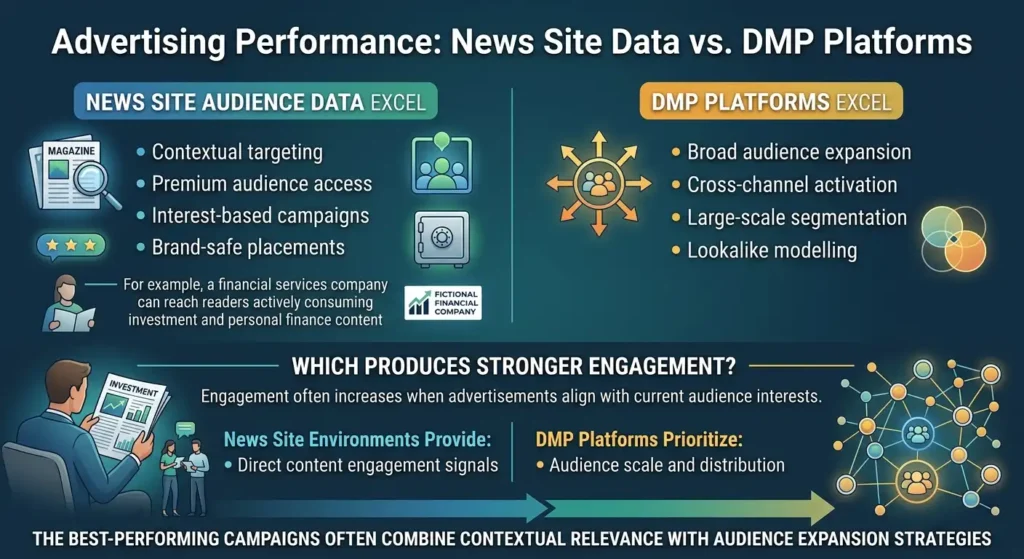
Advertising performance depends on campaign objectives. News site audience data often produces stronger contextual relevance and engagement. DMP platforms provide larger audience scale. Performance differences appear in click-through rates, conversion quality, and audience relevance.
Campaign success requires both reach and relevance.
Where does news site data excel?
Publisher audience data supports:
- Contextual targeting
- Premium audience access
- Interest-based campaigns
- Brand-safe placements
For example, a financial services company can reach readers actively consuming investment and personal finance content.
This creates stronger alignment between message and audience interest.
Where do DMP platforms excel?
DMP platforms support:
- Broad audience expansion
- Cross-channel activation
- Large-scale segmentation
- Lookalike modelling
These capabilities help advertisers reach larger audiences across multiple advertising environments.
Which produces stronger engagement?
Engagement often increases when advertisements align with current audience interests.
News site environments provide this contextual connection through direct content engagement signals.
DMP platforms prioritise audience scale and distribution.
The best-performing campaigns often combine contextual relevance with audience expansion strategies.
What are the cost considerations for UK advertisers?
News site audience partnerships often focus spending on premium audiences and quality insights. DMP platforms require investment in technology, data licensing, and audience activation. Total value depends on campaign objectives and measurement priorities.
Cost evaluation requires examining more than media spend.
What costs are associated with publisher data?
Common investments include:
- Direct publisher partnerships
- Audience insight reports
- Sponsored content programmes
- Premium advertising inventory
The focus is often quality rather than maximum audience volume.
What costs are associated with DMP platforms?
Typical expenses include:
- Platform licensing
- Data acquisition
- Audience activation fees
- Integration costs
- Ongoing management
These costs increase as audience requirements become more complex.
Advertisers evaluating return on investment often compare data quality against total technology expenditure.
Which option is the best choice for UK advertisers?
The best choice depends on business objectives. News site audience data delivers stronger contextual understanding, first-party accuracy, and privacy alignment. DMP platforms provide scale, segmentation, and broad activation capabilities. Many advanced advertisers combine both approaches strategically.
A practical decision framework includes:
Choose news site audience data when:
- Audience understanding is the priority
- Contextual relevance matters
- First-party data quality is critical
- Privacy compliance is a major concern
- Premium audiences are required
Choose DMP platforms when:
- Large-scale audience reach is needed
- Cross-channel activation is essential
- Audience modelling is required
- Multiple data sources must be unified
- Broad segmentation is the objective
When does a hybrid approach work best?
Many UK organisations combine:
- Publisher audience intelligence
- First-party customer data
- DMP activation capabilities
This structure balances audience quality with campaign scale.
Dive Deeper With Our Expert Guides:
How Our Audience Insights Service Reduced One UK Brand’s CPL by 41% in Q1
Audience Insights Reports for UK Advertisers: What’s Included and What It’s Worth
News site audience data and DMP platforms serve different purposes within modern advertising strategies. Publisher data offers direct behavioural insight, stronger contextual understanding, and first-party transparency. DMP platforms provide broad segmentation, audience expansion, and multi-channel activation.
For UK advertisers operating in a privacy-focused environment, first-party audience intelligence has become increasingly valuable. The most effective strategy often begins with high-quality audience understanding and then expands reach through appropriate activation technologies. Businesses evaluating audience targeting investments should compare data accuracy, compliance standards, contextual relevance, scalability, and measurable campaign outcomes before selecting a long-term approach.