
An audience insights service analyses audience data to identify behaviours, interests, motivations, and purchasing patterns. It converts raw information into actionable intelligence that helps marketers improve targeting, reduce wasted spend, and increase campaign efficiency across digital and traditional media channels.
Audience insights services collect and interpret data from multiple sources. These sources include social media activity, website analytics, search behaviour, customer interactions, and media consumption habits.
The goal is simple. Understand who the audience is, what they care about, and how they make decisions.
For UK advertisers, audience insights help answer critical questions:
- Which audience segments convert most efficiently?
- What interests drive engagement?
- Which channels influence purchasing decisions?
- What messaging generates the strongest response?
Without audience intelligence, media buying relies heavily on assumptions. With audience intelligence, campaigns operate using measurable evidence.
How do audience insights differ from basic demographics?
Demographics describe audience characteristics such as age, gender, income, and location.
Audience insights go deeper by examining:
- Behaviour patterns
- Interests
- Motivations
- Media consumption habits
- Purchase triggers
This deeper understanding enables more precise campaign planning and audience targeting.
Why was the UK brand experiencing a high CPL?
The brand’s cost per lead remained high because audience targeting relied primarily on demographic segments. Campaigns reached large numbers of users, but many had low purchase intent, resulting in inefficient spending and lower lead-generation performance.
The brand operated in a competitive UK market where advertising costs increased throughout the previous year.
Initial campaign analysis identified three major issues:
Broad audience targeting
Campaigns targeted large demographic groups without considering behavioural differences.
Users within the same age range demonstrated significantly different interests and purchasing behaviours.
Message-audience mismatch
Creative messaging focused on product features rather than audience motivations.
Engagement rates varied substantially between audience groups.
Budget allocation inefficiencies
Media spend was distributed evenly across channels despite major differences in conversion performance.
Several audience clusters generated engagement but produced very few qualified leads.
These factors contributed to rising acquisition costs and declining efficiency.
How did the audience insights process work?
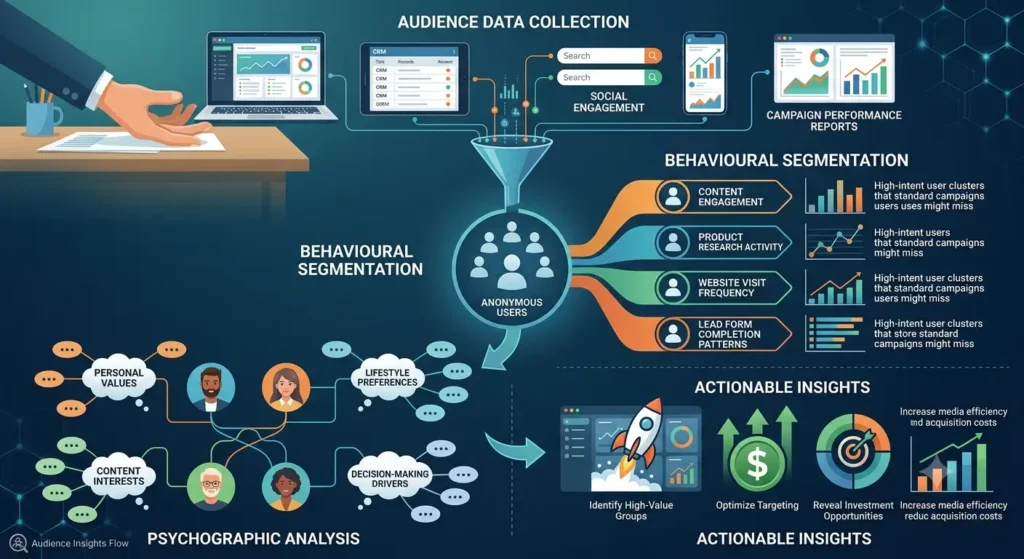
The audience insights process combined audience research, behavioural analysis, segmentation, media consumption evaluation, and campaign performance assessment. The resulting insights identified high-value audience groups and revealed opportunities to optimise targeting and media investment.
The project followed a structured methodology.
Audience data collection
Data was gathered from multiple sources including:
- Website analytics
- CRM records
- Social engagement metrics
- Search behaviour
- Campaign performance reports
This created a comprehensive view of customer activity.
Behavioural segmentation
Users were grouped according to actions rather than demographics alone.
Key behaviours included:
- Content engagement
- Product research activity
- Website visit frequency
- Lead form completion patterns
Behavioural segmentation revealed several high-intent audience groups that existing campaigns were not prioritising.
Psychographic analysis
Audience motivations and interests were examined.
This analysis identified:
- Personal values
- Lifestyle preferences
- Content interests
- Decision-making drivers
Many high-converting users shared similar motivations despite differing demographic profiles.
Readers interested in segmentation approaches can explore:
Psychographic vs Behavioural Segmentation
Which audience insights produced the biggest improvements?
The most valuable insights identified previously overlooked audience segments, content preferences, platform usage patterns, and conversion triggers. These discoveries enabled more accurate targeting and stronger alignment between audience expectations and campaign messaging.
Several findings generated immediate impact.
High-intent audiences consumed different content
Top-performing prospects engaged heavily with educational content before submitting enquiries.
These users demonstrated stronger purchase intent than audiences exposed only to promotional messaging.
Platform performance varied significantly
Certain media channels delivered large volumes of traffic but relatively few qualified leads.
Other channels generated lower traffic volumes but substantially higher conversion rates.
Budget reallocation improved efficiency.
Messaging preferences differed by segment
Audience groups responded differently to campaign messaging.
Some segments engaged with performance-focused content.
Others preferred trust, credibility, and expertise-oriented messaging.
Creative assets were adjusted accordingly.
Engagement timing influenced conversion rates
Audience activity peaked during specific periods.
Campaign scheduling was aligned with these behavioural trends to maximise engagement opportunities.
Readers seeking broader market trends can review:
What 39.7M Social Posts Reveal About UK Audience Behaviour in 2026.
How was the media strategy changed?
The revised media strategy focused investment on high-intent audience segments, optimised channel allocation, improved message relevance, and introduced data-driven targeting rules. These changes increased lead quality while reducing acquisition costs across active campaigns.
Several adjustments were implemented.
Refined audience segments
Large demographic groups were replaced with narrower audience clusters.
These segments reflected actual behaviours and interests rather than broad demographic assumptions.
Improved channel allocation
Media spend shifted toward channels producing stronger conversion rates.
Underperforming placements received reduced investment.
Personalised messaging
Creative assets were tailored to audience motivations.
Each segment received messaging aligned with its interests and decision drivers.
Continuous optimisation
Performance monitoring became an ongoing process.
Audience behaviour changes were tracked regularly to maintain campaign effectiveness.
What results were achieved during Q1?
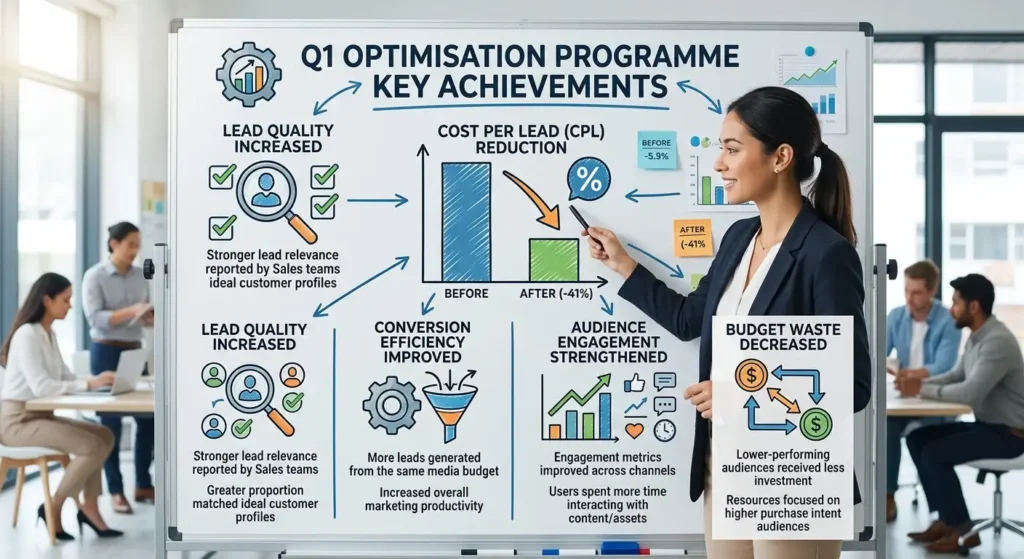
The optimisation programme reduced cost per lead by 41% during Q1. Additional improvements included stronger conversion rates, improved audience engagement, higher lead quality, and more efficient allocation of advertising budgets.
The most significant outcome was the reduction in CPL.
However, several supporting metrics also improved.
Lead quality increased
Sales teams reported stronger lead relevance.
A greater proportion of enquiries matched ideal customer profiles.
Conversion efficiency improved
Campaigns generated more leads from the same media budget.
This increased overall marketing productivity.
Audience engagement strengthened
Engagement metrics improved across multiple channels.
Users spent more time interacting with relevant content and campaign assets.
Budget waste decreased
Lower-performing audience groups received less investment.
Resources focused on audiences demonstrating higher purchase intent.
Together, these changes created a more efficient customer acquisition process.
What benefits do UK advertisers gain from audience insights services?
Audience insights services help advertisers improve targeting accuracy, enhance campaign performance, reduce acquisition costs, strengthen audience engagement, and make more informed media investment decisions based on evidence rather than assumptions.
These benefits apply across industries and campaign objectives.
Better targeting
Insights identify the audiences most likely to engage and convert.
This improves campaign precision.
Lower acquisition costs
More accurate targeting reduces wasted impressions and inefficient spending.
Stronger campaign relevance
Understanding audience motivations enables more effective messaging.
Relevant content typically generates stronger engagement.
Improved decision-making
Data-driven insights provide objective evidence for strategic decisions.
This reduces reliance on assumptions.
Higher return on investment
More efficient targeting and media allocation increase overall campaign effectiveness.
When should a business invest in an audience insights service?
Businesses benefit most from audience insights services when acquisition costs rise, campaign performance stagnates, audience behaviour changes, or expansion into new markets requires deeper understanding of customer preferences and media consumption patterns.
Several indicators signal the need for audience analysis.
Rising CPL
Increasing lead costs often indicate targeting inefficiencies.
Audience insights help identify optimisation opportunities.
Low conversion rates
High traffic with limited conversions suggests audience mismatch.
Insights reveal where adjustments are required.
Market expansion
New markets require detailed audience understanding.
Research reduces uncertainty during expansion initiatives.
Competitive pressure
Competitive environments demand more precise targeting and media efficiency.
Audience intelligence provides a measurable advantage.
How can marketers evaluate an audience insights provider?
Marketers should assess data quality, analytical methodology, reporting transparency, segmentation capabilities, and demonstrated business outcomes. The most effective providers connect audience intelligence directly to measurable performance improvements and marketing objectives.
Evaluation criteria include:
Data sources
Reliable insights depend on high-quality data.
Providers should explain how information is collected and validated.
Segmentation expertise
Advanced audience segmentation capabilities improve targeting precision.
Reporting clarity
Insights must be understandable and actionable.
Complex data without clear recommendations delivers limited value.
Performance outcomes
Case studies and measurable results demonstrate effectiveness.
Metrics such as CPL reduction, conversion improvement, and audience engagement growth provide useful benchmarks.
Dive Deeper With Our Expert Guides:
Audience Insights Reports for UK Advertisers: What’s Included and What It’s Worth
Multi-Platform Audience Insights Services for Total Audience Visibility
Audience insights transform marketing performance by replacing assumptions with evidence-based decision-making. In this UK case, deeper audience understanding enabled more accurate targeting, stronger messaging alignment, better media allocation, and a 41% reduction in cost per lead during Q1.
As media costs continue to rise across the United Kingdom, audience intelligence becomes increasingly important. Brands that understand behaviours, motivations, and purchase drivers can allocate budgets more efficiently, improve lead quality, and achieve stronger marketing outcomes. Audience insights services provide the foundation for those improvements by turning audience data into actionable marketing strategy.