

Understanding audience behaviour is a core requirement for effective media planning, content strategy, and advertising performance. UK publishers generate millions of audience interactions every day through article consumption, topic engagement, device usage, and referral patterns. When structured correctly, this data can be transformed into detailed audience personas that support better marketing decisions.
What is an audience persona built from news site data?
An audience persona built from news site data is a structured profile created using actual reader behaviour, content consumption patterns, demographics, interests, and engagement signals. It represents a defined audience segment based on measurable actions rather than assumptions or survey responses alone.
Traditional audience personas often rely on interviews, questionnaires, and market research. News site audience personas use behavioural evidence collected directly from readers.
A persona combines multiple data points into one profile, including:
- Age range
- Geographic location
- Device preference
- Content interests
- Reading frequency
- Traffic sources
- Engagement patterns
For example, a UK news publisher may identify a segment of readers aged 25–34 who regularly consume technology, business, and AI-related content during weekday commuting hours.
This profile becomes a usable audience persona for campaign planning and content targeting.
Why are behavioural personas more reliable?
Behavioural personas use observed actions.
Survey-based personas rely on stated preferences.
A reader’s actual behaviour often provides stronger evidence than self-reported interests. News site data captures real engagement across thousands or millions of interactions.
Why is news site data valuable for audience persona development?
News sites collect large volumes of first-party audience data across multiple topics, devices, and user journeys. This data provides detailed insight into reader interests, content preferences, and engagement behaviours that help build highly accurate audience personas.
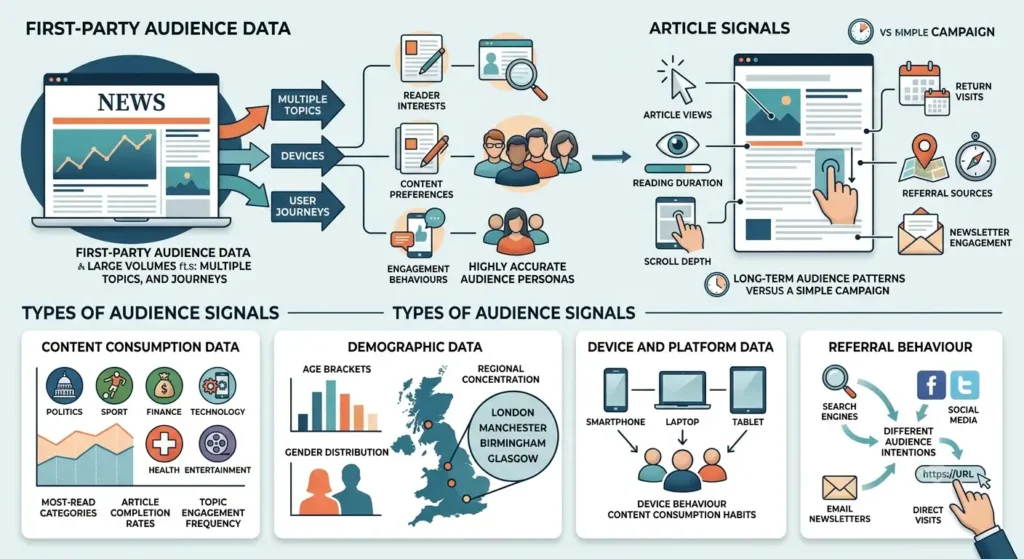
Every article view generates useful audience signals.
Examples include:
- Section preferences
- Reading duration
- Scroll depth
- Return visits
- Referral sources
- Newsletter engagement
Unlike isolated campaign data, publisher datasets often reveal long-term audience patterns.
What types of audience signals are available?
News publishers commonly analyse:
Content Consumption Data
This includes:
- Most-read categories
- Article completion rates
- Topic engagement frequency
Examples include politics, sport, finance, technology, health, and entertainment.
Demographic Data
Audience demographics often include:
- Age brackets
- Gender distribution
- Regional concentration
Examples include readers in London, Manchester, Birmingham, and Glasgow.
Device and Platform Data
This identifies:
- Mobile users
- Desktop users
- Tablet users
Device behaviour often reveals content consumption habits.
Referral Behaviour
Traffic source analysis includes:
- Search engines
- Social media
- Email newsletters
- Direct visits
Each source reflects different audience intentions.
How do you collect the right data before building a persona?
Audience persona development starts with collecting clean, structured, and representative audience data. The objective is to identify meaningful behavioural patterns across a sufficiently large sample of readers rather than analysing isolated interactions.
Data collection requires consistency.
A common framework includes three stages.
Stage 1: Gather Audience Analytics
Collect metrics such as:
- Unique users
- Sessions
- Page views
- Returning visitors
- Average engagement time
These metrics establish audience size and behaviour.
Stage 2: Categorise Content Topics
Group articles into categories.
Examples include:
- Politics
- Business
- Technology
- Lifestyle
- Sport
- Travel
Topic categorisation simplifies audience analysis.
Stage 3: Consolidate Data Sources
Combine information from:
- Analytics platforms
- Subscriber databases
- Newsletter systems
- Audience insight platforms
This creates a unified audience view.
Readers interested in analytics limitations can also explore:
Why Your Google Analytics Is Hiding 60% of What UK Readers Actually Do.
How do you identify audience segments from news site data?
Audience segmentation involves grouping readers with similar behaviours, interests, and engagement patterns. These segments form the foundation of audience personas because they reveal distinct patterns within larger audiences.
Segmentation transforms raw data into actionable groups.
Segment by Content Interest
Examples include:
- Business readers
- Sports enthusiasts
- Technology followers
- Personal finance readers
Each group demonstrates unique content consumption patterns.
Segment by Engagement Level
Common engagement categories include:
- Daily readers
- Weekly readers
- Occasional visitors
Engagement frequency often correlates with audience loyalty.
Segment by Demographics
Demographic segmentation includes:
- Age groups
- Gender distribution
- Geographic regions
These attributes support targeted planning.
Segment by Device Behaviour
Examples include:
- Mobile-first readers
- Desktop-focused readers
- Multi-device users
Device preferences influence content strategy and advertising formats.
How do you transform audience segments into personas?
Audience personas are created by combining demographic, behavioural, and contextual insights into a single audience profile. Each persona represents a meaningful reader group with identifiable characteristics and measurable behaviours.
Persona creation follows a structured process.
Define a Core Audience Group
Select a segment with clear behavioural consistency.
Example:
Technology readers aged 25–34 from major UK cities.
Identify Key Attributes
Document:
- Age range
- Location
- Interests
- Device preference
- Reading frequency
These attributes form the persona foundation.
Add Behavioural Context
Include:
- Preferred content categories
- Engagement depth
- Visit timing
- Referral sources
Behavioural context improves persona accuracy.
Create a Persona Profile
Example:
Name: Tech-Informed Professional
Age Range: 25–34
Location: London and Manchester
Primary Interests: Technology, AI, business innovation
Preferred Device: Mobile
Visit Frequency: Daily
Main Traffic Sources: Search and newsletters
This profile becomes a usable planning asset.
What components should every audience persona include?
Effective audience personas contain demographic, behavioural, contextual, and content preference information. These elements create a complete audience representation that supports marketing, advertising, and editorial decision-making.
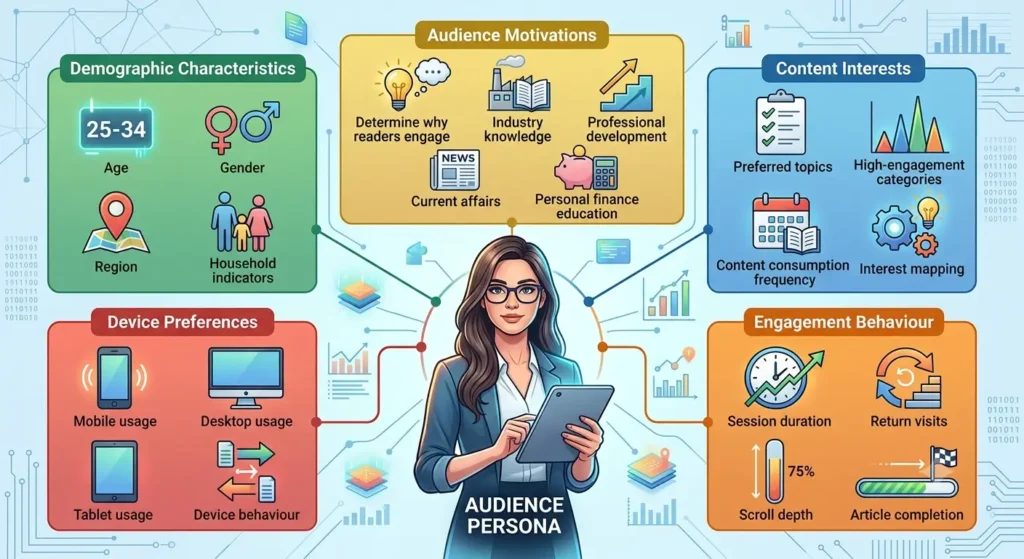
Several components are essential.
Demographic Characteristics
Include:
- Age
- Gender
- Region
- Household indicators
Demographics provide audience context.
Content Interests
Identify:
- Preferred topics
- High-engagement categories
- Content consumption frequency
Interest mapping improves targeting precision.
Engagement Behaviour
Track:
- Session duration
- Return visits
- Scroll depth
- Article completion
Engagement data measures audience involvement.
Device Preferences
Include:
- Mobile usage
- Desktop usage
- Tablet usage
Device behaviour influences campaign design.
Audience Motivations
Determine why readers engage.
Examples include:
- Industry knowledge
- Professional development
- Current affairs
- Personal finance education
Motivation adds strategic depth.
How can UK publishers and advertisers use audience personas?
Audience personas support content planning, advertising targeting, campaign optimisation, and audience growth strategies. They help organisations align messaging with actual audience interests and behaviours.
Audience personas create measurable business value.
Editorial Planning
Editors can identify:
- Popular content categories
- Emerging audience interests
- Content gaps
This improves content relevance.
Advertising Strategy
Advertisers use personas to:
- Select audiences
- Refine messaging
- Improve targeting
Audience alignment often increases campaign efficiency.
Audience Growth
Growth teams use personas to:
- Improve acquisition
- Increase retention
- Enhance newsletter performance
Audience understanding supports long-term growth.
Product Development
Media organisations use personas to guide:
- Subscription strategies
- Membership programmes
- User experience improvements
Audience insights inform product decisions.
How does news site audience data compare with third-party audience platforms?
News site audience data is based on direct reader interactions, while third-party platforms aggregate audience information from multiple external sources. Each approach provides different levels of visibility, accuracy, and audience ownership.
The industry increasingly focuses on first-party data.
News publishers possess direct audience relationships.
Third-party platforms provide broader market visibility.
Combining both approaches often produces stronger audience intelligence.
Readers evaluating different audience intelligence approaches can also explore:
News Site Audience Data vs DMP Platforms: A Head-to-Head UK Comparison.
What advantages does first-party news site data provide?
Benefits include:
- Direct audience ownership
- Higher behavioural accuracy
- Stronger privacy compliance
- Detailed content engagement insights
These factors improve persona quality.
What advantages do external platforms provide?
Benefits include:
- Market-wide audience visibility
- Competitive benchmarking
- Broader reach analysis
These insights complement publisher datasets.
What does a complete audience persona framework look like?
A complete audience persona framework combines audience collection, segmentation, behavioural analysis, persona creation, validation, and ongoing refinement. This process converts raw audience activity into structured decision-making intelligence.
The framework follows six steps:
- Collect audience data
- Categorise content engagement
- Segment audience groups
- Build behavioural profiles
- Create audience personas
- Validate and update personas regularly
Audience behaviour changes over time.
Dive Deeper With Our Expert Guides:
Psychographic vs Behavioural Segmentation: Which Wins for UK Media Buys?
How to Read a UK News Audience Report and Turn It Into a Campaign Strategy
Regular updates ensure persona accuracy.
For UK publishers, advertisers, and media planners, audience personas built from news site data provide a practical method for understanding reader behaviour. When constructed from verified first-party data, these personas improve content planning, audience targeting, campaign performance, and strategic decision-making across the entire media ecosystem.



