

A publisher brief is a concise document that defines campaign goals, target audience, key messages, format, and measurement. It aligns the advertiser and the publisher to reduce wasted spend and improve conversion rates.
A publisher brief sets expectations. It defines who sees the content, what action the audience takes, and how success is measured. Publishers use briefs to assign the right editorial team, choose placement, and select creative formats. Advertisers use briefs to protect brand safety and to ensure audience relevance. A clear brief shortens approval cycles and increases the chance that paid placements drive clicks, leads, or sales.
Define the advertiser, the publisher, the campaign manager, and the creative owner. Specify campaign start and end dates. Provide audience segments by firmographic, demographic, and behavioural criteria. Give exact KPIs, for example: 2,000 click-throughs, 150 leads, or 4% conversion rate.
How do you structure a brief to ensure the publisher delivers high-converting sponsored content?
Include goal, audience, value proposition, content formats, creative assets, distribution plan, and KPIs in that order; keep each section short and measurable.
Start with the campaign goal. State one primary objective (awareness, lead generation, direct purchase) and up to two secondary objectives. Describe the audience with numbers job titles, industries, company sizes, location (United Kingdom regions), and intent signals. Provide the unique value proposition in one sentence that tells the publisher what makes the product or offer relevant.
List the campaign goal, target audience, core message, required formats (native article length, video duration, infographic specs), assets (logo PNG, 1200×628 hero image), tone and compliance notes, placement preferences (homepage, section pages, newsletter), timing, budget envelope, and success metrics. Attach sample creative and past performance benchmarks, previous campaign generated 3.2% CTR and 210 leads over 30 days.
Which content formats convert best on UK publisher platforms?
Native editorial articles, video explainers under 90 seconds, and integrated newsletters convert best when they match publisher voice and include a clear call to action.
Native articles that read like editorial content deliver credibility. Video explainers with subtitles and branded end cards perform well on news pages and social placements. Sponsored newsletter slots yield high engagement when the subject line and preheader match subscriber interests. Interactive assets such as calculators or short quizzes increase time on page and drive higher lead-quality signals.
Specify article length (800–1,200 words for thought leadership; 400–700 words for performance pieces). For video set duration (30–90 seconds), resolution (1080p), and closed captions. For email give subject line character limit (50) and preheader length (90). For interactive tools provide API or data endpoints and required tracking parameters.
What targeting and audience instructions should you include?
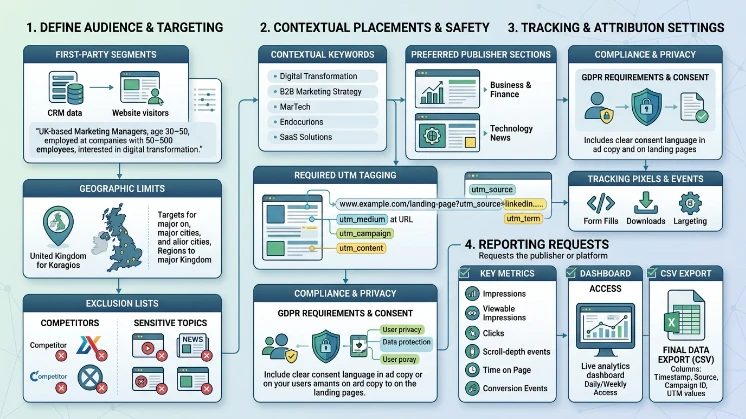
Define first-party audience segments, contextual placements, geographic limits, and exclusion lists; add required tracking and UTM parameters.
Provide exact audience definitions: e.g., “UK-based marketing managers, age 30–50, employed at companies with 50–500 employees, interested in digital transformation.” Supply exclusion lists for competitors and sensitive topics. Specify contextual targeting keywords and preferred sections within the publisher. Include GDPR requirements, consent language, and required UTM tagging to attribute traffic in analytics platforms.
Ask for impressions, viewable impressions, clicks, scroll-depth events, time on page, and conversion events. Request access to daily or weekly reporting dashboards and a final CSV export with timestamp, source, campaign ID, and UTM values.
How should you define creative requirements and editorial control?
State required creative assets, word counts, mandatory messages, disclaimers, and brand guidelines; include an approval workflow with deadlines.
Provide assets: logos, hero images, boilerplate copy, author bio, and product shots. Specify mandatory messages such as price, trial length, or regulatory disclaimers. Supply brand colours, fonts, and logo usage rules. Give a two-step approval process: creative preview within 5 business days, final sign-off within 48 hours. Include an editorial style note indicating whether the piece should be factual, promotional, or neutral.
Require transparent labelling of sponsored content per UK ASA and CMA guidance. Decide on whether the publisher will let an in-house journalist write the piece or if the advertiser will supply a draft. State any must-not topics and legal checks needed for regulated categories, financial services or healthcare copy requires legal clearance.
How do you set KPIs and reporting to prove conversion?
Set one primary KPI and two secondary KPIs with exact numerical targets and reporting cadence; require raw-event level data for verification.
Choose a single primary KPI aligned with campaign goal, for example: 200 qualified leads in 60 days. Add secondary KPIs like 5,000 sessions and 25% scroll depth on article pages. Define what qualifies as a lead: completed contact form with company domain and job title. Specify reporting cadence: daily traffic summary, weekly performance narrative, and a final campaign report with raw CSV.
Use UTM parameters for each creative and placement. Implement server-side event forwarding or postback URLs for lead validation. Ask the publisher to support first-click, last-click, and view-through reporting. Require a pixel or tag placed in a publisher-provided sandbox to verify conversions without exposing PII.
What compliance and legal checks must be in the brief for the UK market?
Include ASA advertising rules, GDPR consent requirements, ASA labelling, and any sector-specific regulations; require publisher confirmation of compliance.
Cite UK ASA guidance for sponsored label wording and placement. State GDPR obligations: obtain consent for personal data, provide a lawful basis, and outline data retention periods. For regulated products add relevant authorities: FCA for financial services, MHRA for medicines, and Ofcom rules for broadcast formats that may intersect with publishers. Request written confirmation of compliance from legal or compliance teams.
Ask the publisher to provide their privacy policy URL, data processing agreement, and an annual compliance audit or statement. Insist on proof of subscriber consent for newsletter placements.
How do you coordinate timelines, budgets, and approvals?
Provide a campaign calendar with milestones, fixed budget or CPM/CPL rates, and a clear approval SLA to avoid delays.
Set campaign start and end dates and backdate content deadlines. Allocate budget by placement type and reserve a contingency of 10% for optimisation. Specify payment terms, invoicing schedule, and any penalties for late delivery. Define approval SLA: 48 hours for creative feedback, 24 hours for final sign-off, and two business days for factual corrections post-publication.
Deadline for draft: 10 business days before launch. Publisher creative preview delivered: 7 business days before launch. Final assets approved: 3 business days before launch. Campaign live: Day 0. Mid-campaign optimisation review: Day 14. Final report delivered: Day 70.
Explore More Expert Insights:
Native vs Branded: Which Sponsored Format Builds More UK Brand Trust?
Designing B2B Sponsored Content: Frameworks for UK News Platforms
What optimisation steps improve conversion during the campaign?
Run A/B tests on headlines and hero images, adjust placements based on early performance, and reallocate budget to top-performing formats within the first 14 days.
Request weekly performance reviews with concrete actions: swap underperforming headlines, move budget to newsletter or homepage slots that show higher click-through rates, and change CTA copy when conversion rates fall. Track lead quality by reviewing a sample of lead records and reject invalid leads per the agreed SLA.
If headline A yields 1.2% CTR and headline B yields 2.9% CTR, pause A and increase runs of B. If newsletter placement converts at 3.5% and homepage at 1.1%, shift 30% of remaining budget to newsletter.
What benefits result from a precise publisher brief?
A precise brief reduces time to launch, increases conversion rates, improves budget efficiency, and delivers clearer measurement for decision-making.
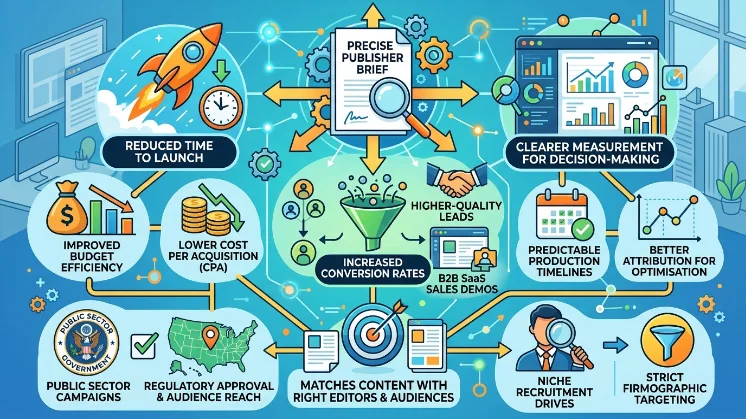
Clear briefs reduce misunderstandings. They allow publishers to match content with the right editors and audiences. They provide predictable production timelines. They enable better attribution, which supports optimisation decisions and future planning. Advertisers gain higher-quality leads and lower cost per acquisition.
Discover More Insights:
91% of UK B2B Marketers Increased Content Output in 2025: What Works?
B2B SaaS product launches that require lead capture for sales demos. Public sector campaigns that need regulatory approval and precise audience reach. Niche recruitment drives that require strict firmographic targeting.
Learn More Here:
Sponsored Content ROI Tracker: A 6-Month UK News Campaign Dissected



