

Native sponsored content integrates editorial-style articles into a publisher’s environment; branded sponsored content features clearly branded messages and formats. Native content matches the look and voice of the host site, while branded content uses overt brand elements such as logos, brand tone, and product-focused messaging.
Native sponsored content is designed to resemble regular editorial content on a publisher’s site. It uses the publisher’s headline style, imagery conventions, and editorial tone. Native content often delivers informative or narrative-driven material with subtle brand presence. Branded sponsored content states the advertiser’s identity clearly. It includes brand logos, taglines, product shots, and direct brand claims. Branded formats include advertorials, branded video series, and sponsored product reviews with explicit brand attribution.
How does each format affect reader trust in the UK market?
Native content increases perceived relevance and reading engagement; branded content increases clarity about the advertiser and can increase transparency-driven trust. Readers in the UK respond to both formats depending on transparency, relevance, and publisher reputation.
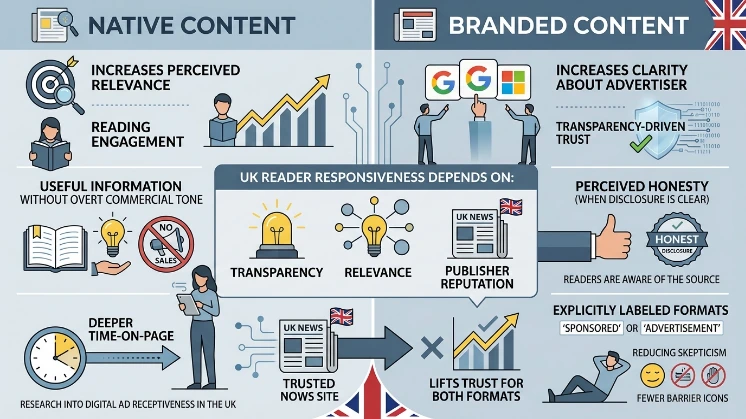
UK audiences value clear disclosure. When disclosure is clear, branded content rates higher on perceived honesty because readers know the source. Native content scores higher on engagement when it provides useful information without overt commercial tone. Research into digital ad receptiveness in the UK shows that editorial-style sponsored articles drive deeper time-on-page metrics, while explicitly labeled branded formats reduce skepticism when branding is upfront. Publisher reputation acts as a multiplier: trusted news sites lift trust for both formats.
Which format drives more engagement and attention?
Native sponsored content drives higher engagement metrics such as time on page and article completion; branded formats drive higher immediate brand recall and ad recognition. Native articles that fit the editorial flow produce longer sessions and higher social sharing. Branded content produces stronger short-term brand recall because branding appears prominently.
Data from UK digital publishers shows native articles generate 2–25 times more engagement than standard display ads across headlines, scroll depth, and session length. Branded video units and branded experiences generate higher unaided recall in post-exposure surveys. Engagement patterns differ: native long-form articles perform for information-seeking audiences; branded short-form content performs for campaign-focused audiences who prioritize brand recognition.
Does native content risk misleading readers about sponsorship?
Native content risks perceived editorial confusion when sponsorship labeling is weak; clear disclosure eliminates misleading impressions. The Advertising Standards Authority (ASA) and Committee of Advertising Practice (CAP) require clear, prominent labeling of sponsored content. Labels such as “Paid partnership,” “Sponsored,” or “Paid for by [Advertiser]” must appear at the start of the article and within HTML meta tags for clarity.
When labels are small, buried, or ambiguous, readers may interpret content as independent journalism. That creates regulatory risk and damages trust once discovered. Publishers that follow ASA and CAP guidelines avoid this risk by placing clear disclosure near the headline and repeating it in-situ where necessary.
How does publisher reputation influence trust for each format?
Publisher reputation amplifies trust for both formats; high-reputation publishers transfer credibility to sponsored content regardless of format. Audiences assign an initial trust baseline based on the publisher. Prestigious UK outlets provide a positive credibility halo that increases perceived accuracy and reliability of sponsored content. Lesser-known sites provide lower initial trust, making disclosure and content quality critical.
For native content, readers expect editorial standards. If a reputable publisher hosts native-sponsored content, readers assume editorial vetting and therefore trust rises. With branded content, publisher reputation raises the credibility of brand claims, but readers still expect conspicuous sponsorship disclosure.
What content components increase trust in sponsored formats?
Clear sponsorship labels, evidence-based claims, author attribution, and third-party data citations increase trust. Use visible sponsor identification at the article outset, include author name and editorial credentials, and cite research with source links. Include dated information and methodology when presenting statistics.
Specific trust-building elements include explicit label text, visible brand markers for branded content, named authors or editors, embedded citations to primary data sources (government reports, industry studies), and measurable performance claims supported by methodology. Examples: citing Office for National Statistics data for demographic claims or referencing a named consumer study for product claims.
When should marketers choose native over branded formats?
Choose native when the objective is audience education, sustained engagement, and content-driven relationships. Native content fits objectives that rely on building topical authority, improving time-on-site, and encouraging social sharing. Use native formats for long-form explainers, how-to guides, investigative features, and thought leadership pieces that require contextual storytelling and editorial reading flow.
Native performs well for awareness and consideration stages where readers research solutions. It supports SEO through long-form, keyword-rich content that aligns with publisher taxonomy. Use native when the brand wants subtle integration and to build trust through value rather than direct persuasion.
When should marketers choose branded sponsored content?
Choose branded content when the objective is clear brand messaging, product differentiation, and direct recall. Branded formats perform when the campaign requires explicit brand exposure, product demonstrations, or promotional offers. Use branded content for product launches, seasonal promotions, and campaigns that require consistent brand presentation across placements.
Branded content works when campaign metrics prioritise recognition, call-to-action performance, or direct conversion tracking. Combine prominent branding with transparent disclosure and evidence-based claims to maintain trust.
How do measurement approaches differ for native and branded formats?
Native metrics focus on attention and engagement; branded metrics focus on brand lift and recall. For native content, measure session duration, scroll depth, article completion rate, social shares, clickthroughs to owned channels, and organic search impressions. For branded content, measure ad recall, aided and unaided brand awareness, view-through rates, click conversion, and direct response metrics.
Both formats benefit from pre/post-exposure surveys and tracking pixels to measure downstream behaviour. Use controlled lift studies to isolate sponsored content effects on brand perception. Attribute conversions through UTM parameters and multi-touch attribution models.
How do UK regulations affect sponsored content formats?
UK advertising rules require clear, prominent disclosure and truthfulness; both formats must comply with ASA and CAP codes. Sponsored content must not mislead. Advertisement labels must be obvious to average readers. Claims that reference performance, savings, or health must be substantiated with credible evidence. Failure to comply triggers ASA investigations and possible removal orders.
Publishers must retain records of sponsor input and approval to demonstrate compliance. Use clear labelling practices and evidence-ready claims to meet regulatory standards.
Explore More Expert Insights:
Designing B2B Sponsored Content: Frameworks for UK News Platforms
The Best London News Publications for High-Impact Sponsored Content
What are practical use cases where one format outperforms the other?
Use native for educational campaigns, long-form storytelling, and SEO-driven topical authority; use branded for product launches, direct response campaigns, and high-recall brand exposure. Examples: a financial-education explainer placed as native content on a national news site yields sustained engagement and organic search presence. A branded video series with explicit product features delivers higher ad recall during a product launch.
Combine formats strategically: run a native editorial explainer to build context, then follow with branded content to convert readers who reach consideration. This staged approach provides both engagement and measurable brand lift.
How should teams decide between native and branded sponsored content?
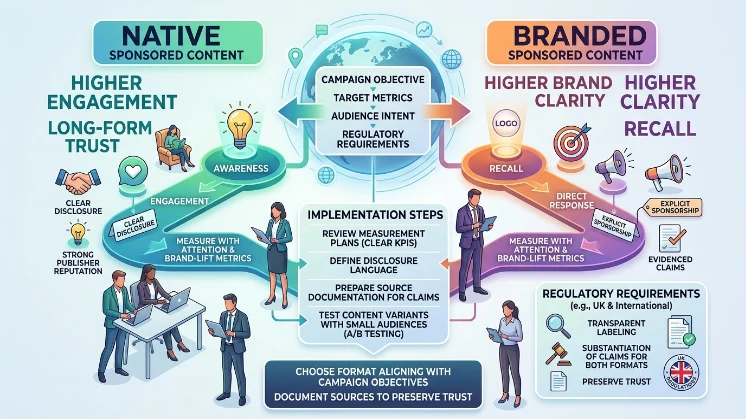
Decide based on campaign objective, target metrics, audience intent, and regulatory requirements. Map objectives to format strengths: awareness and engagement map to native; recall and direct response map to branded. Review measurement plans and legal checks before launch. Align publisher selection with audience match and reputation criteria. Use A/B testing across formats to quantify differences for specific audience segments.
For implementation, create a measurement plan with clear KPIs, define disclosure language, and prepare source documentation for any claims. Test content variants with small audiences before full rollout.
Discover the Full Information:
Sponsored Content Gets 22× More Engagement Than Display Ads: UK Data
Native sponsored content delivers higher engagement and long-form trust when disclosure is clear and publisher reputation is strong. Branded sponsored content delivers higher brand clarity and recall when sponsorship is explicit and claims are evidenced. UK regulations require transparent labeling and substantiation for both formats. Choose the format that aligns with campaign objectives, measure with attention and brand-lift metrics, and document sources to preserve trust.
Explore the Advanced Guide:
Multi-Site Sponsored Content: How 10 UK News Properties Multiply Reach



