
Creative testing for banners is a structured method that compares visual and messaging variants on UK news sites to find combinations that lower cost-per-click (CPC) while maintaining reach.
Creative testing evaluates headline text, imagery, call-to-action wording, and layout by running controlled experiments on news-site placements. Tests record CPC, click-through rate (CTR), viewability, and engagement depth. Results identify the lowest-cost creative that meets campaign objectives. The framework applies to desktop and mobile placements across regional and national UK publishers.
How does the framework define each variable?
Headline text is the short, attention-bearing line shown on the banner. Imagery covers photography, illustration, and background color. Call-to-action wording is the action phrase (for example, “Read” or “Find Out”). Layout is the arrangement of elements, including logo size and navigation cues.
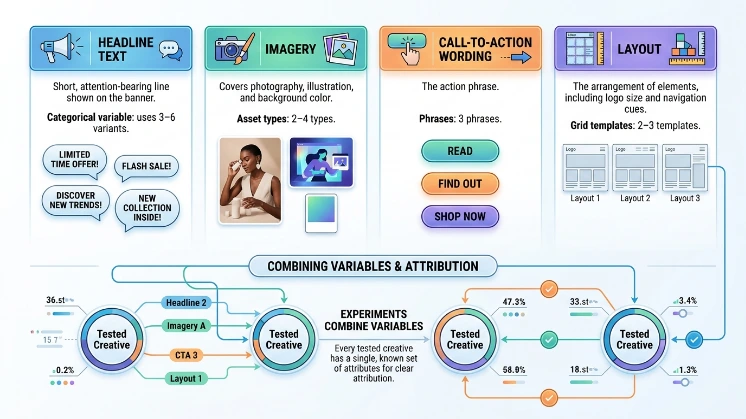
Each variable is categorical. Headline text uses 3–6 variants. Imagery uses 2–4 asset types. Call-to-action wording uses 3 phrases. Layout uses 2–3 grid templates. Experiments combine variables so that every tested creative has a single, known set of attributes for clear attribution.
How does the 4-variable experimental design work?
The 4-variable design runs orthogonal tests that isolate the effect of each variable on CPC by combining variables across creatives in balanced sets.
Design starts with factorial planning. A full factorial test uses every combination: if headlines = 4, imagery = 3, CTAs = 3, layouts = 2, then combinations = 4 × 3 × 3 × 2 = 72 creatives. Full factorial ensures interaction effects are measurable. When publisher inventory or budget restricts scale, a fractional factorial design selects a statistically balanced subset (for example, 24 creatives) that still estimates main effects and key two-way interactions.
Experiments run on news-site placements with uniform targeting. Each creative receives comparable impressions across the publisher mix. Trackers log impressions, clicks, CPC, CTR, viewability, and post-click engagement. Statistical analysis uses confidence intervals and significance thresholds to detect real differences.
What metrics and thresholds guide decisions?
Primary metric: CPC. Secondary metrics: CTR, viewability rate, and post-click engagement (time on page, scroll depth). Use sample sizes that reach at least 1,000 clicks per variant group for stable CPC estimates when possible. Set a minimum viewability threshold of 50% per IAB standards. Flag variants with CTR below 0.2% for desktop and 0.5% for mobile as low-performing. Select the creative with the lowest CPC that meets viewability and engagement thresholds.
Why reduce CPC with creative testing on UK news sites?
Reducing CPC increases paid-media efficiency and extends reach for a fixed budget on UK news publishers.
UK news sites serve high-intent and wide-audience contexts. Lower CPC allows campaigns to buy more clicks in editorial environments where users read and engage. News-site audiences show distinct attention patterns; creative elements that work on social platforms perform differently in news contexts. Testing detects which banner features align with UK readers’ browsing behavior and publisher ad formats.
Which UK-specific factors affect results?
Regional language tone, UK spelling conventions, and topical references influence headline resonance. National publishers often have higher viewability but higher base CPMs; testing finds creatives that offset CPM with lower CPC. Mobile browsing share in the UK commonly ranges from 60% to 70% for news sites; expect mobile-optimized imagery and short CTAs to perform better there.
How to set up the test on a publisher network?
Set targeting, budget, and sample allocation to ensure each creative variant receives comparable impressions across the publisher set.
Steps: define audience segments (national vs regional), fix contextual targeting (news sections), and set frequency caps. Allocate budget to achieve required sample sizes per variant. Use the same bidding strategy for all creatives—preferably a CPC bid—to measure raw creative impact. Maintain consistent landing pages to isolate creative effects.
What reporting cadence and analysis methods work best?
Daily monitoring flags severe outliers. Primary analysis occurs after reaching pre-specified sample sizes—1,000 clicks per major variant group or 100,000 impressions per creative when clicks are scarce. Use ANOVA or regression with dummy variables to estimate main effects and two-way interactions. Report findings with confidence intervals and practical significance (example: variant A reduces CPC by 18% vs baseline).
What are common creative findings from UK news-site tests?
Common findings identify which headline lengths, imagery types, CTA phrases, and layouts produce the lowest CPC on UK news placements.
Example patterns: short, specific headlines with UK spelling often outperform generic phrases. Real-people photography yields lower CPC than abstract illustrations on national news homepages. CTAs that focus on value (for example, “See Results”) lower CPC more than generic CTAs (for example, “Learn More”). Compact layouts with bold headlines and minimal logos increase CTR and lower CPC in above-the-fold placements.
Can you give concrete example outcomes?
A test with 48 creatives on a national publisher found these results headline variant “Latest Analysis” reduced CPC by 12% relative to “Breaking Now”; imagery using real-people reduced CPC by 20% versus abstract illustration; CTA “See Results” produced a 0.06 percentage point higher CTR than “Read More”; compact layout lowered CPC by 8%. Combined, the best creative delivered 34% lower CPC than the baseline.
Which analysis finds interactions between variables?
Interaction analysis finds when a headline works only with a specific image or CTA, and quantifies joint effects on CPC.
Run two-way interaction tests to reveal dependencies like “headline A works only with image type 2.” Use regression models with interaction terms to estimate combined effects and to identify diminishing returns. Prioritize interactions that produce combined CPC lifts greater than 10% for implementation.
How to act on interaction findings?
Deploy winning combinations to the publisher mix in phased rollouts. If inventory limits prevent full rollout, allocate higher budgets to placements where the winning combination shows the largest CPC reductions. Retest on a monthly cadence to detect creative fatigue and seasonal shifts in news consumption.
What are the operational benefits of this framework?
Operational benefits include faster identification of low-CPC creatives, clearer resource allocation, and repeatable testing processes across publishers.
Teams reduce wasted spend by retiring high-CPC creatives. The framework standardises creative naming, tracking, and reporting, which speeds handoffs between creative, media, and analytics teams. Results feed into creative playbooks that specify headline lengths, image types, CTA phrasing, and layout constraints for future campaigns.
Which tools and integrations simplify execution?
Use ad servers that support creative rotation and tracking, analytics platforms that integrate publisher logs, and statistical tools (for example, regression libraries) for analysis. Tagging conventions should encode the 4 variables for automated aggregation. Ensure GDPR-compliant data processing with publisher partners.
Where does this framework apply and where is it limited?
The framework applies to display banners on national and regional UK news sites and to standard desktop and mobile placements; it is limited where inventory or budget prevents balanced sampling.
Apply the framework across news-section contexts, homepage roadblocks, and in-article placements. Limitations occur with bespoke formats (for example, interactive native units) where element control is partial. Also, small publishers with low impressions require pooled testing or pooled analysis across similar sites to reach statistical thresholds.
What case uses deliver the highest ROI?
High-traffic brand-awareness campaigns and product launches on national news sites deliver clear ROI from CPC reductions. Performance-driven campaigns that need cost-efficient clicks also benefit, especially when landing pages convert effectively after click.
Explore More Expert Insights:
How to Set Frequency Caps for UK Display Campaigns That Avoid Audience Fatigue
UK Banner Ad Formats Ranked by Engagement: Leaderboard, MPU, Half-Page and Skin
How to maintain performance after a winning creative is found?
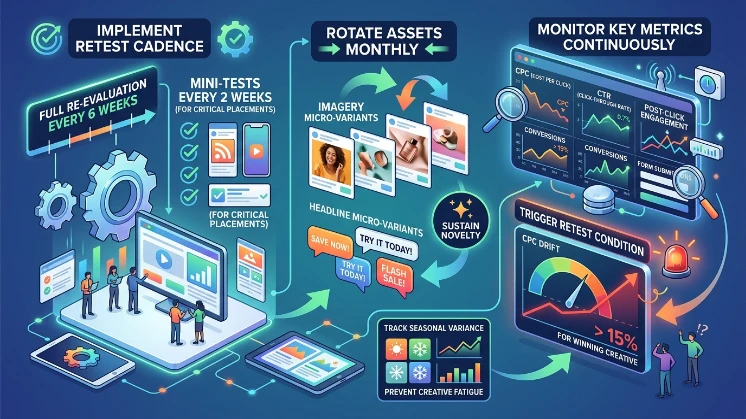
Maintain performance by scheduling periodic retests, rotating assets monthly, and tracking seasonal variance to prevent creative fatigue.
Set a retest cadence: full re-evaluation every 6 weeks, mini-tests every 2 weeks for critical placements. Rotate imagery and headline micro-variants to sustain novelty. Monitor CPC, CTR, and post-click engagement continuously. If CPC drifts upward by more than 15% for a winning creative, trigger a retest.
Dive Deeper Into This Topic:
The UK Holds the World’s Highest E-commerce Retail Share: Why Display Advertising Wins
What governance supports this maintenance?
Document test designs, naming conventions, and decision rules. Create a creative playbook listing approved headline templates, image guidelines, and CTA options. Creative lead, media lead, and analytics lead. Audit tests quarterly to ensure compliance with data and privacy rules.
Learn Everything About It Here:
How One UK Tech Brand Achieved 0.8% CTR on News Site Banners in a 6-Week Run