
A frequency cap limits how many times the same user sees a specific ad within a set time window. It prevents ad overexposure and preserves campaign reach by controlling impressions per unique user.
A frequency cap is a campaign-level or placement-level parameter that counts served impressions by user identifier. Common identifiers include cookie IDs, mobile advertising IDs (IDFA/AAID), and publisher-managed user IDs. Frequency caps apply per creative, per ad group, or per campaign depending on the platform. Platforms record impressions and suppress further delivery when the cap is reached. In the UK digital ecosystem, privacy rules and cookie restrictions affect counting accuracy; server-to-server logs and first-party ID graphs improve measurement.
How do frequency caps reduce audience fatigue?
Frequency caps stop repeated exposures that decrease engagement and raise negative brand reactions. Consistent caps maintain click-through rates and reduce ad annoyance metrics like negative feedback or viewability loss.
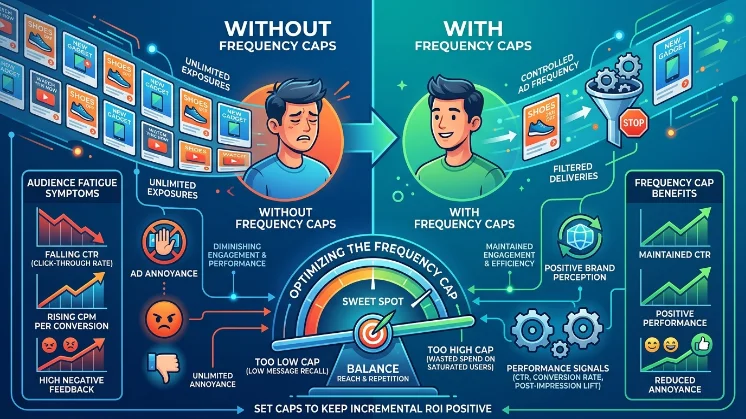
Audience fatigue occurs when repeated ad exposure yields diminishing returns for engagement. Fatigue shows as falling CTR, rising CPM per conversion, and higher negative feedback on social or publisher platforms. Frequency caps limit delivered impressions to preserve novelty and performance. Effective capping balances reach and repetition: too low a cap reduces message recall; too high a cap wastes spend on saturated users. Use performance signals CTR, conversion rate, and post-impression lift to set caps that keep incremental ROI positive.
How do I choose the right frequency cap values for UK display campaigns?
Select caps using campaign objective, conversion window, creative variety, and audience size; typical ranges are 2–8 impressions per user per week. Adjust using performance data and audience overlap.
Awareness goals tolerate higher caps (6–8/week); direct response needs lower caps (2–4/week). Consider the conversion window if conversions occur within 7 days, align the cap to that window. Calculate audience size large audiences accept higher caps without repeated exposure; small audiences require stricter caps to avoid saturation. Use creative rotation to increase effective cap three distinct creatives with cap 3 results in nine exposures without fatigue from the same creative. Run initial A/B tests with cap increments of 1 impression per week and analyse CTR and cost per conversion changes.
When should I use per-day versus per-week frequency limits?
Use per-day caps for time-sensitive promotions and per-week caps for brand or consideration campaigns with longer decision cycles. Daily limits control short-term intensity weekly limits manage cumulative exposure.
Daily caps work for flash sales, event sign-ups, or product launches where immediate action is necessary. Weekly caps suit campaigns focused on awareness, research, or multi-touch paths that require spaced reminders. For multi-channel funnels, align caps across channels to avoid concentrated exposure in a single day. For example, a weekend promotion uses a per-day cap of 1–2 impressions, while a four-week brand lift strategy uses a per-week cap of 6 impressions.
What measurement methods confirm a frequency cap is effective?
Measure CTR, conversion rate, cost per conversion, view-through conversions, and negative feedback before and after cap changes. Also track reach and unique users to confirm reduced overexposure.
Compare performance cohorts with different caps using matched audience segments. Key metrics: CTR trend by exposure count, conversion probability by exposure bin, CPA movement, and percentage of users reached versus reached multiple times. Monitor negative indicators such as ad reporting, low viewability, and short session durations after ad clicks. Use statistical tests (e.g., chi-square for conversion differences) to validate significance. For UK campaigns, segment results by region and device to capture behavioral differences between desktop and mobile users.
Discover the Full Information:
Generative AI Is Pushing Search Budgets to Display: What UK Advertisers Need to Know
How do privacy rules and cookie restrictions affect frequency capping in the UK?
Privacy rules, cookie consents, and browser restrictions reduce deterministic user tracking, making caps conservative and often based on probabilistic matching. Use first-party signals and logged-in IDs to improve cap accuracy.
After cookie restrictions and increased consent requirements, third-party cookie counts shrink, breaking cross-site caps. Platforms substitute probabilistic matching, cleaned-room measurement, or publisher-provided IDs. Advertisers must rely on first-party data (site user IDs, email hashes) for accurate capping. In programmatic buys, use bidstream signals and publisher manifests where available. Implement server-side tracking and consent management platforms to record accepted identifiers, then apply caps in the server or DSP. Always document identifier sources and limitations for accurate performance interpretation.
What are common frequency cap strategies for different campaign objectives?
Awareness: 6–8 impressions per user per week Consideration: 3–5 per week with creative rotation; Direct response: 2–4 per week focused on users within the conversion window. Tailor caps by funnel stage and conversion latency.
Awareness campaigns require repeated exposures for memory encoding; set higher weekly caps and use creative variations to maintain freshness. Consideration-stage audiences respond to fewer, targeted messages; pair caps with sequential messaging (e.g., message A then B). Direct response audiences need minimal repetition to avoid wasted impressions; cap tightly and focus on high-intent segments. For remarketing, limit caps more strictly for small audiences and use frequency decay: reduce impressions per user over time windows (e.g., 4 in week 1, 2 in week 2). Implement RLSA-like exclusion lists to prevent overexposure across channels.
How do I implement frequency caps across programmatic and direct buys?
Set caps in the DSP for programmatic buys and negotiate cap terms with publishers for direct buys; sync caps using shared IDs or campaign calendars. Maintain a single source of truth for user counts.
For programmatic, configure campaign-level or creative-level caps in the DSP UI and confirm reporting granularity. For direct buys, include frequency caps in insertion orders and request daily delivery reports from publishers to ensure adherence. Use unique creative or placement tags to avoid double counting when campaigns run simultaneously. Where shared IDs exist (e.g., publisher ID graphs), coordinate with partners to align caps. If cross-channel capping is required, use a central ad server or a tag-based frequency manager that aggregates impressions and enforces global caps.
What technical setups improve frequency cap accuracy?
Use first-party identifiers, server-side event logging, unified ID solutions, and tag-based frequency managers to increase accuracy. Combine deterministic signals with probabilistic methods for coverage.
Implement a first-party cookie or hashed user ID on the website and pass that ID to ad servers and DSPs. Use server-to-server tracking to log impressions with timestamps and user IDs, then enforce caps from the server. Adopt identity solutions that comply with UK privacy rules (for example, publisher-provided IDs) to unify counts across properties. Deploy a tag manager and frequency manager that deduplicates impressions across creatives and channels. Regularly reconcile DSP and publisher logs to identify discrepancies and update cap logic.
Explore More Expert Insights:
UK Banner Ad Formats Ranked by Engagement: Leaderboard, MPU, Half-Page and Skin
How Entertainment Brands Improve Subscription Intent Using Retargeting Ads
What are the trade-offs when lowering frequency caps?
Lowering caps increases unique reach but reduces message repetition and short-term conversions. It preserves brand sentiment and reduces wasted impressions.
Lower caps extend reach into new users, often lowering CPM efficiency for conversions that require repetition. Reduced repetition can lower immediate conversion volume, particularly for high-consideration purchases. However, lower caps prevent negative feedback and long-term brand damage. Choose trade-offs based on campaign KPIs: prioritise reach when building awareness and prioritise repetition when driving conversions and retargeting small audiences.
How can I test and optimise frequency caps?
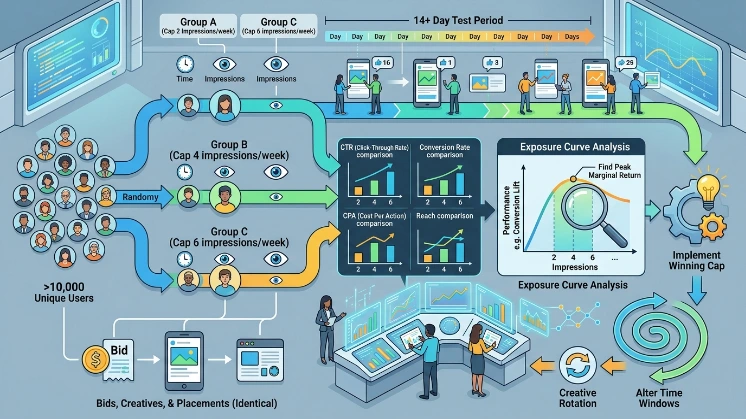
Run controlled A/B tests with different cap values, hold other variables constant, and analyse conversion lift and engagement by exposure count. Iterate using clear success criteria and at least 10,000 unique users per variant for reliable results.
Split your target audience randomly and run caps of, for example, 2, 4, and 6 impressions per week. Keep bids, creatives, and placements identical. After a minimum 14-day test period, compare CTR, conversion rate, cost per action, and reach. Evaluate exposure curves to find the exposure bin with the highest marginal return. Implement the winning cap and repeat tests with creative rotation or altered windows to refine results.
Must-Read Detailed Guide:
Direct Buy vs Programmatic: Why UK Brands Spending £5K+ Choose Direct Placements